Placenta growth factor (PlGF) is a member of the PDGF/VEGF family of growth factors that share a conserved pattern of eight cysteines. Alternative splicing results in at least three human mature PlGF forms containing 131 (PlGF-1), 152 (PlGF-2), and 203 (PlGF-3) amino acids (aa) respectively. Only PlGF-2 contains a highly basic heparin-binding 21 aa insert at the C-terminus. Human PlGF-1 shares 56%, 55%, 74% and 95% aa identity with the comparable isoform of mouse, rat, canine, and equine PlGF, respectively. PlGF is mainly found as variably glycosylated, secreted, 55-60 kDa disulfide linked homodimers. Mammalian cells expressing PlGF include villous trophoblasts, decidual cells, erythroblasts, keratinocytes, and some endothelial cells. Circulating PlGF increases during pregnancy, reaching a peak in mid-gestation; this increase is attenuated in preeclampsia. However, deletion of PlGF in the mouse does not affect development or reproduction. Postnatally, mice lacking PlGF show impaired angiogenesis in response to ischemia. PlGF binds and signals through VEGF R1/Flt-1 but not VEGF R2/Flk-1/KDR, while VEGF binds both but signals only through the angiogenic receptor, VEGF R2. PlGF and VEGF therefore compete for binding to VEGF R1, allowing high PlGF to discourage VEGF/VEGF R1 binding and promote VEGF/VEGF R2-mediated angiogenesis. However, PlGF (especially PlGF-1) and some forms of VEGF can form dimers that decrease the angiogenic effect of VEGF on VEGF R2. PlGF-2, but not PLGF-1, shows heparin-dependent binding of Neuropilin (Npn)-1 and Npn-2. PlGF induces monocyte activation, migration, and production of inflammatory cytokines and VEGF. These activities facilitate wound, bone fracture, and cardiac repair, but also contribute to inflammation in active sickle cell disease and atherosclerosis. PlGF can also inhibit TIMP3 expression in the spleen, leading to immune triggering of hypertension.
Post-translational: N-glycosylated.
生物活性
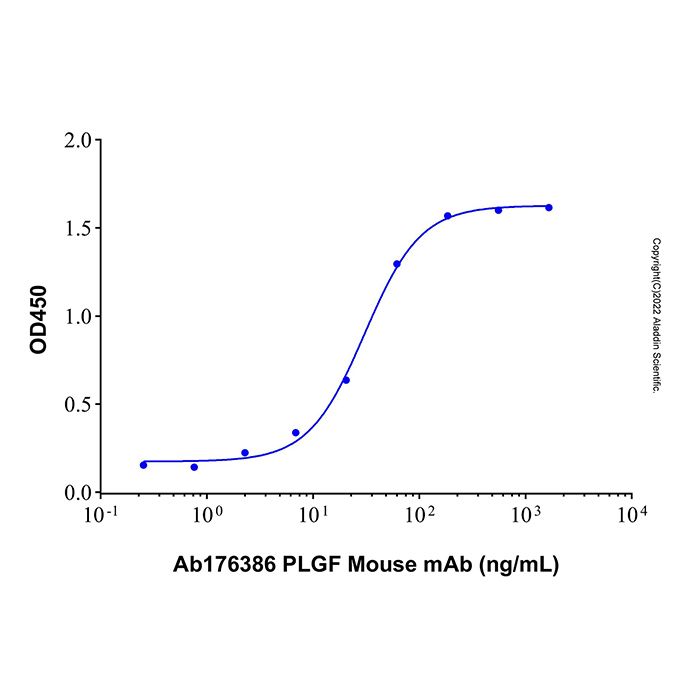
Immobilized Recombinant human PLGF protein (rp170416) at 1.0 μg/mL can bind PLGF Mouse mAb (Ab176386) with the EC50 of 30.7 ng/mL.
25.7-31.5 kDa, under reducing conditions; 28.3-38.9 & 42.1-59.1 & 87.4-108.4 kDa, under non-reducing conditions.
分子类型
蛋白质
产品线
生物产品
储存与运输
物理形态
冻干(Lyophilized)
储存缓冲液
Lyophilized from PBS, pH 7.4
浓度
见COA
复溶
We recommend that this vial be briefly centrifuged prior to opening to bring the contents to the bottom. Reconstitute at 0.1 mg/mL in sterile distilled water. Stock solutions should be apportioned into working aliquots and stored at ≤ -20 °C. Further dilutions should be made in appropriate buffered solutions.
储存条件
-20°C储存,避免反复冻融
运输条件
超低温运输
稳定性与储存
-20℃保存 12个月;复溶后建议分装,避免反复冻融。
图片
Recombinant Human PLGF Protein (rp170416) - ELISA Immobilized Recombinant Human PLGF Protein (rp170416) at 1.0 μg/mL can bind PLGF Mouse mAb (Ab176386) with the EC50 of 30.7 ng/mL.
Recombinant Human PLGF Protein (rp170416) - SDS-PAGE 3 μg/lane of Recombinant Human PLGF Protein was resolved with SDS-PAGE under reducing (R) and non-reducing (N) conditions and visualized by Coomassie® Blue staining, showing a band at 25.7-31.5 kDa under reducing conditions and 28.3-38.9 & 42.1-59.1 & 87.4-108.4 kDa under non-reducing conditions. PLGF typically exists as a dimer. This dimerization is stabilized by intramolecular disulfide bonds, similar to the structural features observed in other members of the VEGF family (PMID: 11069911).

 ZJ26F1039812


 危险品化学品经营许可证(带存储)