Recombinant Human/Rhesus Macaque/Feline CXCL12/SDF-1 alpha Protein
规格或纯度
无载体, ≥95%(SDS-PAGE), expressed in E. coli; 见COA
生化机理
Chemoattractant active on T-lymphocytes and monocytes but not neutrophils (PubMed:18802065, PubMed:39093700).
Activates the C-X-C chemokine receptor CXCR4 to induce a rapid and transient rise in the level of intracellular calcium ions and chemotaxis (PubMed:8752281, PubMed:18802065, PubMed:39093700).
Also binds to atypical chemokine receptor ACKR3, which activates the beta-arrestin pathway and acts as a scavenger receptor for CXCL12/SDF-1 (PubMed:16107333, PubMed:19255243).
Binds to the allosteric site (site 2) of integrins and activates integrins ITGAV:ITGB3, ITGA4:ITGB1 and ITGA5:ITGB1 in a CXCR4-independent manner (PubMed:29301984).
Acts as a positive regulator of monocyte migration and a negative regulator of monocyte adhesion via the LYN kinase (PubMed:18802065).
Stimulates migration of monocytes and T-lymphocytes through its receptors, CXCR4 and ACKR3, and decreases monocyte adherence to surfaces coated with ICAM-1, a ligand for beta-2 integrins (PubMed:16107333, PubMed:18802065, PubMed:19255243, PubMed:39093700).
CXCR4 signaling axis inhibits beta-2 integrin LFA-1 mediated adhesion of monocytes to ICAM-1 through LYN kinase (PubMed:18802065).
Inhibits CXCR4-mediated infection by T-cell line-adapted HIV-1 (PubMed:8752281).
Plays a protective role after myocardial infarction. Induces down-regulation and internalization of ACKR3 expressed in various cells. Has several critical functions during embryonic development; required for B-cell lymphopoiesis, myelopoiesis in bone marrow and heart ventricular septum formation (By similarity).
Stimulates the proliferation of bone marrow-derived B-cell progenitors in the presence of IL7 as well as growth of stromal cell-dependent pre-B-cells (By similarity).
SDF-1-beta(3-72): Shows a reduced chemotactic activity.
SDF-1-alpha(3-67): Shows a reduced chemotactic activity (PubMed:14525775). Binding to cell surface proteoglycans seems to inhibit formation of SDF-1-alpha(3-67) and thus to preserve activity on local sites (PubMed:14525775).
Post-translational: Processed forms SDF-1-beta(3-72) and SDF-1-alpha(3-67) are produced after secretion by proteolytic cleavage of isoforms Beta and Alpha, respectively. The N-terminal processing is probably achieved by DPP4. Isoform Alpha is first cleaved at the C-terminus to yield a SDF-1-alpha(1-67) intermediate before being processed at the N-terminus. The C-terminal processing of isoform Alpha is reduced by binding to heparin and, probably, cell surface proteoglycans.
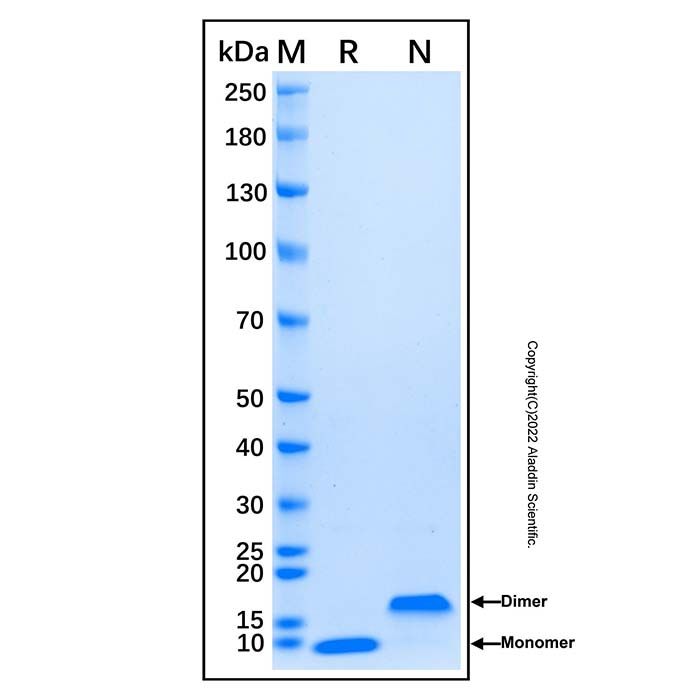
8.1 kDa, under reducing conditions; 16.9 kDa, under non-reducing conditions.
分子类型
蛋白质
产品线
生物产品
储存与运输
物理形态
冻干(Lyophilized)
储存缓冲液
Lyophilized from PBS, pH 7.4
浓度
expressed in E. coli; 见COA
复溶
We recommend that this vial be briefly centrifuged prior to opening to bring the contents to the bottom. Reconstitute at 0.1 mg/mL in sterile distilled water. Stock solutions should be apportioned into working aliquots and stored at ≤ -20 °C. Further dilutions should be made in appropriate buffered solutions.
储存条件
-20°C储存,避免反复冻融
运输条件
超低温运输
稳定性与储存
-20℃保存 12个月;复溶后建议分装,避免反复冻融。
图片
Recombinant Human/Rhesus Macaque/Feline CXCL12/SDF-1 alpha Protein (rp179844) - SDS-PAGE
3μg/lane of Recombinant Human/Rhesus Macaque/Feline CXCL12/SDF-1 alpha Protein was resolved with SDS-PAGE under reducing (R) and non-reducing (N) conditions and visualized by Coomassie® Blue staining, showing a band at 8.1 kDa under reducing conditions and 16.9 kDa under non-reducing conditions.
Monomer or homodimer; in equilibrium. Dimer formation is induced by non acidic pH and the presence of multivalent anions, and by binding to CXCR4 or heparin. Monomeric form is required for full chemotactic activity and resistance to ischemia/reperfusion injury, whereas the dimeric form acts as a partial agonist of CXCR4, stimulating Ca2+ mobilization but with no chemotactic activity and instead acts as a selective antagonist that blocks chemotaxis induced by the monomeric form. Interacts with the N-terminus of ACKR3. Interacts with integrin subunit ITGB3 (via the allosteric site (site 2)) (PubMed: 29301984).



 危险品化学品经营许可证(带存储)