Fibroblast growth factor 9 (FGF-9), also known as HBGF9 and GAF, is a member of the FGF family of secreted glycoproteins involved in mammalian skeleton morphogenesis and growth. The FGF family is characterized by a core heparin-binding FGF domain of approximately 120 amino acids (aa) that exhibits a beta-trefoil structure. Mature mouse FGF-9 shares 99% and 100% aa sequence identity with human and rat FGF-9, respectively. FGF-9, along with FGF-16 and -20, form an FGF subfamily that shares 65-71% aa sequence identity, binds FGFR3(IIIb), and is efficiently secreted despite having an uncleavable, bipartite signal sequence. In addition to FGFR3(IIIb), FGF-9 binding to the IIIc splice forms of FGFR-1, -2, and -3 has been reported. In the mouse embryo, the location and timing of FGF-9 expression affects the development of the skeleton, cerebellum, lungs, heart, vasculature, digestive tract, and testes. Deletion of mouse FGF-9 is lethal at birth due to lung hypoplasia and causes rhizomelia, or shortening of the proximal skeleton. Additionally, a mutation in mouse FGF-9 is responsible for Elbow knee synostosis (Eks), which causes joint fusions in the elbow and knee. In humans, FGF9 mutations that lower receptor binding can result in multiple synostoses syndrome (SYNS). Altered FGF-9 expression or function is reported in human colon, endometrial, and ovarian cancers, correlating with progression, invasiveness, and survival.
Post-translational: Three molecular species were found (30 kDa, 29 kDa and 25 kDa), cleaved at Leu-4, Val-13 and Ser-34 respectively. The smaller ones might be products of proteolytic digestion. Furthermore, there may be a functional signal sequence in the 30 kDa species which is uncleavable in the secretion step. N-glycosylated.
生物活性
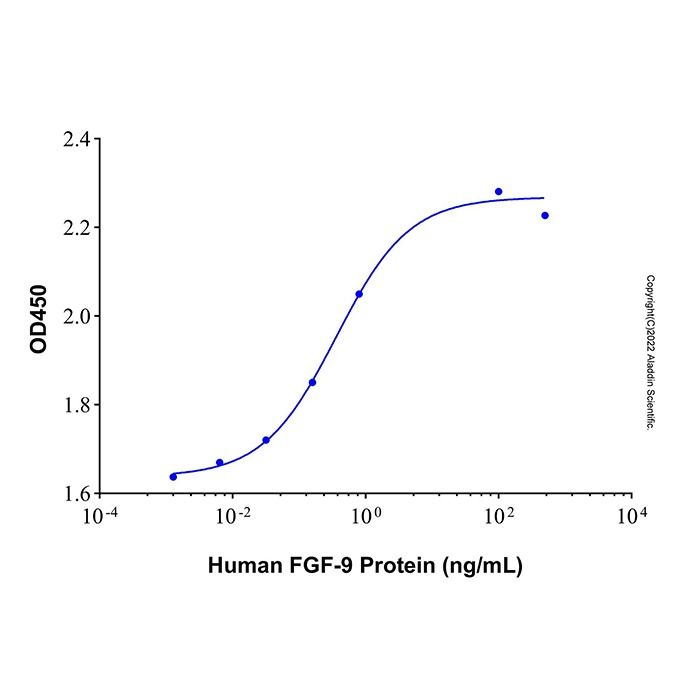
Measured in a cell proliferation assay using Balb/3T3 mouse embryonic fibroblast cells. The ED50 for this effect is 0.36 ng/mL.
Store at -20°C for 1 year. Avoid freeze/thaw cycle.
图片
Recombinant Human FGF-9 Protein (rp181240) - Bioactivity Measured in a cell proliferation assay using Balb/3T3 mouse embryonic fibroblast cells. The ED50 for this effect is 0.36 ng/mL.
Recombinant Human FGF-9 Protein (rp181240) - SDS-PAGE 2 μg/lane of Recombinant Human FGF-9 Protein was resolved with SDS-PAGE under reducing (R) and non-reducing (N) conditions and visualized by Coomassie® Blue staining, showing a band at 25.5 kDa under reducing conditions and 23.9 & 25.8 kDa under non-reducing conditions. The two N bands of FGF-9 should be its two different conformations. The unique N and C termini of FGF9 subfamily ligands mediate reversible homodimerization, and it is speculated that the interaction between these two conformations will form dimerization (PMID: 11060292).

 ZJ25F0320005


 危险品化学品经营许可证(带存储)