CXCL3, also known as Growth-regulated Oncogene gamma (GRO gamma), Macrophage Inflammatory Protein 2 beta (MIP-2beta), Dendritic Cell Inflammatory Protein 1 (DCIP-1), or Cytokine-induced Neutrophil Attractant 2 (CINC-2), is an 8 kDa pro-inflammatory member of the CXC subfamily of heparin-binding chemokines. Mature human CXCL3 (aa 35-107) shares 70% and 74% amino acid (aa) sequence identity with mouse and rat CXCL3, respectively. CXCL3 binds and activates CXCR2 to induce chemoattraction of CXCR2-expressing cells including neutrophils and endothelial cells. Additional N-terminal processing of mature CXCL3 by the removal of aa 35-38 increases its chemotactic activity by several fold. In addition to binding CXCR2, CXCL3 can also bind and be sequestered by the Duffy Antigen Receptor for Chemokines (DARC) decoy receptor.
Post-translational: N-terminal processed form GRO-gamma(5-73) is produced by proteolytic cleavage after secretion from peripheral blood monocytes.
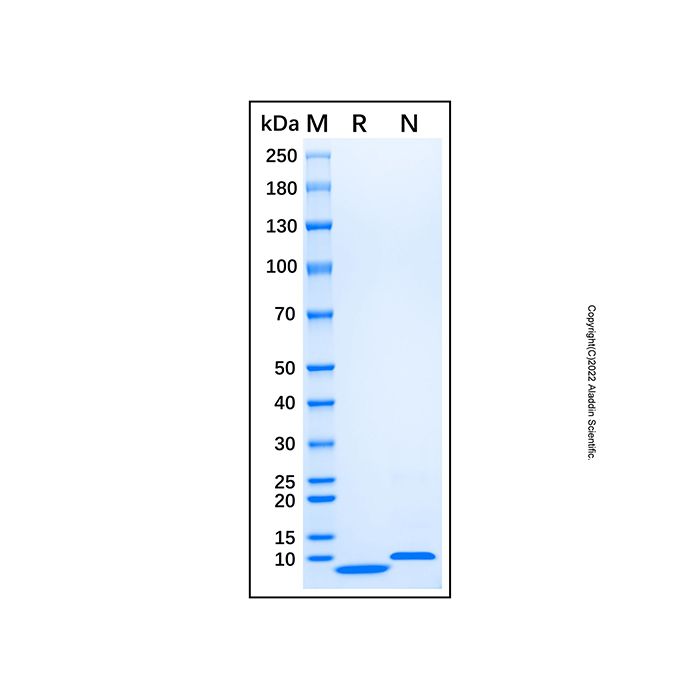
10.0 kDa, under reducing conditions; 10.6 kDa, under non-reducing conditions.
分子类型
蛋白质
产品线
生物产品
储存与运输
物理形态
冻干(Lyophilized)
储存缓冲液
Lyophilized from PBS, pH 7.4
浓度
见COA
复溶
We recommend that this vial be briefly centrifuged prior to opening to bring the contents to the bottom. Reconstitute at 1.0 mg/mL in sterile distilled water. Stock solutions should be apportioned into working aliquots and stored at ≤ -20 °C. Further dilutions should be made in appropriate buffered solutions.
储存条件
-20°C储存,避免反复冻融
运输条件
超低温运输
稳定性与储存
-20℃保存 12个月;复溶后建议分装,避免反复冻融。
图片
Recombinant Human CXCL3/GRO gamma Protein (rp181572) - SDS-PAGE 3 μg/lane of Recombinant Human CXCL3/GRO gamma Protein was resolved with SDS-PAGE under reducing (R) and non-reducing (N) conditions and visualized by Coomassie® Blue staining, showing a band at 10.0 kDa under reducing conditions and 10.6 kDa under non-reducing conditions.

 ZJ25F0926811


 危险品化学品经营许可证(带存储)