Cathepsin S is a lysosomal cysteine protease of the papain family. It plays a major role in the processing of the MHC class II‑associated invariant chain and has been implicated in the pathogenesis of several diseases such as Alzheimer’s disease and degenerative disorders associated with the cells of the mononuclear phagocytic system. Human Cathepsin S is synthesized as a preproenzyme of 331 amino acid residues consisting of a signal peptide (residues 1‑16), a pro region (residues 17‑114), and the mature enzyme (residues 115‑331). Cathepsin S is less abundant in tissues than Cathepsins B, L, and H, with the highest levels found in lymph nodes, spleen, macrophages, and other phagocytic cells.
生物活性
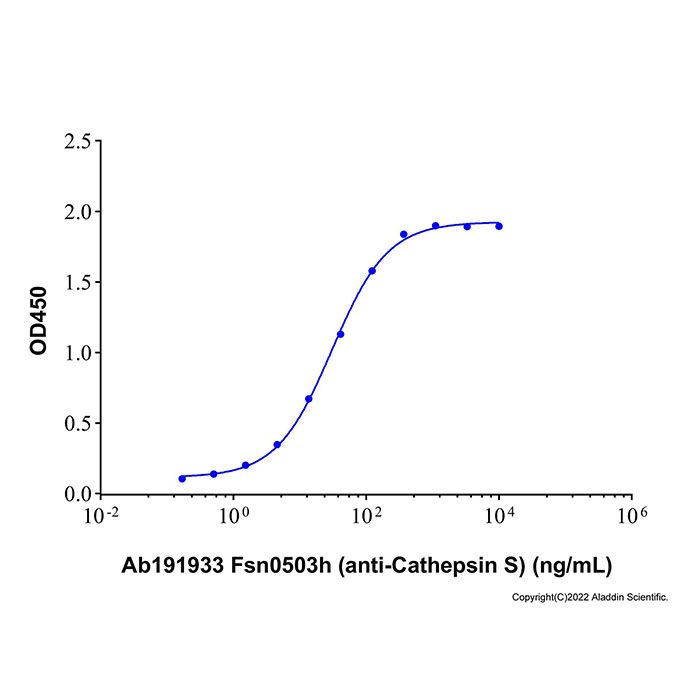
Immobilized Recombinant Human Cathepsin S protein (rp181600) at 1.0 μg/mL can bind Fsn0503h (anti-Cathepsin S) (Ab191933) with the EC50 of 30.8 ng/mL.
36.4 kDa, under reducing conditions; 34.7 kDa, under non-reducing conditions.
分子类型
蛋白质
产品线
生物产品
储存与运输
物理形态
冻干(Lyophilized)
储存缓冲液
Lyophilized from PBS, pH 7.4
复溶
We recommend that this vial be briefly centrifuged prior to opening to bring the contents to the bottom. Reconstitute at 0.5 mg/mL in sterile distilled water. Stock solutions should be apportioned into working aliquots and stored at ≤ -20 °C. Further dilutions should be made in appropriate buffered solutions.
储存条件
-20°C储存,避免反复冻融
运输条件
超低温运输
稳定性与储存
Store at -20°C for 1 year. Avoid freeze/thaw cycle.
图片
Recombinant Human Cathepsin S Protein (rp181600) - SDS-PAGE 3 μg/lane of Recombinant Human Cathepsin S Protein was resolved with SDS-PAGE under reducing (R) and non-reducing (N) conditions and visualized by Coomassie® Blue staining, showing a band at 36.4 kDa under reducing conditions and 34.7 kDa under non-reducing conditions.
Recombinant Human Cathepsin S protein (rp181600) - ELISA Immobilized Recombinant Human Cathepsin S protein (rp181600) at 1.0 μg/mL can bind Fsn0503h (anti-Cathepsin S) (Ab191933) with the EC₅₀ of 30.8 ng/mL.

 ZJ24F1215376


 危险品化学品经营许可证(带存储)