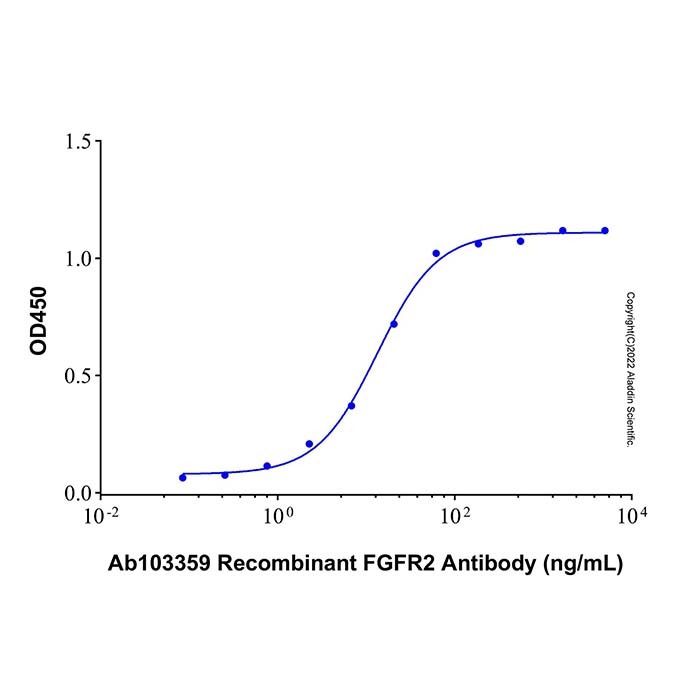
Immobilized Recombinant Human FGFR2 alpha (IIIc) Protein (rp183619) at 1.0 μg/mL can bind Recombinant FGFR2 Antibody (Ab103359) with the EC50 of 13.4 ng/mL.
Fibroblast growth factor receptor 2 (FGFR2) belongs to a family of type I transmembrane tyrosine kinases which mediate the biological functions of FGFs that are involved in a multitude of physiological and pathological cellular processes. The FGFR family is comprised of 4 structurally conserved members (FGFR1-4) all possessing an extracellular domain (ECD) with three immunoglobulin (Ig)-like domains, an acid-box region containing a run of acidic residues between the IgI and IgII domains, a transmembrane domain and cytoplasmic split tyrosine-kinase domain. The ECD of mature, full-length FGFR2 shares 95% amino acid sequence identity with mouse FGFR2. Alternative splicing generates multiple forms of FGFR1-3, each with unique signaling characteristics. For FGFR2, alternative splicing of the ECD, specifically the IgIII domain, results in IIIb, or IIIc isoforms. The FGFR splice variants also exhibit distinct and varying binding affinities for different FGF ligands. Specifically, FGFR2A (IIIc) binds most FGF ligands but not the FGF10 subfamily, while FGFR2A (IIIc) binds only members of the FGF10 subfamily. FGFRs mediate the FGF signaling cascade which regulate developmental processes including cellular proliferation, differentiation, and migration, morphogenesis, and patterning. FGFRs transduce the signals through three dominant pathways including RAS/MAPK, PI3k/AKT, and PLC gamma. While FGFR2 is widely expressed in many adult human tissues, isoform expression is tissue specific, with IIIb predominantly expressed in epithelial cells, while IIIc is expressed in mesenchymal cells. FGFR2 signaling is critical for embryonic development, tissue repair, and regulation of osteoblast function and bone growth. Mutations in FGFR2 or misregulation of FGFR2 mediated signaling is found in multiple skeletal dysplasias, with FGFR2A (IIIc) specifically upregulated in several cancers including prostate, breast and pancreatic and is proposed as a novel therapeutic target for colorectal carcinomas.
Post-translational: Epinephrine-stimulated phosphorylation of Ser-621 by PKA enhances adhesion to laminin.
生物活性
Immobilized Recombinant Human FGFR2 alpha (IIIc) Protein (rp183619) at 1.0 μg/mL can bind Recombinant FGFR2 Antibody (Ab103359) with the EC50 of 13.4 ng/mL.
56.0-80.0 kDa, under reducing conditions; 56.0-80.0 kDa, under non-reducing conditions.
分子类型
蛋白质
产品线
生物产品
储存与运输
物理形态
冻干(Lyophilized)
储存缓冲液
Lyophilized from PBS, 5% Trehalose, pH 7.4
复溶
We recommend that this vial be briefly centrifuged prior to opening to bring the contents to the bottom. Reconstitute at 0.5 mg/mL in sterile distilled water. Stock solutions should be apportioned into working aliquots and stored at ≤ -20 °C. Further dilutions should be made in appropriate buffered solutions.
储存条件
-20°C储存,避免反复冻融
运输条件
超低温运输
稳定性与储存
Store at -20°C for 1 year. Avoid freeze/thaw cycle
图片
Recombinant Human FGFR2 alpha (IIIc) Protein (rp183619) - ELISA Immobilized Recombinant Human FGFR2 alpha (IIIc) Protein (rp183619) at 1.0 μg/mL can bind Recombinant FGFR2 Antibody (Ab103359) with the EC₅₀ of 13.4 ng/mL.
Recombinant Human FGFR2 alpha (IIIc) Protein (rp183619) - SDS-PAGE 3 μg/lane of Recombinant Human FGFR2 alpha (IIIc) Protein was resolved with SDS-PAGE under reducing (R) and non-reducing (N) conditions and visualized by Coomassie® Blue staining, showing a band at 56.0-80.0 kDa.

 ZJ25F1230210


 危险品化学品经营许可证(带存储)