p38 alpha (SAPK2A) is a member of the p38 MAPK family which are activated by various environmental stresses and pro-inflammatory cytokines. The activation of p38 requires its phosphorylation by MAP kinase kinases (MKKs) or its autophosphorylation triggered by the interaction of MAP3K7IP1/TAB1 protein with this kinase. The substrates of p38 include transcription regulator ATF2, MEF2C, MAX, cell cycle regulator CDC25B, and tumor suppressor p53, which suggest the roles of this kinase in stress related transcription and cell cycle regulation, as well as in genotoxic stress response.
Post-translational: Dually phosphorylated on Thr-180 and Tyr-182 by the MAP2Ks MAP2K3/MKK3, MAP2K4/MKK4 and MAP2K6/MKK6 in response to inflammatory citokines, environmental stress or growth factors, which activates the enzyme. Dual phosphorylation can also be mediated by TAB1-mediated autophosphorylation. TCR engagement in T-cells also leads to Tyr-323 phosphorylation by ZAP70. Dephosphorylated and inactivated by DUPS1, DUSP10 and DUSP16. PPM1D also mediates dephosphorylation and inactivation of MAPK14 (PubMed:21283629).Acetylated at Lys-53 and Lys-152 by KAT2B and EP300. Acetylation at Lys-53 increases the affinity for ATP and enhances kinase activity. Lys-53 and Lys-152 are deacetylated by HDAC3.Ubiquitinated. Ubiquitination leads to degradation by the proteasome pathway.
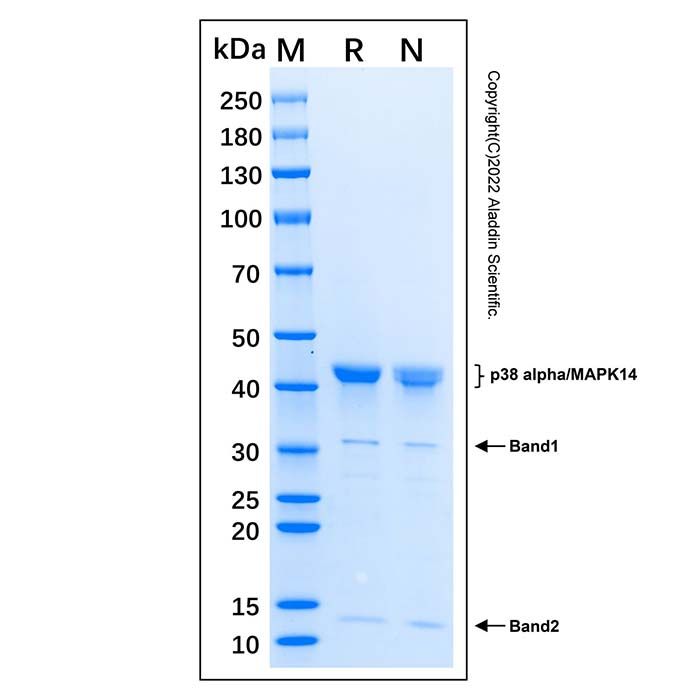
Recombinant Human p38 alpha Protein (rp184106) - SDS-PAGE 3 μg/lane of Recombinant Human p38 alpha Protein was resolved with SDS-PAGE under reducing (R) and non-reducing (N) conditions and visualized by Coomassie® Blue staining, showing a band at 42.3 kDa under reducing conditions and 41.2 & 42.5 kDa under non-reducing conditions. p38 alpha/MAPK14 can be cleaved into two bands during apoptosis (PMID: 11145700).



 危险品化学品经营许可证(带存储)