Glycine N-methyltransferase (GNMT) is a tetrameric cytosolic protein which catalyzes the transfer of a methyl group from S-adenosylmethionine (AdoMet) to glycine producing S-adenosylhomocysteine (AdoHcy) and sarcosine. GNMT plays a major role in maintaining normal AdoMet levels. GNMT is abundant in the liver where it is a major folate-binding protein. It binds 5-methyltetrahydrofolate pentaglutamate in vivo and in vitro, and the binding of the folate inhibits the activity of GNMT. A study of the rat enzyme showed differences in the kinetic parameters between recombinant GNMT and the protein isolated from liver. Based on structural information, the N-terminal part of the protein plays a major role in the transfer of the methyl group from AdoMet to glycine. It has been proposed that the difference in folate inhibitor binding between recombinant GNMT and the liver enzyme may be due to differential acetylation of the N-terminal valine. Hypermethioninemia is caused by defects in GNMT.
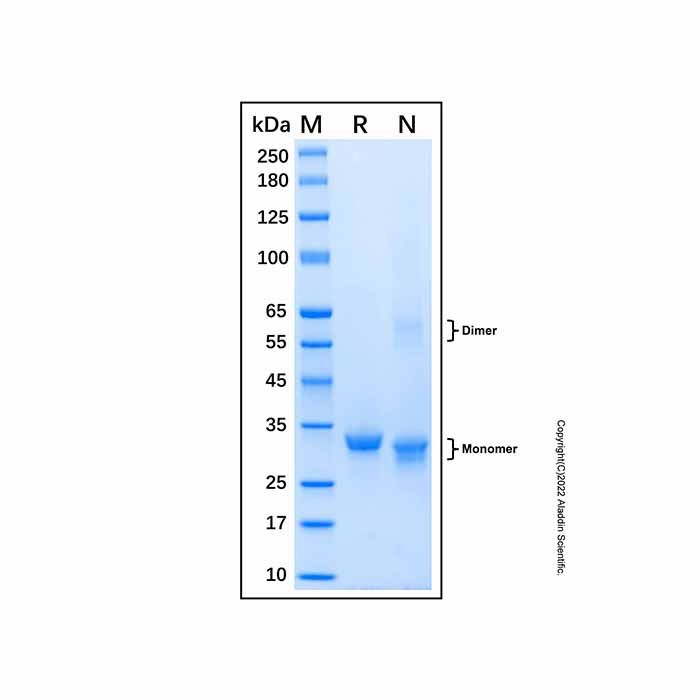
31.6 kDa, under reducing conditions; 29.3 & 31.0 & 60.8 kDa, under non-reducing conditions.
分子类型
蛋白质
产品线
生物产品
储存与运输
物理形态
冻干(Lyophilized)
储存缓冲液
Lyophilized from 20mM Tris, 150mM NaCl, pH 8.0
浓度
见COA
复溶
We recommend that this vial be briefly centrifuged prior to opening to bring the contents to the bottom. Reconstitute at 0.5 mg/mL in sterile distilled water. Stock solutions should be apportioned into working aliquots and stored at ≤ -20 °C. Further dilutions should be made in appropriate buffered solutions.
储存条件
-20°C储存,避免反复冻融
运输条件
超低温运输
稳定性与储存
-20℃保存 6个月;复溶后建议分装,避免反复冻融。
图片
SDS-PAGE: Recombinant Human Glycine N-methyltransferase/GNMT Protein (rp184904)
3 μg/lane of Recombinant Human Glycine N-methyltransferase/GNMT Protein was resolved with SDS-PAGE under reducing (R) and non-reducing (N) conditions and visualized by Coomassie® Blue staining, showing the bands at 31.6 kDa under reducing conditions and 29.3 & 31.0 & 60.8 kDa under non-reducing conditions.
Glycine N-methyltransferase/GNMT can form dimers or tetramers, and this oligomeric state is necessary for its activity (Uniprot: Q14749).



 危险品化学品经营许可证(带存储)