Src-Homology 2 domain Phosphatase-1 (SHP-1), also known as Protein Tyrosine Phosphatase 1C (PTP1C), PTPN6, and Hematopoietic Cell Phosphatase (HCPH), is an enzyme that selectively dephosphorylates tyrosine residues in proteins. Spontaneous point mutations in the SHP-1 gene in mice produce the “motheaten” and "motheaten viable” phenotypes that are severely autoimmune and immunodeficient. The enzyme is highly expressed in leukocyte cell types. SHP-1 has a regulatory region containing two Src homology 2 (SH2) domains that are critical for its binding to ITIM domains in inhibitory immunoreceptors. Deletion of the SH2 domains, as in this product, causes a marked increase in phosphatase activity. SHP-1 will dephosphorylate a wide variety of proteins, including the EGF receptor. A phosphopeptide containing the EGFR (Y992) sequence can be used to measure the activity of SHP-1 by detecting the release of phosphate.
Post-translational: Phosphorylated on tyrosine residues. Binding of KITLG/SCF to KIT increases tyrosine phosphorylation (By similarity). Phosphorylation at Tyr-564 by LYN enhances phosphatase activity. Phosphorylation at Thr-394 by TAOK3 leads to polyubiquitination and subsequent proteasomal degradation (PubMed:38166031). Ubiquitinated after phosphorylation by TAOK3 (PubMed:38166031). Ubiquitinated by a cooperation between ITCH and WWP2 via 'Lys-27'-mediated polyubiquitin chains resulting in the reduction of its association with LCK (PubMed:29925997).
Store at -20°C for 1 year. Avoid freeze/thaw cycle.
图片
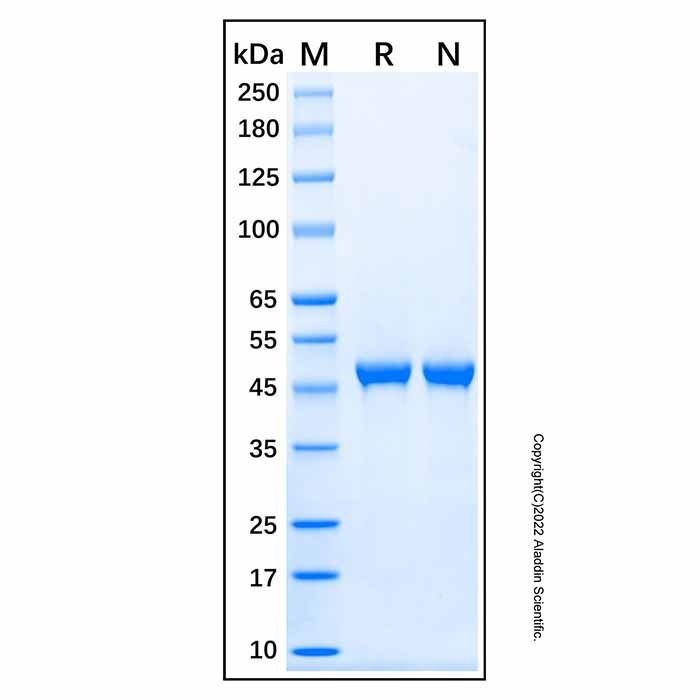
Recombinant Human SHP-1 Protein (rp188274) - SDS-PAGE 3 μg/lane of Recombinant Human SHP-1 Protein was resolved with SDS-PAGE under reducing (R) and non-reducing (N) conditions and visualized by Coomassie® Blue staining, showing a band at 47.2 kDa.

 ZJ24F1215852


 危险品化学品经营许可证(带存储)