英文别名
amyloid beta (A4) precursor protein-binding, family B, member 2 | amyloid beta A4 precursor protein-binding family B member 2 | Amyloid beta precursor protein | Amyloid beta | APP | beta Amyloid | Protease Nexin II
规格或纯度
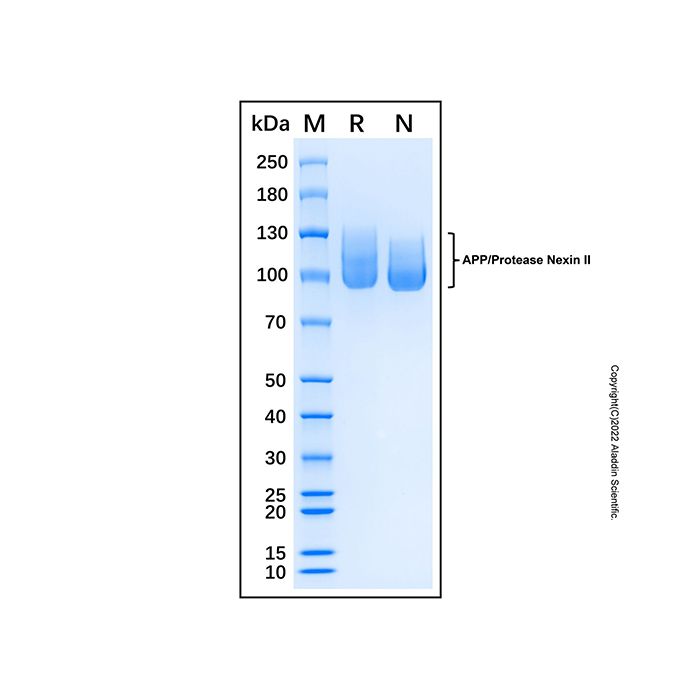
无动物源,无载体,His标签,PBS Only,≥95%(SDS-PAGE),见COA
生化机理
Amyloid precursor protein (APP) is a type I membrane protein with several human isoforms due to alternative splicing. APP-770, -751, and -733 contain a Kunitz protease inhibitor (KPI) domain (residue 291-342) and APP-695 does not. APP is a cell surface molecule with many functions. It can be processed proteolytically in two different pathways. In one pathway, beta- and gamma-secretase cleave at the beta site between residue 670 and 671 and the gamma site between residue 711 and 714 to produce β-amyloid peptide (Aβ40 and Aβ42), a major component in plaques found in brains of patients with Alzheimer's disease. The other pathway involves alpha-secretase that cleaves residues between 687 and 688. It is antiamyloidogenic due to its benign character and the prevention of the Aβ peptide formation. Soluble APP containing the KPI domain, also referred to as protease nexin II, is a potent inhibitor of serine proteases and may have additional functions. For example, it may regulate the contact face of blood coagulation and limit thrombosis specially in brain due to its localization and coagulation factor XI inhibiting activity.
Post-translational: Proteolytically processed under normal cellular conditions. Cleavage either by alpha-secretase, beta-secretase or theta-secretase leads to generation and extracellular release of soluble APP peptides, S-APP-alpha and S-APP-beta, and the retention of corresponding membrane-anchored C-terminal fragments, C80, C83 and C99. Subsequent processing of C80 and C83 by gamma-secretase yields P3 peptides. This is the major secretory pathway and is non-amyloidogenic. Alternatively, presenilin/nicastrin-mediated gamma-secretase processing of C99 releases the amyloid-beta proteins, amyloid-beta protein 40 and amyloid-beta protein 42, major components of amyloid plaques, and the cytotoxic C-terminal fragments, gamma-CTF50, gamma-CTF57 and gamma-CTF59. PSEN1 cleavage is more efficient with C83 than with C99 as substrate (in vitro) (PubMed:30630874). Amyloid-beta protein 40 and Amyloid-beta protein 42 are cleaved by ACE (PubMed:11604391, PubMed:16154999). Many other minor amyloid-beta peptides, amyloid-beta 1-X peptides, are found in cerebral spinal fluid (CSF) including the amyloid-beta X-15 peptides, produced from the cleavage by alpha-secretase and all terminating at Gln-686. Proteolytically cleaved by caspases during neuronal apoptosis. Cleavage at Asp-739 by either CASP6, CASP8 or CASP9 results in the production of the neurotoxic C31 peptide and the increased production of amyloid-beta peptides. N-glycosylated (PubMed:2900137). N- and O-glycosylated (PubMed:2649245). O-glycosylation on Ser and Thr residues with core 1 or possibly core 8 glycans. Partial tyrosine glycosylation (Tyr-681) is found on some minor, short amyloid-beta peptides (amyloid-beta 1-15, 1-16, 1-17, 1-18, 1-19 and 1-20) but not found on amyloid-beta protein 38, amyloid-beta protein 40 nor on amyloid-beta protein 42. Modification on a tyrosine is unusual and is more prevelant in AD patients. Glycans had Neu5AcHex(Neu5Ac)HexNAc-O-Tyr, Neu5AcNeu5AcHex(Neu5Ac)HexNAc-O-Tyr and O-AcNeu5AcNeu5AcHex(Neu5Ac)HexNAc-O-Tyr structures, where O-Ac is O-acetylation of Neu5Ac. Neu5AcNeu5Ac is most likely Neu5Ac 2,8Neu5Ac linked. O-glycosylations in the vicinity of the cleavage sites may influence the proteolytic processing. Appicans are L-APP isoforms with O-linked chondroitin sulfate. Phosphorylation in the C-terminal on tyrosine, threonine and serine residues is neuron-specific (PubMed:10341243). Phosphorylation can affect APP processing, neuronal differentiation and interaction with other proteins (PubMed:10341243). Phosphorylated on Thr-743 in neuronal cells by Cdc5 kinase and Mapk10, in dividing cells by Cdc2 kinase in a cell-cycle dependent manner with maximal levels at the G2/M phase and, in vitro, by GSK-3-beta (PubMed:11146006, PubMed:8131745). The Thr-743 phosphorylated form causes a conformational change which reduces binding of Fe65 family members (PubMed:11517218). In dopaminergic (DA) neurons, phosphorylation on Thr-743 by LRKK2 promotes the production and the nuclear translocation of the APP intracellular domain (AICD) which induces DA neuron apoptosis (PubMed:28720718). Phosphorylation on Tyr-757 is required for SHC binding (PubMed:11877420). Phosphorylated in the extracellular domain by casein kinases on both soluble and membrane-bound APP. This phosphorylation is inhibited by heparin (PubMed:8999878). Extracellular binding and reduction of copper, results in a corresponding oxidation of Cys-144 and Cys-158, and the formation of a disulfide bond. In vitro, the APP-Cu+ complex in the presence of hydrogen peroxide results in an increased production of amyloid-beta-containing peptides. Trophic-factor deprivation triggers the cleavage of surface APP by beta-secretase to release sAPP-beta which is further cleaved to release an N-terminal fragment of APP (N-APP). Amyloid-beta peptides are degraded by IDE. Sulfated on tyrosine residues.

 ZJ25F0927298


 危险品化学品经营许可证(带存储)