
计算溶液所需的质量、体积或浓度。
为什么选择此级别
提供 ≥25% 纯度,适用于对基线干扰要求严格的色谱和分析工作流程。
储存与运输
室温。常规运输 。请查阅批次 COA 获取详细规格。
质量文档
SDS、COA、产品数据表及规格说明书均可下载。可通过批号查询获取批次 COA。
文献证明
在色谱分析、有机合成和交叉偶联反应领域已被 10 篇同行评审文献引用。
概述
药品、化妆品的发泡剂。用于液体基剂香波,低皮肤刺激性,低浓度使用时有高泡性、去污性。
产品介绍
本品为25%的水溶液;
规格
英文别名
2-(Dodecyloxy)ethyl sodium sulfate | sodium lauryl ethoxy sulphate | Potassium dichromate, Yanagishima Pharmaceutical Co. Ltd. | SCHEMBL675596 | UNII-SUY7YR7K8F | FT-0699797 | Tox21_302374 | NCGC00255215-01 | DSSTox_CID_9298 | DTXSID70274019 | Ethanol, 2-
规格或纯度
≥25%
英文名称
Sodium lauryl polyoxyethylene ether sulfate
储存条件
室温
运输条件
常规运输
作用类型
抑制剂
纯度
≥25%
名称和识别符
PubChem SID
EC号
688-491-3
分子类型
聚合物
IUPAC Name
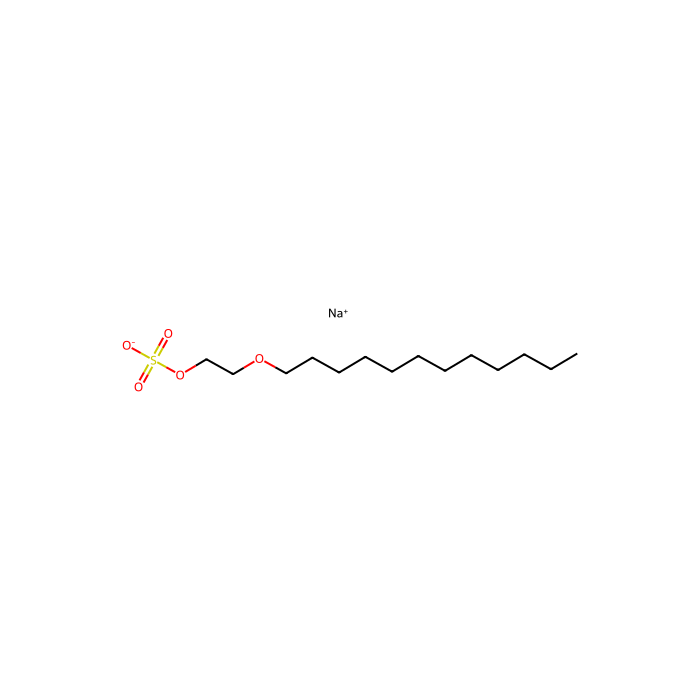
sodium;2-dodecoxyethyl sulfate
INCHI
1S/C14H30O5S.Na/c1-2-3-4-5-6-7-8-9-10-11-12-18-13-14-19-20(15,16)17;/h2-14H2,1H3,(H,15,16,17);/q;+1/p-1
InChi Key
ASEFUFIKYOCPIJ-UHFFFAOYSA-M
Smiles
CCCCCCCCCCCCOCCOS(=O)(=O)[O-].[Na+]
Isomeric SMILES
CCCCCCCCCCCCOCCOS(=O)(=O)[O-].[Na+]
PubChem CID
技术文档
高级数据
系统学分类
分类树(Taxonomy Tree)
| 界(kingdom) | 有机化合物 |
|---|---|
| 超类(Superclass) | 有机酸及其衍生物 |
| 类(Class) | 有机硫酸及其衍生物 |
| 亚类(Subclass) | 硫酸酯 |
| 中间层级节点(Intermediate Tree Nodes) | 暂无 |
| 直接上位类(Direct Parent) | 硫酸单酯 |
| 其他上位类(Alternative Parents) | 烷基硫酸盐 二烷基醚 有机钠盐 有机氧化物 碳氢化合物衍生物 |
| 分子骨架(Molecular Framework) | 脂肪族无环化合物 |
| 取代基(Substituents) | 脂肪族非环化合物 - 烷基硝酸酯 - 二烷基醚 - 乙醚 - 烃衍生物 - 有机碱金属盐 - 有机氧化物 - 有机氧化合物 - 有机盐 - 有机钠盐 - 有机氧化合物 - 磺酸酯 - 硫酸单酯 |
| 描述(Description) | 该化合物属于有机化合物中的硫酸单酯类。这类化合物含有硫酸单酯官能团,其通用结构为ROS(O)(=O)=O(R=有机烷基)。 |
| 外部描述符(External Descriptors) | 暂无 |
三维结构
交互式化学结构模型
化学和物理性质
溶解性
溶于乙醇; 不溶于二甲苯,
分子量
332.430 g/mol
XLogP3
氢键供体数Hydrogen Bond Donor Count
0
氢键受体数Hydrogen Bond Acceptor Count
5
可旋转键计数Rotatable Bond Count
15
精确质量Exact Mass
332.163 Da
单同位素质量Monoisotopic Mass
332.163 Da
拓扑极表面积Topological Polar Surface Area
84.000 Ų
重原子数Heavy Atom Count
21
形式电荷Formal Charge
0
复杂度Complexity
290.000
同位素原子数Isotope Atom Count
0
定义的原子立体中心计数Defined Atom Stereocenter Count
0
未定义的原子立体中心计数Undefined Atom Stereocenter Count
0
定义的键立体中心计数Defined Bond Stereocenter Count
0
未定义的键立体中心计数Undefined Bond Stereocenter Count
0
所有立体化学键的总数The total count of all stereochemical bonds
0
共价键合单元计数Covalently-Bonded Unit Count
2
安全和危险性(GHS)
信号词
危险
危险声明
H302: 吞食有害
H315: 引起皮肤刺激
H318: 造成严重的眼睛损伤
H319: 引起严重眼睛刺激
预防措施声明
P264: 处理后要彻底洗手。
P270: 使用本产品时,请勿进食、饮水或吸烟。
P280: 戴防护手套/穿防护服/戴防护眼罩/戴防护面具。
P321: 特殊处理(请参阅此标签上的...)。
P330: 漱口
P302+P352: 如皮肤沾染:用水充分清洗。
P305+P351+P338: 如进入眼睛:用水小心冲洗几分钟。如戴隐形眼镜并可方便地取出,取出隐形眼镜。继续冲洗。
P362+P364: 脱掉沾污的衣服,清洗后方可重新使用。
P501: 将内容物/容器处理到。。。
P264+P265: 处理后彻底洗手[和…]。不要触摸眼睛。
P301+P317: 如果被吞咽:请寻求医疗帮助。
P305+P354+P338: 如果进入眼睛:立即用水冲洗几分钟。取下隐形眼镜(如果有的话),并且操作简单。继续冲洗。
P317: 寻求紧急医疗救助。
P337+P317: 如果眼睛刺激持续:寻求医疗帮助。
P332+P317: 如果出现皮肤刺激:请寻求医疗帮助。
质检证书(CoA,COO,BSE/TSE 和分析图谱)
C of A & Other Certificates(BSE/TSE, COO):
输入批号以搜索分析图谱:
通过匹配包装上的批号来查找并下载产品的 COA,每批产品都进行了严格的验证,您可放心使用!
| 批号(Lot Number) | 证书类型 | 货号 |
|---|---|---|
 J2614058 |
分析证书 | S196294 |
| H2611036 |
分析证书 | S196294 |
| J2218337 |
分析证书 | S196294 |
| G2227357 |
分析证书 | S196294 |
| G2227359 |
分析证书 | S196294 |
| I2529496 |
分析证书 | S196294 |
| G2008078 |
分析证书 | S196294 |
| A2422190 |
分析证书 | S196294 |
| A2425041 |
分析证书 | S196294 |
| A2507040 |
分析证书 | S196294 |
| G2227356 |
分析证书 | S196294 |
| I2311043 |
分析证书 | S196294 |
| L2403094 |
分析证书 | S196294 |
| L2406133 |
分析证书 | S196294 |
| L2510015 |
分析证书 | S196294 |
| A2218048 |
分析证书 | S196294 |
技术文档和文章
Alcohol Ethoxylates (AEO) Explained: Structure, Key Parameters, Application Scenarios, and Aladdin’s Selection Tables (Main + Appendix)
目录: 技术文章
A Panoramic Guide to Surfactants: Definitions & Mechanisms, Key Metrics, Application Scenarios, and Selection Navigation (Tables 1–3)
目录: 技术文章
Potassium Fatty Acid Soaps: Structure and Formulation Applications—Production Processes, Alkalinity, Foam Control, and Low-Foam Cleaning
目录: 技术文章
Application of Fatty Acid Methyl Ester Sulfonate (MES) in Household Detergent and Cleaning Formulations: Detergency, Hard-Water Tolerance, and Selection Criteria
目录: 技术文章
K12 (Sodium Lauryl Sulfate/SLS) Is More Than a Foaming Agent: Structure, Properties, and Applications in Personal Care and Household Care Formulations
目录: 技术文章
What Is the Difference Between Triethanolamine and Diethanolamine: Understanding Their Formulation Functions, Application Differences, and Selection Logic from a Molecular-Structure Perspective
目录: 技术文章
Thickening, Suspension, Auxiliary Stabilization, and Agglomeration Mechanisms of Xanthan Gum in Personal Care Formulations: From Molecular Structure to Processing Applications
目录: 技术文章
Why Can 6501 (Cocamide DEA) Stabilize Foam and Build Viscosity? Structural Mechanism, 1:1/1:1.5 Differences, and Application Selection
目录: 技术文章
Why Limonene Can Soften Greasy Soils Yet Is Difficult to Dissolve in Water: Understanding the Cleaning Mechanism and Formulation Applications of Naturally Derived Solvents from Molecular Structure
目录: 技术文章
Degreasing Agents from a Molecular-Structure Perspective: How AEO, APG, and Related Surfactants Can Replace Nonylphenol Ethoxylates (NPE)
目录: 技术文章
Understanding CAPB from Its Structure: How Cocamidopropyl Betaine Improves Foam, Enhances Mildness, and Supports Thickening
目录: 技术文章
Why Do Daily Chemical Products Become Opaque? Formation Mechanisms of Milky Turbidity, Pearlescence, and Coverage, and How to Select the Right Ingredients
目录: 技术文章
Interfacial Mechanism and Formulation Applications of AEO-9 (Fatty Alcohol Polyoxyethylene Ether): An Analysis of Emulsification, Wetting, Oil Soil Removal, and Co-Formulation Compatibility
目录: 技术文章
Sodium Metasilicate in Cleaning Applications: Hydration-Form Differences, Mechanisms of Action, and Selection Logic
目录: 技术文章
Analysis of the Foaming Performance Differences Between K12 and AOS: Structure, Acid–Base Stability, and Formulation Selection
目录: 技术文章
Understanding Anionic Surfactants in Household and Personal-Care Formulations from a Structural Perspective: Structural and Performance Differences among Representative Raw Materials such as LAS, AES, K12, AOS, MES, and FMES
目录: 技术文章
The Structural Logic of Amphoteric Surfactants: Representative Ingredients, Performance Mechanisms, and Formulation Applications in Personal Care and Home Care
目录: 技术文章
Mechanisms and Troubleshooting of Foam Reduction in Personal and Household Care Formulations: Film Rupture, Weak Interfacial Films, Insufficient Surfactant Supply, and Phase-State Disturbance
目录: 技术文章
此产品的引用文献
溶液计算器
产品仅提供给经过验证的企业、机构和合格的专业人员用于研发。不适用于人类、动物、诊断或治疗。
Copyright © 2023至今 上海阿拉丁生化科技股份有限公司 保留所有权利。


 危险品化学品经营许可证(带存储)