
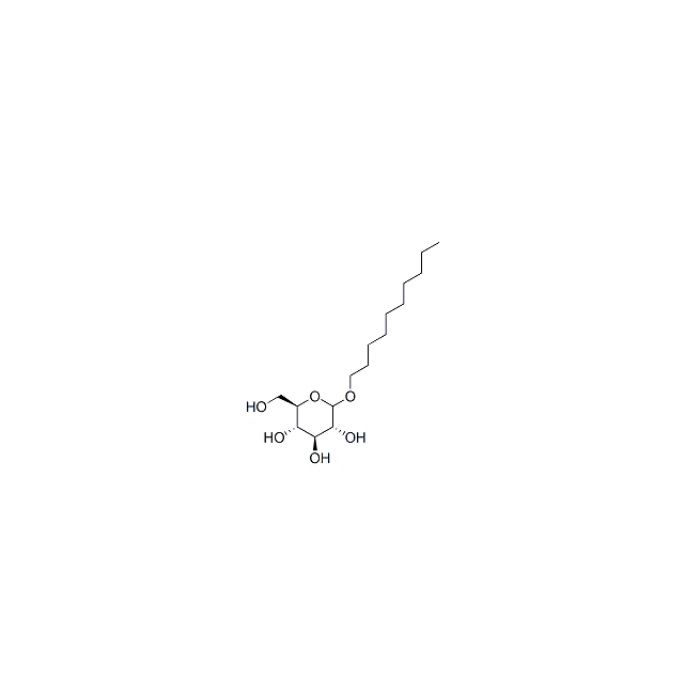
癸基葡糖苷(APG)

CAS: 68515-73-1 货号: T476404 分子式: C16H32O6 分子量: 320.22 EC号: 500-220-1
有货
级别和纯度: Moligand™ ? Moligand™ —— 阿拉丁的配体和生物活性小分子系列。适用于需要明确小分子工具的受体、通路和结合研究。 60% in H2O
别名
烷基糖苷 (APG)-天然表面活性剂 | 烷基糖苷 APG0810
储存条件
室温,充氩
运输条件
常规运输
★
规格
库存
价格
数量
100ml
T476404-100ml
现货 Stock Image
¥279.90
500ml
T476404-500ml
现货 Stock Image
¥429.90
2.5L
T476404-2.5L
现货 Stock Image
¥1,299.90
请输入您要添加的产品数量
🧪
为什么选择此级别

Moligand™ 级 ,适用于对基线干扰要求严格的色谱和分析工作流程。

🌡

储存与运输

室温,充氩。常规运输 。请查阅批次 COA 获取详细规格。

📋

质量文档

SDS、COA、产品数据表及规格说明书均可下载。可通过批号查询获取批次 COA。

📚

文献证明

在色谱分析、有机合成和交叉偶联反应领域已被 5 篇同行评审文献引用。

概述

APG 0810是一种含 58.0-62.0% D -吡喃葡萄糖、低聚物、癸基辛基糖苷和 38.0-42.0% 水的混合物。癸醇含量小于 2%,辛醇含量小于 1.0%。

应用

APG 0810可用于:制备可作为视黄酸和类视黄醇载体的多层囊泡研究草甘膦除草剂在土壤中的矿化、浸出和吸附。

APG 0810 is a mixture of 58.0-62.0% D-glucopyranose, oligomeric, decyl octyl glycoside and 38.0-42.0% water. Contains less than 2% decanol and less than 1.0% octanol.

规格

别名
烷基糖苷 (APG)-天然表面活性剂 | 烷基糖苷 APG0810
英文别名
C16H32O6 | A867031 | W-203522 | (3R,4S,5S,6R)-2-(Decyloxy)-6-(hydroxymethyl)-tetrahydro-2H-Pyran-3,4,5-triol | (3R,4S,5S,6R)-2-(Decyloxy)-6-(hydroxymethyl)tetrahydro-2H-Pyran-3,4,5-triol | D-Glucopyranoside, decyl | decyl glucopyranoside | DS-3841 | (3R,4
规格或纯度
Moligand™, 60% in H2O
英文名称
Decyl glucoside (APG)
应用
APG 0810 can be used:In the preparation of multilamellar vesicles as carriers for tretinoins and retinoids.In the study of mineralization, leaching, and adsorption of glyphosate herbicide in the soil.
储存条件
室温,充氩
运输条件
常规运输
名称和识别符
PubChem SID
EC号
500-220-1
分子类型
未知
IUPAC Name
(3R,4S,5S,6R)-2-decoxy-6-(hydroxymethyl)oxane-3,4,5-triol
INCHI
1S/C16H32O6/c1-2-3-4-5-6-7-8-9-10-21-16-15(20)14(19)13(18)12(11-17)22-16/h12-20H,2-11H2,1H3/t12-,13-,14+,15-,16?/m1/s1
InChi Key
JDRSMPFHFNXQRB-IWQYDBTJSA-N
Smiles
CCCCCCCCCCOC1C(C(C(C(O1)CO)O)O)O
Isomeric SMILES
CCCCCCCCCCOC1[C@@H]([C@H]([C@@H]([C@H](O1)CO)O)O)O
分子量
320.22
Reaxy-Rn
35664303
Reaxys-RN link address
https://www.reaxys.com/reaxys/secured/hopinto.do?context=S&query=IDE.XRN=35664303&ln=

技术文档

📋 安全数据表 (SDS)

全面的危险、操作、储存及法规合规文件。

下载 SDS →

✅ 分析证书 (COA)

批次质量数据。输入批号以获取对应 COA。

查询 COA →

📊 产品数据表

产品规格和应用的快速参考摘要。

查看数据表 →

🔬 规格说明书

该级别的完整质量属性和验收标准。

查看规格说明 →

高级数据

系统学分类

分类树(Taxonomy Tree)

界(kingdom) 有机化合物
超类(Superclass) 脂质和脂质样分子
类(Class) 脂肪酰基
亚类(Subclass) 脂肪酰基糖苷
中间层级节点(Intermediate Tree Nodes) 暂无
直接上位类(Direct Parent) 单糖和双糖的脂肪酰基糖苷
其他上位类(Alternative Parents) 己糖  烷基糖苷  O-糖基化合物  氧烷  仲醇  多元醇  氧环化合物  缩醛  伯醇  碳氢化合物衍生物  
分子骨架(Molecular Framework) 脂肪族杂单环化合物
取代基(Substituents) 乙醛酸 - 羟基苯甲酸酯 - 脂肪族杂单环化合物 - 烷基苷 - 单糖或双糖的脂肪酰基糖苷 - 糖基化合物 - 己糖单糖 - 烃衍生物 - 单糖 - O-羧基化合物 - 有机氧化合物 - 有机杂环化合物 - 有机氧化合物 - 氧杂环 - 氧杂环丁烷 - 多醇 - 初级醇 - 醛基
描述(Description) 该化合物属于单糖和双糖的脂肪酰基糖苷类有机化合物。这类化合物由单糖或双糖片段与脂肪醇的羟基、磷酸化醇(磷酸烯醇)、羟基脂肪酸、脂肪酸的羧基(酯键)或氨基醇相连而成。
外部描述符(External Descriptors) 暂无
三维结构
交互式化学结构模型


化学和物理性质
溶解性
 水:在 20°C 下可自由溶解(目测)
密度
1.09kg/m³
分子量
320.420 g/mol
XLogP3
2.400
氢键供体数Hydrogen Bond Donor Count
4
氢键受体数Hydrogen Bond Acceptor Count
6
可旋转键计数Rotatable Bond Count
11
精确质量Exact Mass
320.22 Da
单同位素质量Monoisotopic Mass
320.22 Da
拓扑极表面积Topological Polar Surface Area
99.400 Ų
重原子数Heavy Atom Count
22
形式电荷Formal Charge
0
复杂度Complexity
275.000
同位素原子数Isotope Atom Count
0
定义的原子立体中心计数Defined Atom Stereocenter Count
4
未定义的原子立体中心计数Undefined Atom Stereocenter Count
1
定义的键立体中心计数Defined Bond Stereocenter Count
0
未定义的键立体中心计数Undefined Bond Stereocenter Count
0
所有立体化学键的总数The total count of all stereochemical bonds
0
共价键合单元计数Covalently-Bonded Unit Count
1
安全和危险性(GHS)
象形图
信号词
危险
危险声明

H315: 引起皮肤刺激

H318: 造成严重的眼睛损伤

H319: 引起严重眼睛刺激

预防措施声明

P264: 处理后要彻底洗手。

P280: 戴防护手套/穿防护服/戴防护眼罩/戴防护面具。

P321: 特殊处理(请参阅此标签上的...)。

P302+P352: 如皮肤沾染:用水充分清洗。

P305+P351+P338: 如进入眼睛:用水小心冲洗几分钟。如戴隐形眼镜并可方便地取出,取出隐形眼镜。继续冲洗。

P362+P364: 脱掉沾污的衣服,清洗后方可重新使用。

P264+P265: 处理后彻底洗手[和…]。不要触摸眼睛。

P305+P354+P338: 如果进入眼睛:立即用水冲洗几分钟。取下隐形眼镜(如果有的话),并且操作简单。继续冲洗。

P317: 寻求紧急医疗救助。

P337+P317: 如果眼睛刺激持续:寻求医疗帮助。

P332+P317: 如果出现皮肤刺激:请寻求医疗帮助。

质检证书(CoA,COO,BSE/TSE 和分析图谱)
C of A & Other Certificates(BSE/TSE, COO):
输入批号以搜索分析图谱:

通过匹配包装上的批号来查找并下载产品的 COA,每批产品都进行了严格的验证,您可放心使用!

找到26个结果

批号(Lot Number) 证书类型 货号
J2609844 分析证书 T476404
J2609843 分析证书 T476404
J2609842 分析证书 T476404
I2603150 分析证书 T476404
I2603009 分析证书 T476404
F2611442 分析证书 T476404
F2611441 分析证书 T476404
F2611440 分析证书 T476404
F23061892 分析证书 T476404
A2627668 分析证书 T476404
E2607080 分析证书 T476404
A2627669 分析证书 T476404
A2627507 分析证书 T476404
E2528592 分析证书 T476404
E2528591 分析证书 T476404
E2528478 分析证书 T476404
J2422795 分析证书 T476404
J2422797 分析证书 T476404
J2422798 分析证书 T476404
F23061905 分析证书 T476404
F23061908 分析证书 T476404
F23061986 分析证书 T476404
H2422105 分析证书 T476404
D2310135 分析证书 T476404
D2310121 分析证书 T476404
D2310110 分析证书 T476404
技术文档和文章
生物基化学品:从平台分子到应用场景——趋势洞察与阿拉丁产品布局
Bio-based Chemicals: From Platform Molecules to Application Scenarios — Trend Insights and Aladdin’s Product Portfolio
香精科普:从配方黑箱到可工程化体系——相容性、稳定性、控释、可追溯与选型指南
A Practical Guide to Fragrance Compositions: Turning a Black-Box Formula into an Engineerable System—Compatibility, Stability, Controlled Release, Traceability, and Selection
表面活性剂全景指南:定义与机理、关键指标、应用场景与选型导航(表1–表3)
A Panoramic Guide to Surfactants: Definitions & Mechanisms, Key Metrics, Application Scenarios, and Selection Navigation (Tables 1–3)
脂肪酸钾皂的结构与配方应用:生产工艺、偏碱性、泡沫调控及低泡清洗解析
Potassium Fatty Acid Soaps: Structure and Formulation Applications—Production Processes, Alkalinity, Foam Control, and Low-Foam Cleaning
为什么日化清洁配方常用 LABSA(磺酸):中和机理、去污作用与配方应用要点
Why LABSA (Sulfonic Acid) Is Commonly Used in Household Cleaning Formulations: Neutralization Mechanism, Detergency Action, and Formulation Application Points
脂肪酸甲酯磺酸盐(MES)在日化洗涤清洁配方中的应用:去污、硬水适应性与选用要点
Application of Fatty Acid Methyl Ester Sulfonate (MES) in Household Detergent and Cleaning Formulations: Detergency, Hard-Water Tolerance, and Selection Criteria
烷基糖苷(APG)与椰油酰胺丙基甜菜碱(CAPB)有何不同:结构、泡沫表现与日化复配应用解析
How Alkyl Polyglucosides (APG) Differ from Cocamidopropyl Betaine (CAPB): Structure, Foam Performance, and Applications in Personal Care and Household-Care Formulations
日化配方中溶剂、共溶剂与增溶体系:分类、作用与选型指南
Solvents, Co-solvents, and Solubilization Systems in Home and Personal Care Formulations: Classification, Functions, and Selection Guide
K12(十二烷基硫酸钠/SLS)不只是起泡剂:结构、性能与日化配方应用解析
K12 (Sodium Lauryl Sulfate/SLS) Is More Than a Foaming Agent: Structure, Properties, and Applications in Personal Care and Household Care Formulations
三乙醇胺与二乙醇胺有何不同:从分子结构看日化配方作用、应用差异与选用逻辑
What Is the Difference Between Triethanolamine and Diethanolamine: Understanding Their Formulation Functions, Application Differences, and Selection Logic from a Molecular-Structure Perspective
黄原胶在日化配方中的增稠、悬浮、辅助稳定与结团机制:从分子结构到工艺应用
Thickening, Suspension, Auxiliary Stabilization, and Agglomeration Mechanisms of Xanthan Gum in Personal Care Formulations: From Molecular Structure to Processing Applications
6501(椰油酰胺DEA)为什么能稳泡增稠?结构机理、1:1/1:1.5差异与应用选型
Why Can 6501 (Cocamide DEA) Stabilize Foam and Build Viscosity? Structural Mechanism, 1:1/1:1.5 Differences, and Application Selection
烷基糖苷 APG 在清洁配方中的作用:结构特点、核心性能与选用要点
Role of Alkyl Glucosides APG in Cleaning Formulations: Structural Features, Core Performance, and Selection Considerations
小防白、大防白、PnB和DPnB:丁基醇醚在硬表面清洁配方中的作用机制与选型
Xiao Fang Bai, Da Fang Bai, PnB and DPnB: Mechanisms and Selection of Butyl Glycol Ethers in Hard-Surface Cleaning Formulations
柠檬烯为何能软化油污却难溶于水:从分子结构理解天然来源溶剂的清洁机理与配方应用
Why Limonene Can Soften Greasy Soils Yet Is Difficult to Dissolve in Water: Understanding the Cleaning Mechanism and Formulation Applications of Naturally Derived Solvents from Molecular Structure
从分子结构看除油剂:AEO、APG 等如何替代壬基酚聚氧乙烯醚(NPE)
Degreasing Agents from a Molecular-Structure Perspective: How AEO, APG, and Related Surfactants Can Replace Nonylphenol Ethoxylates (NPE)
从结构看懂 CAPB:椰油酰胺丙基甜菜碱如何改善泡沫、提升温和性并辅助增稠?
Understanding CAPB from Its Structure: How Cocamidopropyl Betaine Improves Foam, Enhances Mildness, and Supports Thickening
AEO-9(脂肪醇聚氧乙烯醚)的界面作用机理与配方应用——乳化、润湿、油污去除与复配相容性解析
Interfacial Mechanism and Formulation Applications of AEO-9 (Fatty Alcohol Polyoxyethylene Ether): An Analysis of Emulsification, Wetting, Oil Soil Removal, and Co-Formulation Compatibility
不仅是 pH 调节剂:柠檬酸在日化清洁中的作用机理、选型逻辑与替代酸源分析
More Than a pH Adjuster: Mechanisms, Selection Logic, and Alternative Acid Source Analysis of Citric Acid in Home-Care Cleaning
日化清洁体系中渗透剂的润湿渗透机理与代表结构解析——以 JFC、OEP-70 和 DOSS 为例
Wetting and Penetration Mechanisms of Penetrating Agents in Household and Personal Care Cleaning Systems: Representative Structural Analysis Using JFC, OEP-70, and DOSS as Examples
从结构到选型:脂肪酸甲酯乙氧基化物(FMEE)低泡除油除蜡的机理与应用判断
From Structure to Selection: Mechanisms and Application Assessment of Low-Foam Oil and Wax Removal with Fatty Acid Methyl Ester Ethoxylates (FMEE)
K12 与 AOS 发泡性能差异解析:结构、酸碱稳定性与配方选型
Analysis of the Foaming Performance Differences Between K12 and AOS: Structure, Acid–Base Stability, and Formulation Selection
棕榈来源异构醇聚氧乙烯醚 PLE-S9 的结构特性、低温流动性与日化清洁应用
Structural Characteristics, Low-Temperature Flowability, and Home-Care Cleaning Applications of Palm-Derived Isomeric Alcohol Polyoxyethylene Ether PLE-S9
两性表面活性剂的结构逻辑:代表原料、性能机制与日化配方应用
The Structural Logic of Amphoteric Surfactants: Representative Ingredients, Performance Mechanisms, and Formulation Applications in Personal Care and Home Care
非离子表面活性剂的结构逻辑:作用机制、分类特点与选用逻辑
Structural Logic of Nonionic Surfactants: Mechanisms of Action, Classification Features, and Selection Principles
夏季日化产品为什么容易返稀?核心机理、排查方法与解决思路
Why Are Daily Chemical Products Prone to Viscosity Thinning in Summer? Core Mechanisms, Troubleshooting Methods, and Solutions
从分子电荷看懂四类表面活性剂:阴离子、阳离子、两性及两性离子与非离子的日化应用逻辑
Understanding the Four Classes of Surfactants Through Molecular Charge: Application Logic of Anionic, Cationic, Amphoteric and Zwitterionic, and Nonionic Surfactants in Personal Care and Home Care
此产品的引用文献
溶液计算器

需要帮助选择级别?

我们的级别选择指南涵盖了目录中所有的变体的纯度、稳定剂状态和应用适用性。

查看 Moligand™ 级别指南 →
