
计算溶液所需的质量、体积或浓度。
有货
BioReagent,生物染色剂,用于显微镜 级 ,适用于对基线干扰要求严格的色谱和分析工作流程。
2-8°C储存,避光。低温运输 。请查阅批次 COA 获取详细规格。
SDS、COA、产品数据表及规格说明书均可下载。可通过批号查询获取批次 COA。
在色谱分析、有机合成和交叉偶联反应领域已被 85 篇同行评审文献引用。
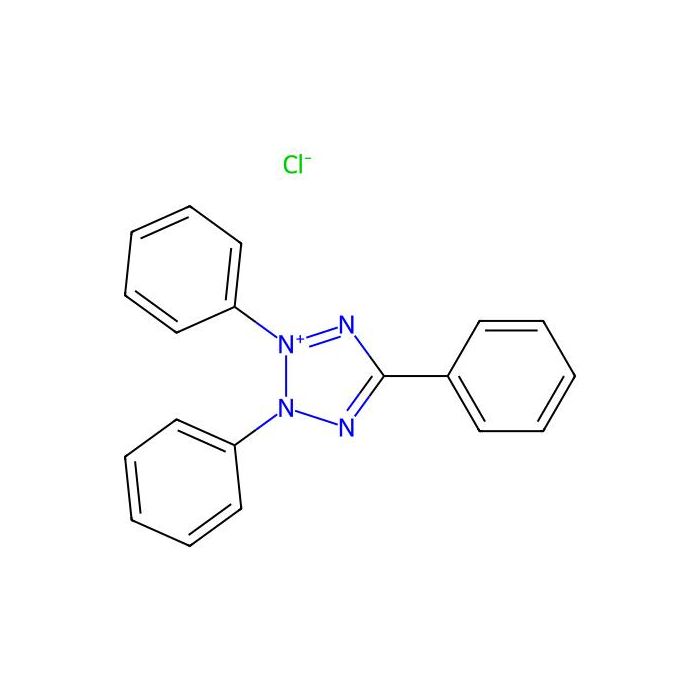
2,3,5- 三苯基氯化四氮唑(2,3,5-Triphenyltetrazolium chloride,TTC ),分子量为334.80,分子式为C19H15ClN4,CAS号为298-96-4。TTC是脂溶性光敏感复合物,最初用于检测种子生存能力,后来用于染色检测哺乳动物组织的缺血梗塞。TTC是呼吸链中吡啶核苷结合酶系统的质子受体,TTC 与正常组织中的呼吸酶反应而呈红色,而缺血组织内呼吸酶活性下降,不能反应,故不会产生变化呈苍白色,该染色是一种用于评价组织内脱氢酶活性的大体染色方法。
TTC 染色液(1%)对心肌梗死及脑组织坏死区的观测较电镜早3~6h,较光镜早24h,多用于尸检中的新鲜心脏组织和脑组织以及实验动物模型早期梗死组织的染色,同时亦可对种子和花粉活力进行鉴定。该产品的特点:①TTC 染色直接取材于新鲜组织即可染色,无需固定、包埋等步骤;②TTC 染色时间短,一般 20~30min;③TTC 染色液可重复使用,10mL可染20张片子。
使用说明:
(一)脑组织染色
1、取待检新鲜脑组织样本 (一般可麻醉后直接取脑或经生理盐水灌注后取脑),取出后-20°C速冻 20~30min,便于切片。
2、将待检脑组织切片,一般动物样本层厚 2~3mm,人的样本层厚 3~5mm,可连续切4~5 张。第一刀在脑前极与视交叉连线中点处;第二刀在视交叉部位;第三刀在漏斗柄部位;第四刀在漏斗柄与后叶尾极之间 (参考:张均田主编,现代药理试验方法)。
3、切片入 TTC 染色液(1%),避光浸染 30~35min。
4、切片入 4%多聚甲醛或 10%中性福尔马林中固定 4~24h。
5、吸干组织表面清水,应用 IPP 等图像分析系统测量脑梗死面积并计算大脑梗死体积。
(二)种子染色
1、取不同活力的种子用刀片做横切和沿种胚中央准确纵切,取每粒种子的一半备用。
2、将上述种子置于 TTC 染色液(1%)中,37°C避光孵育 20min。
3、倒出染色液,自来水冲洗 2~3 次,立即观察种胚着色情况。
注意事项:
1、TTC 染色液(1%)对人体有轻微刺激性,请注意小心防护。
2、取脑时应仔细保持大脑的完整性。
3、如果染色效果不佳,应适当延长染色时间。
4、样本越新鲜越好,为了防止正常心肌及脑组织的酶活性减弱或消失,应尽快染色。
5、为了您的安全和健康,请穿实验服并戴一次性手套。
染色结果:
| 正常心肌或脑组织 | 红色 |
| 心肌或脑梗坏死区 | 苍白色 |
| 缺血脑组织 | 介于红色与苍白色之间 |
2,3,5-Triphenyltetrazolium chloride (TTC) has a molecular weight of 334.80, a molecular formula of C₁₉H₁₅ClN₄, and a CAS number of 298-96-4. TTC is a lipid-soluble, light-sensitive compound initially used to assess seed viability and later employed to stain and detect ischemic infarcts in mammalian tissues. TTC acts as a proton acceptor for the pyridine nucleotide-linked enzyme system in the respiratory chain. It reacts with respiratory enzymes in normal tissue, producing a red color. In ischemic tissue, where respiratory enzyme activity is reduced, the reaction does not occur, leaving the tissue unstained (pale). This staining is a gross staining method used to evaluate dehydrogenase activity within tissues.
TTC Staining Solution (1%) can detect myocardial infarction and cerebral necrosis 3–6 hours earlier than electron microscopy and 24 hours earlier than light microscopy. It is commonly used for staining fresh heart and brain tissue from autopsies, as well as early infarcted tissue in experimental animal models. It can also be used to assess seed and pollen viability. Features of this product include: ① TTC staining can be performed directly on fresh tissue without fixation, embedding, or other processing steps; ② TTC staining is rapid, typically taking 20–30 minutes; ③ TTC staining solution can be reused; 10 mL is sufficient for staining approximately 20 tissue sections.
Instructions for Use
1. Staining of Brain Tissue
1.1 Collect the fresh brain tissue sample (typically from anesthetized animals, either directly or after perfusion with physiological saline). After removal, quickly freeze at -20°C for 20–30 minutes to facilitate sectioning.
1.2 Slice the brain tissue. For animal samples, the recommended thickness is 2–3 mm; for human samples, 3–5 mm. Typically, 4–5 consecutive slices can be obtained. The first cut is made at the midpoint between the frontal pole and the optic chiasm; the second at the level of the optic chiasm; the third at the infundibular stalk; and the fourth between the infundibular stalk and the caudal pole of the posterior lobe (Reference: Zhang Juntian, Ed., Modern Pharmacological Experimental Methods).
1.3 Immerse the tissue slices in TTC Staining Solution (1%) and stain in the dark for 30–35 minutes.
1.4 Fix the stained slices in 4% paraformaldehyde or 10% neutral formalin for 4–24 hours.
1.5 Blot excess liquid from the tissue surface. Use an image analysis system (e.g., IPP) to measure the infarct area and calculate the cerebral infarct volume.
2. Staining of Seeds
2.1 Take seeds with varying viability. Cut them transversely or make a precise longitudinal cut through the center of the embryo. Use one half of each seed for staining.
2.2 Place the seed halves in TTC Staining Solution (1%) and incubate at 37°C in the dark for 20 minutes.
2.3 Pour off the staining solution, rinse the seeds 2–3 times with tap water, and immediately observe the coloration of the embryo.
Precautions
TTC Staining Solution (1%) is slightly irritating to humans. Please handle with care and take appropriate protective measures.
When removing the brain, take care to preserve its structural integrity.
If staining results are suboptimal, appropriately extend the staining time.
The fresher the sample, the better. To prevent the weakening or loss of enzyme activity in normal myocardial or brain tissue, perform staining as soon as possible.
For your safety and health, please wear a lab coat and disposable gloves during operation.
Staining Results
| Tissue Type | Color |
| Normal myocardium or brain tissue | Red |
| Myocardial or cerebral infarct necrotic area | Pale (unstained) |
| Ischemic brain tissue | Intermediate between red and pale |
分类树(Taxonomy Tree)
| 界(kingdom) | 有机化合物 |
|---|---|
| 超类(Superclass) | 有机杂环化合物 |
| 类(Class) | 唑类 |
| 亚类(Subclass) | 四唑类 |
| 中间层级节点(Intermediate Tree Nodes) | 暂无 |
| 直接上位类(Direct Parent) | 苯基四唑及其衍生物 |
| 其他上位类(Alternative Parents) | 苯及其取代衍生物 杂芳族化合物 氮杂环化合物 有机光子化合物 有机氮化合物 有机氯化物盐 碳氢化合物衍生物 |
| 分子骨架(Molecular Framework) | 芳香族杂单环化合物 |
| 取代基(Substituents) | 芳香族杂单环化合物 - 氮杂环 - 苯基化合物 - 杂芳香族化合物 - 烃衍生物 - 单环苯基基团 - 有机氯酸盐 - 有机硝基化合物 - 有机盐 - 有机氮化合物 - 有机氮化合物 - 苯基吡唑 |
| 描述(Description) | 该化合物属于苯基四唑及其衍生物类有机化合物。这类化合物含有苯基四唑骨架,即四唑基团与苯基相连的结构。 |
| 外部描述符(External Descriptors) | organic chloride salt |
H228: 易燃固体
H315: 引起皮肤刺激
H319: 引起严重眼睛刺激
H335: 可能引起呼吸道刺激
通过匹配包装上的批号来查找并下载产品的 COA,每批产品都进行了严格的验证,您可放心使用!
| 批号(Lot Number) | 证书类型 | 货号 |
|---|---|---|
 ZJ26F0939580 |
分析证书 | T774567 |
| ZJ26F0131281 |
分析证书 | T774567 |
我们的级别选择指南涵盖了目录中所有的变体的纯度、稳定剂状态和应用适用性。
查看 BioReagent 级别指南 → 查看 Biological Stain 级别指南 → 查看 for Microscopy 级别指南 →

 危险品化学品经营许可证(带存储)