Glutamate dehydrogenase (NADP) is the catalytic enzyme for glutamate production. Dysfunction of Glutamate dehydrogenase (NADP) may induce various neurodegenerative diseases, such as Parkinson's disease, epilepsy, Alzheimer's disease, schizophrenia, and frontotemporal dementia. Glutamate dehydrogenase (NADP) can be used in research on neurological diseases such as Parkinson's disease, epilepsy, and Alzheimer's disease.
Reaction Equation
L-Glutamate + H₂O + NADP⁺⇌ α-Ketoglutarate + NH₃ + NADPH + H⁺
Specification
Specific Activity: >60 U/mg protein (for reduction of α-Ketoglutarate to L-Glutamate)
Contaminants
Glucose 6-phosphate dehydrogenase: < 0.02%
Phosphogluconate dehydrogenase: < 0.1%
Glutamate dehydrogenase (NAD⁺): < 0.03%
Glutathione reductase: < 0.02%
NADPH oxidase: < 0.003%
Properties
pH stability: pH 5.0 - 10.5 (25 °C, 1 week)
Thermal stability: ≤70 °C (pH 7.5, 10 min)
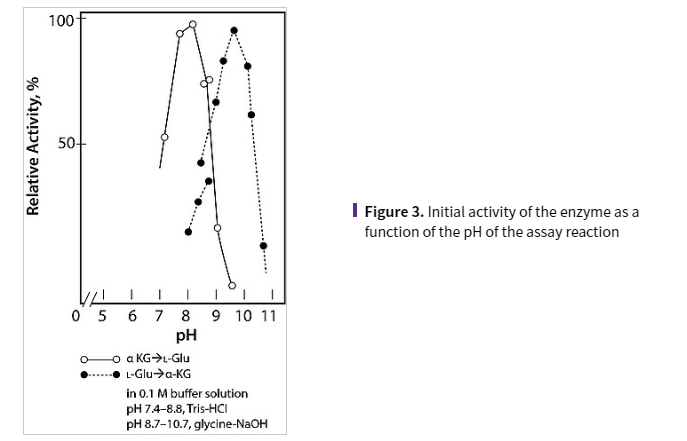
Optimum pH: 7.5 - 8.0
Optimum temp.: ≥70 °C
Km value:
2.5 × 10² mol/L (L-Glutamate)
6.4 × 10⁵ mol/L (NADP⁺)
4.1 × 10⁴ mol/L (α-Ketoglutarate)
2.4 × 10⁵ mol/L (NADPH)
4.7 × 10⁵ mol/L (Ammonium acetate)
Molecular weight: 46 kDa (SDS-PAGE)
Assay Procedure
I Spectrophotometric Method
Wavelength: 340 nm, Light path length: 1 cm
Final volume: 3.02 mL, Temperature: 25 °C
Pipette the following reagents into a cuvette:
2.50 mL Triethanolamine-HCl buffer (0.1 mol/L, pH 7.6)
0.15 mL α-Ketoglutarate (0.1 mol/L)
0.05 mL NADPH (12 mmol/L)
0.30 mL Ammonium acetate (2 mol/L)
0.02 mL rGIDH(NADP) (approx. 3 U/mL)
II Calculation
ΔA/min = The change in absorbance at 340 nm/minute
V = Total volume of reaction mixture (3.02 mL)
D = Enzyme dilution factor
6.2 = mmol/L extinction coefficient of NADPH (L·mmol⁻¹·cm⁻¹)
d = Light path length (1 cm)
v = Volume of enzyme sample (0.02 mL)