
计算溶液所需的质量、体积或浓度。
有货
提供 ≥98% 纯度,适用于对基线干扰要求严格的色谱和分析工作流程。
避光,-20°C储存,充氩,干燥。超低温运输 。请查阅批次 COA 获取详细规格。
SDS、COA、产品数据表及规格说明书均可下载。可通过批号查询获取批次 COA。
在色谱分析、有机合成和交叉偶联反应领域已被 17 篇同行评审文献引用。
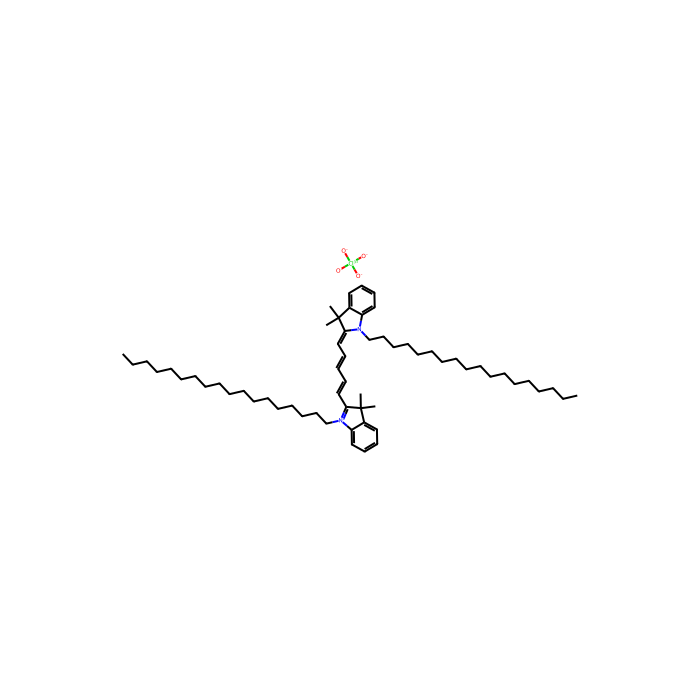
DiD,DiO,DiI,DiR和DiS染料是一族亲脂性的荧光染料,可以用来染细胞膜和其它脂溶性生物结构。当与细胞膜结合后其荧光强度大大增强,这类染料有着很高的淬灭常数和激发态寿命。一旦对细胞染色,这类染料在整个细胞膜上扩散,最佳浓度时可以使整个细胞膜染色。它们的荧光颜色区分明显:DiI(橙色荧光),DiO(绿色荧光),DiD(红色荧光)和 DiR (深红色荧光)这使得他们可以用来对活细胞进行多色成像和流式分析。DiI和DiO可以分别用标准的 FITC和TRITC的滤光片。DiD可以用 633 nm He–Ne 激光器激发,有着比DiI更长的激发波长和发射波长,在细胞和组织染色中更有价值。 DiR的红外荧光可以穿透细胞和组织,在活体成像中用来示踪。
使用方法
1. DiD,DiO,DiI,DiR和DiS细胞膜染色液制备
(1)配置DMSO或EtOH 储存液:储存液用 DMSO或EtOH配置浓度1~5 mM。
注意:未使用的储存液保存在-20°C,避免反复冻融。
(2)工作液制备:用合适的缓冲液(如:无血清培养基,HBSS或PBS)稀释储存液,配制浓度为1~5 µM的工作液。
注意:工作液的最终浓度是根据不同细胞和实验的经验来配制。可以从推荐浓度的十倍以上寻找最佳条件。
2. 悬浮细胞染色
(1)悬浮细胞密度为 1 × 10⁶/mL加入到工作液中。
(2)在37 ℃培养细胞 2~20分钟,不同的细胞最佳培养时间不同。
(3)染色细胞试管在1000~1500转离心5分钟。
(4)倾倒上清液,再次缓慢加入预温37℃的培养液。
(5)重复(3),(4)步骤两次以上。
3. 粘壁细胞的染色
(1)使粘壁的细胞在无菌实验室培养。
(2)从培养基中移走盖玻片,吸走过量培养液,将盖玻片放在潮湿的环境中。
(3)在盖玻片的一角加入100μL的染料工作液,轻轻晃动使染料均匀覆盖所有细胞。
(4)在37 ℃培养细胞 2~20分钟,不同的细胞最佳培养时间不同。
(5)吸干染料工作液,用培养液洗盖玻片2~3次,每次用预温的培养基覆盖所有细胞,培养5~10分钟,然后吸干培养基。
4. 显微镜检测
(1)DiI滤光器选择XF32-Omega, 31002-Chroma
(2)多色染料的同时检测,滤光器按照以下设定:
a) DiI和DiO=Omega XF52,Chroma 51004;
b) DiI和DiD=Omega XF92,Chroma 51007;
c) DiI,DiO和DiD=Omega XF93,Chroma 61005
5. 流式细胞仪的检测
DiD,DiO,DiI,DiR和DiS 染色的细胞可以分别用经典的FL1,FL2,FL3和FL4流式细胞仪检测。
DiD, DiO, DiI, DiR and DiS dyes are a family of lipophilic fluorescent dyes that can be used to stain cell membranes and other fat-soluble biological structures. When combined with the cell membrane, the fluorescence intensity is greatly enhanced, and this type of dye has a high quenching constant and excited state lifetime. Once the cells are stained, this type of dye spreads across the cell membrane, and the optimal concentration can stain the entire cell membrane. Their fluorescence colors are clearly distinguished: DiI (orange fluorescence), DiO (green fluorescence), DiD (red fluorescence) and DiR (dark red fluorescence) which allows them to be used for multicolor imaging and flow analysis of living cells. DiI and DiO can use standard FITC and TRITC filters respectively. DiD can be excited by a 633 nm He-Ne laser, has a longer excitation and emission wavelength than DiI, and is more valuable in cell and tissue staining. DiR's infrared fluorescence can penetrate cells and tissues and be used for tracking in in vivo imaging.
Instructions
1. DiD, DiO, DiI, DiR and DiS cell membrane staining solution preparation
(1) Configure DMSO or EtOH storage solution: Use DMSO or EtOH to configure the storage solution with a concentration of 1 to 5 mM.
Note: Store the unused storage solution at -20°C, avoid repeated freezing and thawing.
(2) Preparation of working solution: Dilute the stock solution with a suitable buffer (such as serum-free medium, HBSS or PBS) to prepare a working solution with a concentration of 1 to 5 µM.
Note: The final concentration of the working solution is prepared according to the experience of different cells and experiments. The best conditions can be found from ten times the recommended concentration. To
2. Suspension cell staining
(1) The suspended cell density is 1 × 10⁶/mL and added to the working solution.
(2) Incubate cells at 37°C for 2-20 minutes. The optimal culture time varies for different cells.
(3) Centrifuge the stained cell tube at 1000-1500 rpm for 5 minutes.
(4) Pour the supernatant, and slowly add the pre-warmed 37°C culture solution again.
(5) Repeat steps (3) and (4) twice or more.
3. Staining of mucosal cells
(1) The cells that adhere to the wall are cultured in a sterile laboratory.
(2) Remove the cover glass from the culture medium, aspirate the excess medium, and place the cover glass in a humid environment.
(3) Add 100μL of dye working solution to one corner of the cover glass, and shake gently to make the dye evenly cover all cells.
(4) Cultivate the cells at 37°C for 2-20 minutes. The optimal culture time is different for different cells.
(5) Blot the dye working solution, wash the cover glass 2 to 3 times with the culture solution, cover all the cells with pre-warmed culture medium each time, incubate for 5-10 minutes, and then blot the culture medium.
4. Microscope inspection
(1) DiI filter selection XF32-Omega, 31002-Chroma
(2) Simultaneous detection of multicolor dyes, the filter is set as follows:
a) DiI and DiO = Omega XF52, Chroma 51004;
b) DiI and DiD = Omega XF92, Chroma 51007;
c) DiI, DiO and DiD = Omega XF93, Chroma 61005
5. Flow cytometry detection
DiD, DiO, DiI, DiR and DiS stained cells can be detected by classic FL1, FL2, FL3 and FL4 flow cytometry, respectively.
通过匹配包装上的批号来查找并下载产品的 COA,每批产品都进行了严格的验证,您可放心使用!
| 批号(Lot Number) | 证书类型 | 货号 |
|---|---|---|
 E2609450 |
分析证书 | D266406 |
| E2609451 |
分析证书 | D266406 |
| E2609452 |
分析证书 | D266406 |
| D2613079 |
分析证书 | D266406 |
| F2516234 |
分析证书 | D266406 |
| F2516283 |
分析证书 | D266406 |
| B2429010 |
分析证书 | D266406 |
| I2406509 |
分析证书 | D266406 |
| I2406551 |
分析证书 | D266406 |
| I2406538 |
分析证书 | D266406 |
| I2406550 |
分析证书 | D266406 |
| G2405067 |
分析证书 | D266406 |
| F2314492 |
分析证书 | D266406 |
| E2422093 |
分析证书 | D266406 |
| B2320154 |
分析证书 | D266406 |
| B2320241 |
分析证书 | D266406 |


 危险品化学品经营许可证(带存储)