
计算溶液所需的质量、体积或浓度。
只有 %1 左
产品规格与参数
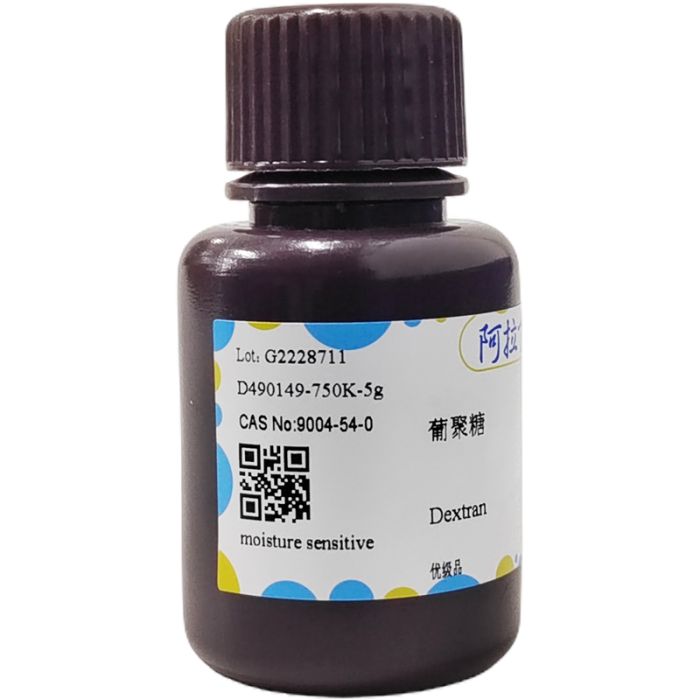
右旋糖酐(Dextran,又名葡聚糖)是一类主要由葡萄糖单元组成的多糖,特别是通过 α-(1-6) 键连接的 D-葡萄糖单元。其高分子量和具体结构取决于负责其生产的微生物菌株。这种均质多糖是通过细胞外右旋糖酐蔗糖酶的作用产生的,这些酶通常存在于乳酸菌属中,如明串珠菌属、乳杆菌属、链球菌属、魏斯氏菌属和片球菌属。右旋糖酐功能丰富,广泛用于生物化学、细胞生物学、药物递送研究和凝胶电泳等领域。 来自明串珠菌属的葡聚糖已用于: 与海水中的胚胎悬浮液混合,制备冷冻成像样品 将斑马鱼幼虫的尾巴浸入水中冷冻固定 在乙烯基砜修饰右旋糖酐(DX-VS)的合成中 通过酯键(DX-O-MeA)合成甲基丙烯酸酯官能化葡聚糖 作为 NCTC-135 组织培养基中的补充剂,以制备灌注培养基 葡聚糖是由线性α(1→6)连接的葡萄糖单元和α(1→3)连接启动的支链组成的支链葡聚糖。葡聚糖的分子量范围为10,000至150,000 Kd。 葡聚糖在多种应用中被用来作为体积扩增剂,稳定剂,基质组分,结合平台,润滑剂和物理结构组分。 Dextran 40 被用来研发移植器官改良保存溶液。葡聚糖40可以用来确定细胞紧密度和细胞层之间的通量参数。葡聚糖40可用作胶体血浆体积扩增剂。 生化/生理作用 渗透平衡:右旋糖酐通过增加溶液中的溶质浓度来帮助维持渗透平衡。这可以防止水分过多地穿过细胞膜,从而保持细胞的完整性和功能。 -冷冻保护:右旋糖酐通过在冷冻过程中在细胞和组织周围形成保护屏障来作为冷冻保护剂。这种屏障抑制冰晶的形成,冰晶会损害细胞膜和结构。 -粘度控制:右旋糖酐可以通过增加溶液的分子量来改变溶液的粘度。这种粘度变化会影响溶液的流动性,使其可用于控制各种工艺中溶液的稠度。 -药物递送:修饰右旋糖酐用作受控药物递送的载体。右旋糖酐可以包封药物并逐渐释放,提高药物的溶解度,控制释放曲线,从而改善治疗效果。 -凝胶电泳:右旋糖酐可增加凝胶电泳中样品上样溶液的密度。这种增加的密度有助于样品沉入凝胶基质中,从而在电泳过程中根据大小和电荷更精确地分离分子。 -酶稳定:右旋糖酐通过提供保护性环境来稳定酶。它在酶周围形成稳定的基质,增强酶的活性并延长其在各种生化反应中的寿命。这种保护可以防止酶变性和失活,使酶更有效地发挥作用。 |
Product specifications and parameters
Dextran (also known as glucan) is a class of polysaccharides composed mainly of glucose units, specifically D-glucose units linked by α-(1-6) bonds. Its high molecular weight and specific structure depend on the microbial strain responsible for its production. This homogeneous polysaccharide is produced by the action of extracellular dextran sucrases, which are commonly found in lactic acid bacteria such as Leuconostoc, Lactobacillus, Streptococcus, Weissella, and Pediococcus. Dextran is versatile and widely used in fields such as biochemistry, cell biology, drug delivery research, and gel electrophoresis. Dextran from Leuconostoc has been used: To mix with embryo suspensions in seawater to prepare cryo-imaging samples To cryofix zebrafish larvae by immersing their tails in water In the synthesis of vinyl sulfone-modified dextran (DX-VS) To synthesize methacrylate-functionalized dextran via an ester bond (DX-O-MeA) As a supplement in NCTC-135 tissue culture medium to prepare perfusion medium Dextran is a branched dextran composed of linear α(1→6) linked glucose units with branches initiated by α(1→3) linkages. The molecular weight of dextran ranges from 10,000 to 150,000 Kd. Dextran is used in a variety of applications as a volume expander, stabilizer, matrix component, binding platform, lubricant, and physical structural component. Dextran 40 is used to develop improved preservation solutions for transplanted organs. Dextran 40 can be used to determine cell compactness and flux parameters between cell layers. Dextran 40 can be used as a colloidal plasma volume expander. Biochemical/Physiological Actions Osmotic Balance: Dextran helps maintain osmotic balance by increasing the concentration of solutes in a solution. This prevents excessive water from crossing the cell membrane, thereby maintaining cell integrity and function. - Cryoprotection: Dextran acts as a cryoprotectant by forming a protective barrier around cells and tissues during freezing. This barrier inhibits the formation of ice crystals, which can damage cell membranes and structures. -Viscosity control: Dextran can change the viscosity of a solution by increasing its molecular weight. This change in viscosity affects the fluidity of the solution, making it useful for controlling the consistency of solutions in various processes. -Drug delivery: Modified dextran is used as a carrier for controlled drug delivery. Dextran can encapsulate drugs and release them gradually, increasing the solubility of the drug, controlling the release profile, and thus improving the therapeutic effect. -Gel electrophoresis: Dextran can increase the density of the sample loading solution in gel electrophoresis. This increased density helps the sample sink into the gel matrix, allowing for more precise separation of molecules based on size and charge during electrophoresis. -Enzyme stabilization: Dextran stabilizes enzymes by providing a protective environment. It forms a stable matrix around the enzyme, enhancing the enzyme's activity and extending its lifespan in various biochemical reactions. This protection prevents enzyme denaturation and inactivation, allowing the enzyme to function more effectively. |
分类树(Taxonomy Tree)
| 界(kingdom) | 有机化合物 |
|---|---|
| 超类(Superclass) | 脂质和脂质样分子 |
| 类(Class) | 脂肪酰基 |
| 亚类(Subclass) | 脂肪酰基糖苷 |
| 中间层级节点(Intermediate Tree Nodes) | 暂无 |
| 直接上位类(Direct Parent) | 单糖和双糖的脂肪酰基糖苷 |
| 其他上位类(Alternative Parents) | 烷基糖苷 O-糖基化合物 双糖 氧烷 β-羟基醛 α-羟基醛 仲醇 多元醇 氧环化合物 缩醛 伯醇 有机氧化物 碳氢化合物衍生物 |
| 分子骨架(Molecular Framework) | 脂肪族杂单环化合物 |
| 取代基(Substituents) | 乙醛酸 - 羟基苯甲酸酯 - 醛 - 脂肪族杂单环化合物 - 烷基苷 - α-羟基醛 - β-羟基醛 - 羰基 - 二糖 - 单糖或双糖的脂肪酰基糖苷 - 糖基化合物 - 烃衍生物 - O-羧基化合物 - 有机氧化物 - 有机氧化合物 - 有机杂环化合物 - 有机氧化合物 - 氧杂环 - 氧杂环丁烷 - 多醇 - 初级醇 - 醛基 |
| 描述(Description) | 该化合物属于单糖和双糖的脂肪酰基糖苷类有机化合物。这类化合物由单糖或双糖片段与脂肪醇的羟基、磷酸化醇(磷酸烯醇)、羟基脂肪酸、脂肪酸的羧基(酯键)或氨基醇相连而成。 |
| 外部描述符(External Descriptors) | a small molecule |
通过匹配包装上的批号来查找并下载产品的 COA,每批产品都进行了严格的验证,您可放心使用!
| 批号(Lot Number) | 证书类型 | 货号 |
|---|---|---|
 J2619184 |
分析证书 | D490149 |
| J2619183 |
分析证书 | D490149 |
| J2619182 |
分析证书 | D490149 |
| I2623409 |
分析证书 | D490149 |
| I2623376 |
分析证书 | D490149 |
| I2623375 |
分析证书 | D490149 |
| H2612352 |
分析证书 | D490149 |
| H2612353 |
分析证书 | D490149 |
| H2612354 |
分析证书 | D490149 |
| H2604446 |
分析证书 | D490149 |
| H2604447 |
分析证书 | D490149 |
| H2604454 |
分析证书 | D490149 |
| G2613098 |
分析证书 | D490149 |
| G2613120 |
分析证书 | D490149 |
| G2613119 |
分析证书 | D490149 |
| G2622251 |
分析证书 | D490149 |
| G2622252 |
分析证书 | D490149 |
| G2622249 |
分析证书 | D490149 |
| A2616109 |
分析证书 | D490149 |
| G2609411 |
分析证书 | D490149 |
| G2609410 |
分析证书 | D490149 |
| G2609409 |
分析证书 | D490149 |
| F2622292 |
分析证书 | D490149 |
| F2622294 |
分析证书 | D490149 |
| G2228704 |
分析证书 | D490149 |
| E2607370 |
分析证书 | D490149 |
| E2607359 |
分析证书 | D490149 |
| E2607351 |
分析证书 | D490149 |
| A2616110 |
分析证书 | D490149 |
| G2228713 |
分析证书 | D490149 |
| L2518374 |
分析证书 | D490149 |
| L2518373 |
分析证书 | D490149 |
| J2528102 |
分析证书 | D490149 |
| G2228670 |
分析证书 | D490149 |
| G2228699 |
分析证书 | D490149 |
| G2320591 |
分析证书 | D490149 |
| J2513035 |
分析证书 | D490149 |
| I2516080 |
分析证书 | D490149 |
| G2320582 |
分析证书 | D490149 |
| G2320579 |
分析证书 | D490149 |
| I2518166 |
分析证书 | D490149 |
| I2518165 |
分析证书 | D490149 |
| H2527308 |
分析证书 | D490149 |
| H2527309 |
分析证书 | D490149 |
| G2521135 |
分析证书 | D490149 |
| G2521134 |
分析证书 | D490149 |
| G2521133 |
分析证书 | D490149 |
| G2521345 |
分析证书 | D490149 |
| G2521341 |
分析证书 | D490149 |
| G2228708 |
分析证书 | D490149 |
| C2507091 |
分析证书 | D490149 |
| G2228710 |
分析证书 | D490149 |
| G2228702 |
分析证书 | D490149 |
| J2409034 |
分析证书 | D490149 |
| G2320592 |
分析证书 | D490149 |
| J2310579 |
分析证书 | D490149 |
| J2310578 |
分析证书 | D490149 |
| G2228706 |
分析证书 | D490149 |
| G2228711 |
分析证书 | D490149 |
| I2304113 |
分析证书 | D490149 |
| G2228709 |
分析证书 | D490149 |
| G2326055 |
分析证书 | D490149 |
| G2320572 |
分析证书 | D490149 |
| G2320580 |
分析证书 | D490149 |
| G2320587 |
分析证书 | D490149 |
| G2320573 |
分析证书 | D490149 |
| F2310757 |
分析证书 | D490149 |
| F2310758 |
分析证书 | D490149 |
| F2610175 |
分析证书 | D490149 |
| J2531064 |
分析证书 | D490149 |
| E2317314 |
分析证书 | D490149 |
| E2317326 |
分析证书 | D490149 |
| E2317320 |
分析证书 | D490149 |
| E2317317 |
分析证书 | D490149 |
| E2317319 |
分析证书 | D490149 |
| B2626146 |
分析证书 | D490149 |
| E2317313 |
分析证书 | D490149 |


 危险品化学品经营许可证(带存储)