细胞增殖检测广泛应用于细胞活性、遗传毒性及抗肿瘤药物效果的评价中, 直接检测细胞中的DNA合成被认为是最精确的检测细胞增殖的方法。EdU(5-ethynyl-2’-deoxyuridine), 中文名为5-乙炔基-2’-脱氧尿苷, 是一种新型胸苷(胸腺嘧啶脱氧核苷, thymidine)类似物, EdU可以在DNA合成过程中替代胸苷掺入到新合成的DNA中。EdU上的乙炔基能与荧光标记的小分子叠氮化物探针(如Azide AF 488、Azide AF 555、Azide AF 594、Azide AF 647 等)通过一价铜离子的催化发生共价反应, 形成稳定的三唑环, 该反应非常迅速, 被称作点击反应(Click reaction)。通过点击反应, 新合成的DNA会被相应的荧光探针所标记, 从而可以使用适当的荧光检测设备检测到增殖的细胞。
E1373493 | Component | 50 T | 100 T | 200 T | Storage conditions | Quantity Per Test |
E1373493A | EdU(10 mM) | 100 μL | 200 μL | 400 μL | -20℃.Store in the dark. | 2 μL per 1.0-2.0x 10⁶ cells |
E1373493B | AF647 azide | 250 μL | 500 μL | 1000 μL | -20℃.Store in the dark. | 5 μL per 1.0-2.0x 10⁶ cells |
E1373493C | Click Reaction Buffer | 12 mL | 24 mL | 48 mL | -20℃.Store in the dark. | 240 μL per 1.0-2.0x 10⁶ cells |
E1373493D | CuSO₄ | 250 μL | 500 μL | 1000 μL | -20℃. | 5 μL per 1.0-2.0x 10⁶ cells |
E1373493E | Click Additive | 991 mg | 1982 mg | 3964 mg | -20℃.Store in the dark. | 250 μL per 1.0-2.0x 10⁶ cells |
E1373493F | DAPI Staining Solution(1000×) | 25 μL | 50 μL | 100 μL | -20℃.Store in the dark. | 0.5 μL per 1.0-2.0x 10⁶ cells |
注: 每个Test推荐的细胞数量为1.0-2.0x 10⁶ cells,可根据实验样本情况调整 Click 反应液的用量。
使用方法
1. 准备工作
(1) Click Additive Solution 的配置: 对于50T规格的试剂盒, 取12.5 mL预冷的去离子水加入到管中, 混匀至全部溶解, 即为Click Additive Solution ; 对于100T规格的试剂盒, 取25 mL预冷的去离子水加入到管中, 混匀至全部溶解, 即为Click Additive Solution; 对于200T规格的试剂盒, 取50 mL预冷的去离子水加入到管中, 混匀至全部溶解, 即为Click Additive Solution。配置后适量分装, 并于-20°C 保存。如果溶解后有白色物质析出, 请上下颠倒多次, 待全部溶解后使用。如果该溶液颜色变成棕色, 说明该组分的有效成分已失效, 请弃用。
(2) Click Reaction Buffer 首次溶解后, 根据每次样本数量适量分装, 并于-20°C 保存;
2. EdU标记细胞
推荐EdU终浓度为10 μM(1×)。用细胞培养液1:500稀释EdU(10mM)即可得到2×EdU工作液(20μM)。将37℃预热的2×EdU工作液(20μM)与等体积细胞悬液混合使EdU终浓度变为1×。37℃培养箱培养2小时。细胞培养基, 细胞生长密度及细胞类型和其他实验条件都有可能影响细胞的标记效果, 因此EdU 的标记浓度和标记时间应根据所用的细胞类型做相应的优化选择。
3. 固定与通透
(1) 收集细胞, 300×g离心5 min, 用含2% FBS的 PBS 溶液清洗细胞2次。
(2) 用4%多聚甲醛溶液固定细胞, 充分混匀后室温避光孵育15 min。
(3) 收集细胞, 300×g 离心5 min, 清洗细胞2次。
(4) 加入含0.3% TritonX100的 PBS 溶液重悬细胞, 混匀后室温孵育15 min。
(5) 300×g 离心5 min, 清洗细胞2次。
4. 荧光标记
(1) 本说明书按照按照每2×10⁶细胞500 μL 的反应体系。可根据实验样本情况调整 Click 反应液的用量。
(2) 300×g 离心5 min, 收集细胞, 每孔加入500 μL 的 Click 反应液, 混匀后室温避光孵育 30 min。
(3) 反应结束后,用含2% FBS的PBS 清洗细胞2次。
(4) 用含2% FBS的PBS 将DAPI Staining Solution(1000×)稀释成1×, 每个样加250 μL, 室温孵育5 min。
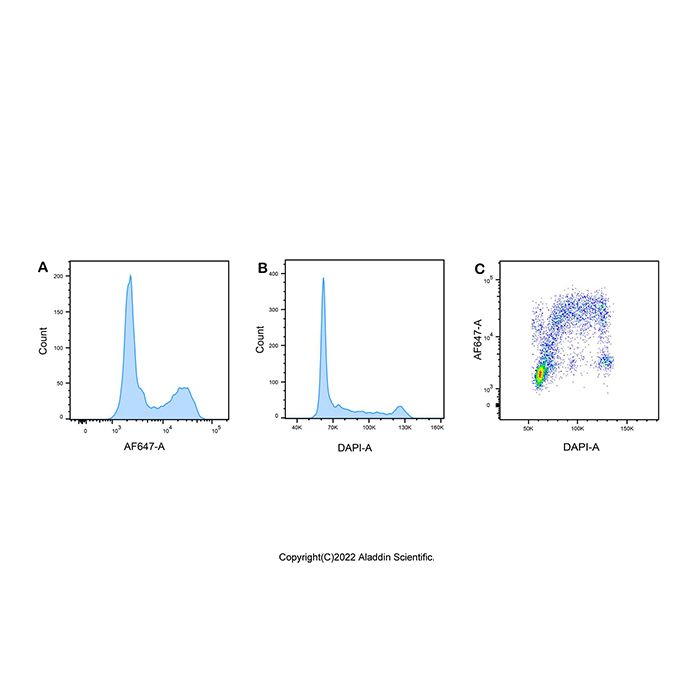
(5) 最后再补加250 μL 含2% FBS 的 PBS 溶液混匀, 上机检测。
Component | Number of samples |
1 | 2 | 4 | 5 | 10 | 25 | 50 |
Click Reaction Buffer | 240 μL | 480 μL | 960 μL | 1200 μL | 2400 μL | 6000 μL | 12000 μL |
CuSO₄ | 5 μL | 10 μL | 20 μL | 25 μL | 50 μL | 125 μL | 250 μL |
Azide 647 | 5 μL | 10 μL | 20 μL | 25 μL | 50 μL | 125 μL | 250 μL |
Click Additive Solution | 250 μL | 500 μL | 1000 μL | 1250 μL | 2500 μL | 6250 μL | 12500 μL |
Total volume | 500 μL | 1000 μL | 2000 μL | 2500 μL | 5000 μL | 12500 μL | 25000 μL |
注意事项
1. 请严格按照上表中组分顺序和体积配制 Click 反应液, 否则会影响后续实验。
2. Click 反应液需在配制后 15 min 内使用。
3.为避免荧光淬灭, 请尽快检测。
Cell proliferation assays are widely used in the evaluation of cell viability, genotoxicity, and the efficacy of antitumor drugs. Direct detection of DNA synthesis in cells is considered the most accurate method for assessing cell proliferation. EdU (5-ethynyl-2′-deoxyuridine) is a novel thymidine (thymine deoxyribonucleoside) analogue. During DNA synthesis, EdU can be incorporated into newly synthesized DNA in place of thymidine. The ethynyl group on EdU can undergo a covalent reaction with fluorescently labeled small-molecule azide probes (such as Azide AF 488, Azide AF 555, Azide AF 594, Azide AF 647, etc.) via Cu(I)-catalyzed click chemistry, forming a stable triazole ring. This reaction is highly efficient and is referred to as the Click reaction. Through this process, newly synthesized DNA is labeled with the corresponding fluorescent probes, enabling the detection of proliferating cells using appropriate fluorescence detection equipment.
E1373493 | Component | 50 T | 100 T | 200 T | Storage conditions | Quantity Per Test |
E1373493A | EdU(10 mM) | 100 μL | 200 μL | 400 μL | -20℃.Store in the dark. | 2 μL per 1.0-2.0x 10⁶ cells |
E1373493B | AF647 azide | 250 μL | 500 μL | 1000 μL | -20℃.Store in the dark. | 5 μL per 1.0-2.0x 10⁶ cells |
E1373493C | Click Reaction Buffer | 12 mL | 24 mL | 48 mL | -20℃.Store in the dark. | 240 μL per 1.0-2.0x 10⁶ cells |
E1373493D | CuSO₄ | 250 μL | 500 μL | 1000 μL | -20℃. | 5 μL per 1.0-2.0x 10⁶ cells |
E1373493E | Click Additive | 991 mg | 1982 mg | 3964 mg | -20℃.Store in the dark. | 250 μL per 1.0-2.0x 10⁶ cells |
E1373493F | DAPI Staining Solution(1000×) | 25 μL | 50 μL | 100 μL | -20℃.Store in the dark. | 0.5 μL per 1.0-2.0x 10⁶ cells |
Note: The recommended number of cells to stain per test is 1.0-2.0x 10⁶ cells. The amount of Click reaction solution can be adjusted according to the experimental samples.
Usage Protocol
1. Preparation
1) Preparation of Click Additive Solution:
For a 50-test kit: Add 12.5 mL of pre-chilled deionized water to the tube. Mix thoroughly until completely dissolved to obtain the Click Additive Solution. For a 100-test kit: Add 25 mL of pre-chilled deionized water to the tube. Mix thoroughly until completely dissolved to obtain the Click Additive Solution. For a 200-test kit: Add 50 mL of pre-chilled deionized water to the tube. Mix thoroughly until completely dissolved to obtain the Click Additive Solution. After preparation, aliquot the solution as needed and store at -20°C. If a white precipitate forms after dissolution, invert the tube repeatedly until it is fully dissolved before use. If the solution turns brown, it indicates degradation of the active component; discard it.
2) Upon initial dissolution of the Click Reaction Buffer, aliquot it according to the number of samples per experiment and store at -20°C.
2. EdU Labeling of Cells
It is recommended to use a final EdU concentration of 10 μM (1×). A 1:500 dilution of EdU (10 mM) in cell culture medium yields a 2× EdU working solution (20 μM). Mix an equal volume of pre-warmed (37°C) 2× EdU working solution (20 μM) with the cell suspension to achieve a final 1× EdU concentration. Incubate in a 37°C, 5% CO₂ incubator. Factors such as cell culture medium, cell density, cell type, and other experimental conditions may affect labeling efficiency. Therefore, the optimal EdU concentration and labeling duration must be empirically determined based on the cell type under investigation.
3. Fixation and Permeabilization
1) Harvest cells and centrifuge at 300 ×g for 5 min. Wash cells twice with PBS containing 2% FBS.
2) Fix cells with 4% paraformaldehyde solution. Mix thoroughly and incubate for 15 min at room temperature protected from light.
3) Collect cells and centrifuge at 300 × g for 5 min. Wash cells twice.
4) Resuspend cells in PBS containing 0.3% Triton X-100. Mix well and incubate for 15 min at room temperature.
5) Centrifuge at 300 × g for 5 min and wash cells twice.
4. Fluorescent Labeling
1) This protocol is based on a 500 μL reaction system per 2 × 10⁶ cells. The volume of the Click reaction mixture can be adjusted according to the experimental sample size.
2) Centrifuge the cells at 300 ×g for 5 minutes. Add 500 μL of Click reaction mixture per sample, mix gently, and incubate for 30 minutes at room temperature protected from light.
3) After the reaction, wash the cells twice with PBS containing 2% FBS.
4) Dilute the DAPI Staining Solution (1000×) to 1× using PBS containing 2% FBS. Add 250 μL of the diluted DAPI solution to each sample and incubate for 5 minutes at room temperature.
5) Add an additional 250 μL of PBS containing 2% FBS, mix gently, and proceed to detection using an appropriate flow cytometry instrument.
Component | Number of samples |
1 | 2 | 4 | 5 | 10 | 25 | 50 |
Click Reaction Buffer | 240 μL | 480 μL | 960 μL | 1200 μL | 2400 μL | 6000 μL | 12000 μL |
CuSO₄ | 5 μL | 10 μL | 20 μL | 25 μL | 50 μL | 125 μL | 250 μL |
Azide 647 | 5 μL | 10 μL | 20 μL | 25 μL | 50 μL | 125 μL | 250 μL |
Click Additive Solution | 250 μL | 500 μL | 1000 μL | 1250 μL | 2500 μL | 6250 μL | 12500 μL |
Total volume | 500 μL | 1000 μL | 2000 μL | 2500 μL | 5000 μL | 12500 μL | 25000 μL |
Precautions
1. Strictly adhere to the component order and volumes specified in the table above when preparing the Click reaction mixture, as deviations may affect subsequent experimental results.
2. The Click reaction mixture must be used within 15 minutes of preparation.
3. To avoid fluorescence quenching, perform detection as soon as possible after sample preparation.

 ZJ26F0231888


 危险品化学品经营许可证(带存储)