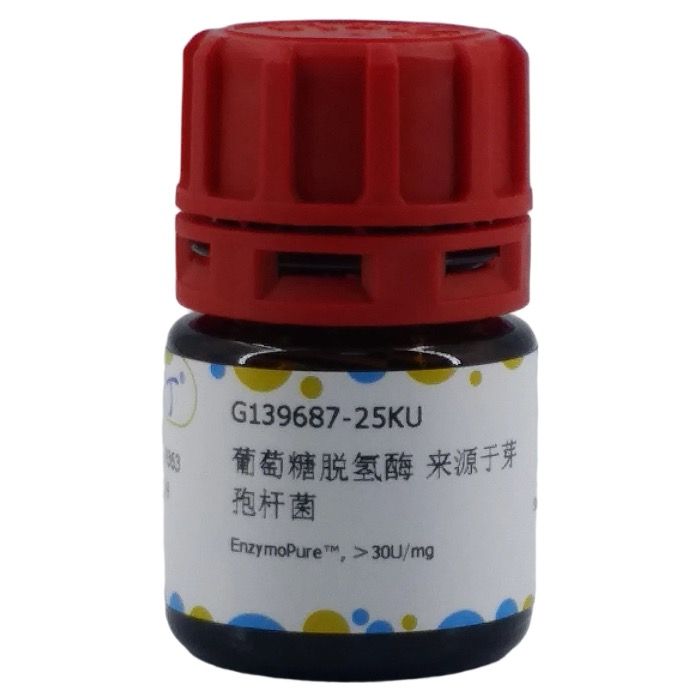
This productis a glucose dehydrogenase preparation manufactured by a unique fermentation process using a selected strain of bacteria.
Glucose Dehydrogenase from Bacillus sp. is an oxidoreductase that uses NAD⁺ as a coenzyme, specifically catalyzes the dehydrogenation of glucose to gluconolactone, and reduces NAD⁺ to NADH. NAD-dependent glucose dehydrogenase exhibits favorable substrate selectivity and stability, and is not affected by oxygen.
ORIGIN : Bacillus sp.
CATALYSIS : β-D-Glucose + NAD(P)⁺ ⇌ D-Glucono-δ-lactone + NAD(P)H + H⁺
SPECIFICATIONS:
Activity: ≥ 30 u/mg
Appearance: White powder, lyophilized
Contaminants: NADH oxidase ≤ 2 × 10⁻³ %; LDH ≤ 2 × 10⁻³ %
Additives: BSA, NaCl
CHARACTERISTICS:
1. Molecular weight: 105,000 (Gel filtration)
2. Isoelectric point: 4.5
3. Km: 0.8×10⁻² M (Glucose); 1.5×10⁻⁴ M (NAD); 4.3×10⁻⁵ M (NADP)
4. Optimum pH: 8.0-9.0
5. pH stability: 5.0-8.0 (40℃, 90 min)
6. Optimum temperature: 50℃
7. Thermal stability: up to 80℃ (pH 7.0, 50 min)
8. Inhibitors: Ag⁺, Hg²⁺
9. Stabilizers: Inorganic salts
10. Application: Used for the enzymatic determination of glucose in serum by coupling with mutarotase in clinical diagnosis.
Expiration (Storage)
24 months from the date of analysis when stored at 5°C or below in a dry place under sealed conditions.
Safe Handling
1. Do not inhale.
2. In case of direct contact with skin or eyes, immediately wash or rinse with plenty of water.
Assay Method of Glucose Dehydrogenase
Principle

The appearance of NADH is measured at 340 nm by spectrophotometry.
Unit Definition
One unit is defined as the enzyme quantity which produces one μ mole of NADH per minute under the conditions described below.
Reagents
A. 0.1M Tris-HCl buffer (pH 8.0)
B. 0.1M Phosphate Buffer (KH₂PO₄-Na₂HPO₄, pH 7.0)
C. Substrate solution
Weigh 6.75 g of glucose and dissolve in deionized water. Fill up to 25 ml with deionized water.
Use Substrate solution at 30 minutes or later after preparation. (Can be used for 2 weeks at room temperature)
D. NAD solution
Weigh 40 mg of β-NAD⁺ and dissolve in 1 ml of deionized water.
(Can be used for 1 week at 2–8℃)
E. Enzyme solution
Weigh some of Glucose Dehydrogenase and dissolve in chilled 0.1 M Phosphate buffer (B).
Enzyme solution should be prepared so that the value of ΔOD/minute becomes in the range of 0.100 ± 0.020.
Procedure
Pipette 2.7 ml of 0.1M Tris-HCl buffer (A), 0.2 ml of Substrate solution (C) and 0.1 ml of NAD solution (D) respectively into a quartz cell (d =10 mm), and keep at 25 ± 0.5℃ for 5 minutes. Then, pipette 0.05 ml of Enzyme solution (E) into the quartz cell and mix well immediately. Keep the reaction mixture at 25 ± 0.5℃. Exactly at 2 minutes and 5 minutes after the addition of Enzyme solution (E), measure the absorbances of the reaction mixture at 340 nm (A2 and A5).
As a blank, pipette 0.1M Phosphate buffer (B) into another quartz cell (d =10 mm) instead of Enzyme solution (E), and take the same procedure described above (Ab2 and Ab5).
Calculation

3: Reaction time
6.22: Millimolar absorption coefficient of NADH at 340 nm
3.05: Volume of the reaction mixture
0.05: Volume of Enzyme solution
n: Dilution factor of Enzyme solution


 H2627052


 危险品化学品经营许可证(带存储)