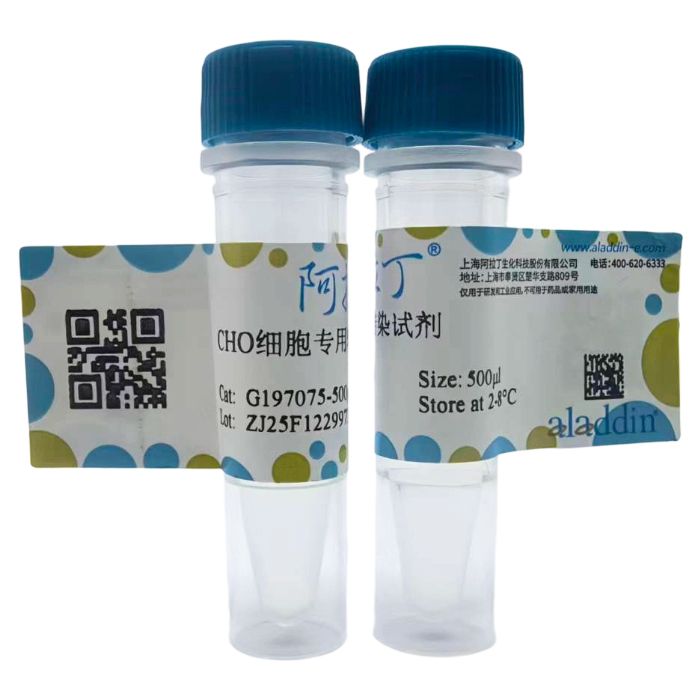
CHO细胞专用转染试剂是⼀款能够有效地将DNA转⼊CHO细胞系的转染试剂。该产品适用于⼤规模蛋白⽣产以及病毒载体⾼效表达, 具有操作简单、表达量⾼、细胞毒性低等优势。产品以⽆菌的液体形式提供。
实验材料:
• 本产品包含CHO细胞专用转染试剂
• ⾼纯度的核酸储液(0.5∼5 μg/μL)
• ⽆⾎清培养基(如 O778393 Optimal-MEM减血清培养基 (含酚红) )
质量控制:
• 4 ℃保存条件下有效期⼀年
• 本产品经严格的质量检验证明,⽆⽣物污染
注意事项:
• 常温下制备 CHO细胞专用转染试剂-核酸复合物,孵育时间共 25 min。转染时使用⽆⾎清培养基(如:O778393 Optimal-MEM减血清培养基 (含酚红) )和灭酶管。
• 利用本产品转染孔板中的细胞4-6 h后,去除原培养基,更换为新鲜含⾎清培养基;利用本产品转染摇瓶培养的悬浮细胞时,⽆需更换培养基。
• 本产品应该在4℃密闭保存,避免反复冻融。
• 初次使用应该优化核酸浓度与CHO细胞专用转染试剂的比例以得到最⾼的转染效率。
• 转染时请使用适当保存和经常传代的健康细胞,并确保培养基⽆细菌、真菌或支原体污染。如细胞是近期复苏的液氮冻存细胞,请在转染前⾄少传代两次。
• 转染试剂使用后请立即盖好盖⼦,避免长时间暴露在空⽓中,影响转染效率。
转染效果示例:

图1. CHO细胞专用转染试剂和竞品在ExipiCHO-S悬浮细胞中递送 pDNA 48 h后的细胞阳性率和绿⾊荧光蛋白表达量 (24孔板,每孔转染1μg EGFP-pDNA)。
按照下表转染细胞。每种反应混合物体积为单个孔的体积,且考虑了移液差异。按比例计算其他孔的体积。
放附件 [G197075] CHO细胞专用转染试剂-中英文步骤表格中,中文表格
CHO细胞专用转染试剂----转染步骤详细说明(以24孔板为例)
1. 将1μg DNA加⼊ 25 μL O778393 Optimal -MEM减血清培养基 (含酚红)中,得到 DNA 稀释液。
2. 将2 μL CHO细胞专用转染试剂加⼊25 μL O778393 Optimal -MEM减血清培养基 (含酚红)中,并静置5min(CHO细胞专用转染试剂的用量可在2 – 4 μL范围内进⾏优化,以寻求最佳转染效果)。
3. 将步骤1中的 DNA 稀释液与步骤2中稀释的CHO细胞专用转染试剂充分混合均匀,室温下孵育20 min。
4. 将孵育好的CHO细胞专用转染试剂–DNA 复合物与450 μL ⽆⾎清培养基混合后加⾄细胞。
5. 37 ℃孵育细胞4-6 h 后,将培养基更换为500 μL新鲜的完全培养基,继续37℃孵育细胞2-4天后分析转染细胞。

CHO细胞专用转染试剂----转染悬浮细胞步骤详细说明 (以125mL培养瓶、30mL培养体系为例)
1. 将30μg DNA用O778393 Optimal -MEM减血清培养基 (含酚红)稀释到 300μL,得到 DNA 稀释液。
2. 将60μL CHO细胞专用转染试剂加⼊240 μL O778393 Optimal -MEM减血清培养基 (含酚红)中,并静置5min(CHO细胞专用转染试剂的用量可在60–120 μL范围内进⾏优化,以寻求最佳转染效果)。
3. 将步骤1中的 DNA 稀释液与步骤2中的 CHO细胞专用转染试剂稀释液充分混合均匀,室温下孵育20 min。
4. 将孵育好的 CHO细胞专用转染试剂–DNA 复合物直接加⼊到细胞培养瓶中,培养过程中的补料⽅案按照悬浮细胞培养说明书中的具体要求进⾏,继续37 ℃孵育细胞5~7天,分析细胞转染情况。

CHO Cell-Specific Transfection Reagent is a transfection reagent that can efficiently deliver DNA into CHO cell lines. This product is suitable for large-scale protein production and high-efficiency expression of viral vectors, with advantages including simple operation, high expression level, and low cytotoxicity. It is supplied as a sterile liquid.
Experimental Materials:
• This product includes the CHO Cell-Specific Transfection Reagent.
• High-purity nucleic acid stock solution (0.5–5 μg/μL).
• Serum-free medium (e.g., O778393 Optimal-MEM Reduced Serum Medium (with Phenol Red) ).
Quality Control:
• The shelf life is 1 year when stored at 4 °C.
• Strict quality inspection has confirmed that this product is free from biological contamination.
Precautions:
• CHO Cell-Specific Transfection Reagent-nucleic acid complex at room temperature, with a total incubation time of 25 minutes. For transfection, use serum-free medium (e.g., O778393 Optimal-MEM Reduced Serum Medium (with Phenol Red)) and enzyme-free tubes.
• After transfecting cells in well plates with this product for 4–6 hours, remove the original medium and replace it with fresh serum-containing medium; when transfecting suspension cells cultured in shake flasks with this product, there is no need to replace the medium.
• This product should be stored tightly sealed at 4 °C, and repeated freezing and thawing should be avoided.
• For first-time use, the ratio of nucleic acid concentration to the CHO Cell-Specific Transfection Reagent should be optimized to achieve the highest transfection efficiency.
• For transfection, use healthy cells that are properly preserved and regularly passaged, and ensure that the medium is free from bacterial, fungal, or mycoplasma contamination. If the cells are cryopreserved cells recently recovered from liquid nitrogen, passage them at least twice before transfection.
• After using the transfection reagent, close the cap immediately to avoid prolonged exposure to air, which may affect transfection efficiency.
Example of transfection effect:

Figure 1. Cell positive rate and green fluorescent protein expression level 48 hours after delivering pDNA in ExipiCHO-S suspension cells using the CHO Cell-Specific Transfection Reagent and competing products (24-well plate, 1 μg of EGFP-pDNA transfected per well).
Transfect cells according to the table below. The volume of each reaction mixture refers to the volume for a single well, with pipetting differences taken into account. Calculate the volumes for other wells in proportion.

CHO Cell-Specific Transfection Reagent----Detailed Instructions for Transfection Steps (Taking 24-well Plate as an Example)
1. Add 1μg of DNA to 25 μL of O778393 Optimal-MEM Reduced Serum Medium (with Phenol Red) to obtain the DNA dilution.
2. Add 2 μL of CHO Cell-Specific Transfection Reagent to 25 μL of O778393 Optimal-MEM Reduced Serum Medium (with Phenol Red), and let it stand for 5 minutes. (The dosage of CHO Cell-Specific Transfection Reagent can be optimized within the range of 2–4 μL to achieve the best transfection effect.)
3. Thoroughly mix the DNA dilution from Step 1 with the diluted CHO Cell-Specific Transfection Reagent from Step 2, and incubate at room temperature for 20 minutes.
4. Mix the incubated CHO Cell-Specific Transfection Reagent-DNA complex with 450 μL of serum-free medium, then add the mixture to the cells.
5. After incubating the cells at 37°C for 4-6 hours, replace the medium with 500 μL of fresh complete medium. Continue incubating the cells at 37°C for 2-4 days before analyzing the transfected cells.

CHO Cell-Specific Transfection Reagent----Detailed Instructions for Transfecting Suspension Cells (Taking a 125mL Culture Flask and 30mL Culture System as Examples)
1. Dilute 30 μg of DNA to a total volume of 300 μL using O778393 Optimal-MEM Reduced Serum Medium (with Phenol Red) to obtain the DNA dilution.
2. Add 60 μL of CHO Cell-Specific Transfection Reagent to 240 μL of O778393 Optimal-MEM Reduced Serum Medium (with Phenol Red), and let it stand for 5 minutes. (The dosage of CHO Cell-Specific Transfection Reagent can be optimized within the range of 60–120 μL to achieve the best transfection effect.)
3. Thoroughly mix the DNA dilution from Step 1 with the diluted CHO Cell-Specific Transfection Reagent from Step 2, and incubate at room temperature for 20 minutes.
4. Directly add the incubated CHO Cell-Specific Transfection Reagent-DNA complex into the cell culture flask. Follow the specific requirements in the Suspension Cell Culture Instruction Manual for the feeding protocol during the culture process. Continue incubating the cells at 37°C for 5–7 days, then analyze the cell transfection status.


 ZJ25F1229973


 危险品化学品经营许可证(带存储)