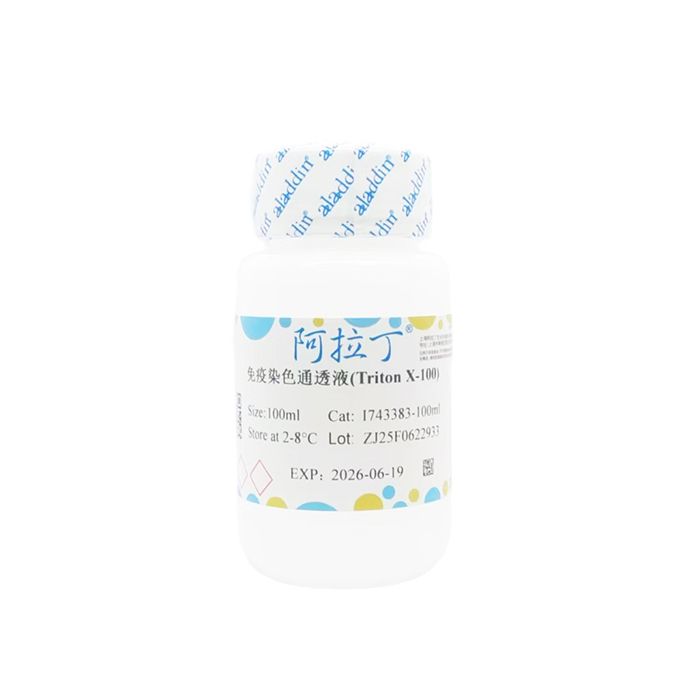
免疫染色通透液(Triton X-100)(Immunostaining Permeabilization Buffer with Triton X-100,也称 Immunostaining Permeabilization Solution with Triton X-100),可以用于免疫染色等多种原位检测时细胞样品、冰冻或石蜡切片的通透处理,有助于暴露抗原、核酸等作用靶点,使抗体、探针或标记物等更容易进入细胞内,从而确保染色等的检测效果。本产品为即用型工作液,可以直接使用,无需稀释。
本产品通透能力较强,推荐用于各种常规的免疫荧光、免疫组化、免疫细胞化学、流式检测等中细胞的通透。对于通透效果要求不高的情况,也可以使用免疫染色洗涤液,对于需要检测细胞膜蛋白的情况推荐使用免疫染色通透液(Saponin)。对于通透要求比较高的情况,可以使用免疫染色强力通透液。对于凝集素(lectin)的检测推荐使用本产品或免疫染色强力通透液。
通透液通常可以通过使用有机溶剂例如甲醇、丙酮等,或者使用去垢剂例如Triton X-100、Saponin等来实现对于细胞膜的通透。甲醇或丙酮等有机溶剂,一方面可以溶解细胞膜和核膜从而充分暴露细胞浆和细胞核中的目的蛋白等,另一方面也可以使细胞内的蛋白变性起到固定的作用。甲醇或丙酮等有机试剂操作比较简单,一步处理可以同时实现固定和通透,缺点是膜蛋白也会被溶解掉并且有些蛋白变性后不利于后续的检测,因此有机溶剂使用相对较少,仅用于一些要求比较粗糙的检测。Triton X-100是常用的通透试剂,可以通透细胞膜和核膜,作用的原理也是非特异性的溶解细胞膜,因此其缺点是不利于膜蛋白的检测,但当使用多聚甲醛进行交联和固定后,相当一部分膜蛋白会被交联固定,从而不会被Triton X-100溶解, 因此后续仍然能检测到。Saponin可以特异性地溶解细胞膜中的胆固醇,从而实现在细胞膜上选择性地打孔,其优点是适合于细胞膜蛋白的检测,特别适合通过流式细胞仪检测细胞膜上的标志性蛋白,缺点是对于一些胆固醇含量低的细胞通透效果差,通透效果弱于Triton X-100和有机溶剂,并且不能通透胆固醇含量很低的核膜和线粒体膜。对于凝集素(lectin)的检测,含Triton X-100等非特异性去垢剂的通透液的效果显著优于主要含Saponin的通透液。
本免疫染色通透液(Triton X-100)中含有Triton X-100等去垢剂,配制在PBS中。经本免疫染色通透液(Triton X-100)处理的样品,对于细胞浆或细胞核内目的蛋白的免疫染色检测结果表明,染色效果与常规的通透液相比基本一致或略有增强。
按照每个样品需要0.1或1毫升免疫染色通透液(Triton X-100)计算,一个100ml包装的本产品可以通透1000个或100个样品,一个500ml包装的本产品可以通透5000个或500个样品。
使用方法
1、 对于切片,在固定、洗涤结束后,每样滴50-100μl免疫染色通透液(Triton X-100),也可以在染色缸中完全浸没进行通透。对于细胞样品,在固定、洗涤结束后,按照六孔板每孔加入1毫升免疫染色通透液(Triton X-100),其它多孔板参考该比例加入。对于其它样品,加入免疫染色通透液(Triton X-100)的量以充分盖住样品为准。
2、 通常在免疫染色通透液(Triton X-100)中室温孵育5-10分钟,即可完成通透。对于较难通透的样品或者要求通透特别充分的情况,可以在免疫染色通透液(Triton X-100)中室温孵育10-30分钟。
注意事项
1、 尽量减少反复冻融的次数,以免失效。
2、 为了您的安全和健康,请穿好实验服并佩戴一次性手套和口罩操作。
3、 本产品仅限于专业人员的科学研究用,不得用于临床诊断或治疗,不得用于食品或药品,不得存放于普通住宅内。
Immunostaining Permeation Buffer with Triton X-100 (also known as Triton X-100) Immunostaining Permeabilization Solution with Triton X-100), It can be used for permeabilization treatment of cell samples, frozen or paraffin sections during various in situ detections such as immunostaining, which helps to expose targets such as antigens and nucleic acids, making it easier for antibodies, probes or markers to enter the cell, thereby ensuring the detection effect of staining. This product is a ready to use working fluid that can be used directly without dilution.
This product has strong permeability and is recommended for various conventional cell permeabilization methods such as immunofluorescence, immunohistochemistry, immunohistochemistry, and flow cytometry. For situations where high transparency is not required, immunostaining wash solution can also be used. For situations where cell membrane proteins need to be detected, it is recommended to use immunostaining wash solution (Saponin). For situations with high transparency requirements, immunostaining strong permeability solution can be used. For the detection of lectin, it is recommended to use this product or immunostaining strong penetration solution.
Permeation of cell membranes can usually be achieved by using organic solvents such as methanol, acetone, etc., or by using detergents such as Triton X-100, Saponin, etc. Organic solvents such as methanol or acetone can dissolve the cell membrane and nuclear membrane, fully exposing the target proteins in the cytoplasm and nucleus. On the other hand, they can also denature and fix the proteins inside the cell. Organic reagents such as methanol or acetone are relatively simple to operate, and can achieve both fixation and permeability in one step. However, the disadvantage is that membrane proteins can also be dissolved and some proteins may denature, which is not conducive to subsequent detection. Therefore, organic solvents are used relatively less and are only used for rough detection requirements. Triton X-100 is a commonly used permeabilizing reagent that can penetrate cell membranes and nuclear membranes. Its principle of action is also non-specific dissolution of cell membranes, so its disadvantage is that it is not conducive to the detection of membrane proteins. However, when using polyformaldehyde for cross-linking and fixation, a considerable portion of membrane proteins will be cross-linked and fixed, and will not be dissolved by Triton X-100, so they can still be detected in the future. Saponin can specifically dissolve cholesterol in the cell membrane, thereby selectively punching holes on the cell membrane. Its advantage is that it is suitable for detecting cell membrane proteins, especially for detecting marker proteins on the cell membrane through flow cytometry. The disadvantage is that it has poor permeability for some cells with low cholesterol content, weaker than Triton X-100 and organic solvents, and cannot penetrate nuclear and mitochondrial membranes with low cholesterol content. For the detection of lectin, the effect of permeate containing non-specific detergents such as Triton X-100 is significantly better than that of permeate mainly containing Saponin.
This immunostaining permeabilization solution (Triton X-100) contains detergents such as Triton X-100, prepared in PBS. The immunostaining results of the target protein in the cytoplasm or nucleus of the sample treated with Triton X-100 showed that the staining effect was basically consistent or slightly enhanced compared to conventional permeabilization solution.
According to the requirement of 0.1 or 1 milliliter of immunostaining permeabilization solution (Triton X-100) for each sample, a 100ml package of this product can permeabilize 1000 or 100 samples, and a 500ml package of this product can permeabilize 5000 or 500 samples.
Usage
1. For slicing, after fixation and washing, drop 50-100 μ l of immunostaining permeabilization solution (Triton X-100) per sample, or completely immerse it in a staining tank for permeabilization. For cell samples, after fixation and washing, 1 milliliter of immunostaining permeabilization solution (Triton X-100) was added to each well of a six well plate, while other well plates were added according to this ratio. For other samples, the amount of immunostaining permeabilization solution (Triton X-100) added should be sufficient to cover the sample.
2. Usually, the permeabilization can be completed by incubating at room temperature in immunostaining permeabilization medium (Triton X-100) for 5-10 minutes. For samples that are difficult to permeabilize or require particularly sufficient permeabilization, they can be incubated at room temperature in immunostaining permeabilization solution (Triton X-100) for 10-30 minutes.
precautions
1. Try to minimize the number of repeated freeze-thaw cycles to avoid failure.
2. For your safety and health, please wear lab clothes and disposable gloves and masks during operation.
3. This product is only for scientific research by professionals and should not be used for clinical diagnosis or treatment, food or medicine, or stored in ordinary residential areas.

 ZJ25F1129527


 危险品化学品经营许可证(带存储)