The most powerful of the lysosomal proteases. It has a higher specific activity than cathepsin B and H in the degradation of a variety of physiological protein substrates. The level of cathepsin L is a strong predictor of relapse and survival following treatment of a primary breast tumor.
Activity: > 1 unit/mg of protein. One unit is defined as the amount of enzyme that hydrolyzes one micromole of Z-Phe-Arg-AFC per minute at 25°C using 400 mM Na Acetate, pH 5.5 with 4 mM EDTA and 8 mM DTT as the activation buffer in the presence of Brij.
Prepared from tissue shown to be non reactive for HBsAg, anti-HCV, anti-HBc, and negative for anti-HIV 1 & 2 by FDA-required tests.
Thiol protease important for the overall degradation of proteins in lysosomes (Probable). Plays a critical for normal cellular functions such as general protein turnover, antigen processing and bone remodeling. Involved in the solubilization of cross-linked TG/thyroglobulin and in the subsequent release of thyroid hormone thyroxine (T4) by limited proteolysis of TG/thyroglobulin in the thyroid follicle lumen (By similarity). In neuroendocrine chromaffin cells secretory vesicles, catalyzes the prohormone proenkephalin processing to the active enkephalin peptide neurotransmitter (By similarity). In thymus, regulates CD4+ T cell positive selection by generating the major histocompatibility complex class II (MHCII) bound peptide ligands presented by cortical thymic epithelial cells. Also mediates invariant chain processing in cortical thymic epithelial cells (By similarity). Major elastin-degrading enzyme at neutral pH. Accumulates as a mature and active enzyme in the extracellular space of antigen presenting cells (APCs) to regulate degradation of the extracellular matrix in the course of inflammation (By similarity). Secreted form generates endostatin from COL18A1. Critical for cardiac morphology and function. Plays an important role in hair follicle morphogenesis and cycling, as well as epidermal differentiation (By similarity). Required for maximal stimulation of steroidogenesis by TIMP1 (By similarity). (Microbial infection) In cells lacking TMPRSS2 expression, facilitates human coronaviruses SARS-CoV and SARS-CoV-2 infections via a slow acid-activated route with the proteolysis of coronavirus spike (S) glycoproteins in lysosome for entry into host cell. Proteolysis within lysosomes is sufficient to activate membrane fusion by coronaviruses SARS-CoV and EMC (HCoV-EMC) S as well as Zaire ebolavirus glycoproteins. Isoform 2: Functions in the regulation of cell cycle progression through proteolytic processing of the CUX1 transcription factor. Translation initiation at downstream start sites allows the synthesis of isoforms that are devoid of a signal peptide and localize to the nucleus where they cleave the CUX1 transcription factor and modify its DNA binding properties. Catalytic activity: Specificity close to that of papain. As compared to cathepsin B, cathepsin L exhibits higher activity toward protein substrates, but has little activity on Z-Arg-Arg-NHMec, and no peptidyl-dipeptidase activity. Activity regulation: Inhibited by the propeptide produced by autocleavage. Long isoform of CD74/Ii chain stabilizes the conformation of mature CTSL by binding to its active site and serving as a chaperone to help maintain a pool of mature enzyme in endocytic compartments and extracellular space of APCs. IFNG enhances the conversion into the CTSL mature and active form (By similarity). Inhibited by CST6. Inhibited by the glycopeptide antibiotic teicoplanin. Inhibited by amantadine. pH Dependence: canonical. Optimum pH is 5.5, also active at pH 7.0 with CUX1 as substrate.
Post-translational: During export along the endocytic pathway, pro-CTSL undergoes several proteolytic cleavages to generate the CTSL single-chain and two-chain mature forms, composed of a heavy chain linked to a light chain by disulfide bonds (By similarity). Autocleavage; produces the single-chain CTSL after cleavage of the propeptide. The cleavage can be intermolecular.
生物活性
≥1 U/mg protein
种属
人(Human)
来源
天然
预测分子量
25-29 kDa
CAS编号和信息
60616-82-2
酶学委员会编号
EC 3.4.22.15
分子类型
酶
产品线
生物产品
储存与运输
物理形态
液体
储存缓冲液
20 mM Malonate, 400 mM NaCl, 1 mM EDTA, pH 5.5.
浓度
≥1 U/mg protein;蛋白浓度: 见COA
储存条件
-80℃储存,避免反复冻融
运输条件
特低温运输
稳定性与储存
长期储存-80℃(大于1 年);收货后建议分装,避免反复冻融。
单位定义
One unit is defined as the amount of enzyme that hydrolyzes 1 μmolof Z-Phe-Arg-AFC per minute at 25 °C using 400 mM sodium acetate, pH 5.5 with 4 mM EDTA, and 8 mM DTT as the activation buffer in the presence of Brij.

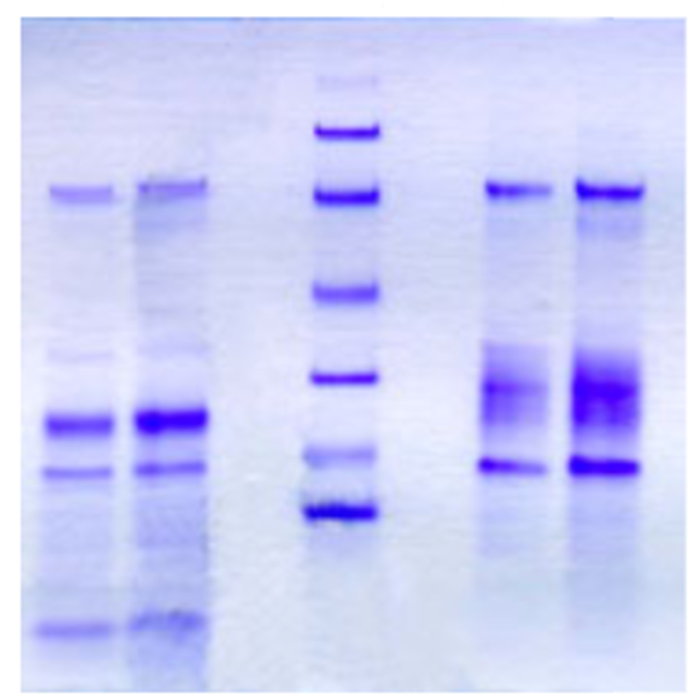
 ZJ26F1039718


 危险品化学品经营许可证(带存储)