
计算溶液所需的质量、体积或浓度。
Plus血浆低丰度蛋白富集试剂盒
有货
BioReagent,无菌,蛋白组学级 ,适用于对基线干扰要求严格的色谱和分析工作流程。
2-8°C储存,室温。低温运输 。请查阅批次 COA 获取详细规格。
SDS、COA、产品数据表及规格说明书均可下载。可通过批号查询获取批次 COA。
在色谱分析、有机合成和交叉偶联反应领域已被 0 篇同行评审文献引用。
血液样本是临床研究中重要的生物信息来源,血液中含有来自多个组织器官的循环蛋白,参与广泛的生物过程,可用作生物标志物或药物靶标。而血液样本存在蛋白种类复杂、动态范围大、高丰度蛋白占比高等问题,这为蛋白质组检测带了巨大的困难。该试剂盒基于免疫磁珠捕获的方法,对血浆样本中的循环蛋白进行富集,在下游的蛋白组学检测中能够降低高丰度蛋白对低丰度蛋白信号覆盖的作用,从而提高低丰度蛋白的信号强度,提升蛋白鉴定数量和定量的重复性。
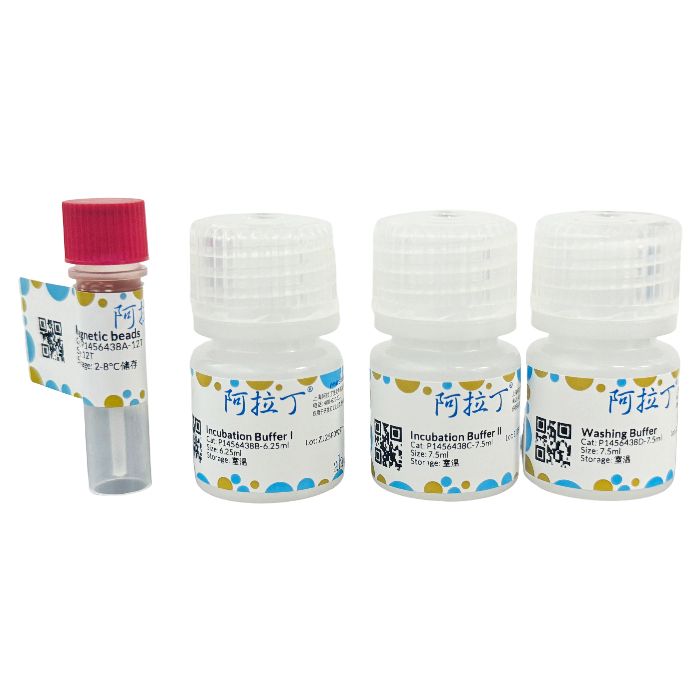
产品组分及储存条件:
| 项目号 | Component | 12T | 24T | 48T | Storage |
| P1456438A | Magnetic beads | 12T | 24T | 48T | 4℃ |
| P1456438B | Incubation Buffer I | 6.25 mL | 12.5 mL | 25 mL | RT |
| P1456438C | Incubation Buffer II | 7.5 mL | 15 mL | 30 mL | RT |
| P1456438D | Washing Buffer | 7.5 mL | 15 mL | 30 mL | RT |
产品特点:
更高:血浆蛋白的检测深度提升至6000+。
更稳:搭配自动化前处理仪器,减少人工操作误差,一次性可处理96个样本。
更值:合作广泛,实现性能提升与成本效益的双重优化。
操作流程:
1.血浆样本离心 (3000g, 10min),取上清备用 (如需保存请置于-80°C条件下长期保存,避免反复冻融)。
2.取50-100μL离心后的血浆,加入400μL的Incubation buffer I,再加入30μL的Magnetic beads,涡旋混匀,置于震荡混匀仪室温孵育1h。
3.孵育结束后,用磁力架磁吸3min,弃上清。
4.取下Ep管,加入500μL Incubation buffer II,轻柔上下颠倒混匀多次,磁吸3min,弃上清。
5.取下Ep管,加入500μL Washing Buffer,轻柔上下颠倒混匀多次,磁吸3min,弃上清。
6.将步骤5得到的beads,加入50μL蛋白裂解液 (P1408622)。
7.按照实验室常规的蛋白组学前处理步骤处理即可,或者选用我司蛋白组学前处理试剂盒 (P1456469) (需另行采购) 进行处理。
注意事项:
1.磁珠静置后会沉淀,每次使用磁珠前请温和、充分的震荡,使磁珠保持均匀的悬浮状态。
2.磁珠保存及使用过程中应避免冷冻、干燥和高速离心等操作,否则会破坏磁珠结构,影响蛋白结合能力。
3.本产品仅限于专业人员的科学研究使用,不得用于临床诊断或治疗,不得用于食品或药品。
Product Introduction:
Blood samples are an important source of biological information in clinical research. They contain circulating proteins from multiple tissues and organs, which are involved in a wide range of biological processes and can be used as biomarkers or drug targets. However, blood samples have problems such as complex types of proteins, a large dynamic range, and a high proportion of high-abundance proteins, which bring great difficulties to proteome detection. This kit enriches circulating proteins in plasma samples based on the immunomagnetic bead capture method. In downstream proteomics detection, it can reduce the coverage of low-abundance protein signals by high-abundance proteins, thereby increasing the signal intensity of low-abundance proteins and improving the number of identified proteins and the repeatability of quantification.
Product Components and Storage Conditions:
| 项目号 | Component | 12T | 24T | 48T | Storage |
| P1456438A | Magnetic beads | 12T | 24T | 48T | 4℃ |
| P1456438B | Incubation Buffer I | 6.25 mL | 12.5 mL | 25 mL | RT |
| P1456438C | Incubation Buffer II | 7.5 mL | 15 mL | 30 mL | RT |
| P1456438D | Washing Buffer | 7.5 mL | 15 mL | 30 mL | RT |
Product Features:
Higher: The detection depth of plasma proteins is increased to over 6000.
More stable: Combined with automated pretreatment instruments, it reduces manual operation errors and can process 96 samples at one time.
More valuable: With extensive cooperation, it achieves dual optimization of performance improvement and cost-effectiveness.
Operating Procedure:
1.Centrifuge the plasma sample (3000g, 10min), and take the supernatant for later use (if storage is needed, store it at -80°C for long-term preservation to avoid repeated freezing and thawing).
2.Take 50-100μL of centrifuged plasma, add 400μL of Incubation buffer I, then add 30μL of Magnetic beads, vortex to mix, and incubate at room temperature on a shaking mixer for 1h.
3.After incubation, use a magnetic rack to magnetically attract for 3min, and discard the supernatant.
4.Remove the EP tube, add 500μL of Incubation buffer II, gently invert up and down to mix several times, magnetically attract for 3min, and discard the supernatant.
5.Remove the EP tube, add 500μL of Washing Buffer, gently invert up and down to mix several times, magnetically attract for 3min, and discard the supernatant.
6.Add 50μL of Protein Lysis Buffer (P1408622) to the beads obtained in step 5.
7.It can be processed according to the conventional proteomics pretreatment steps in the laboratory, or our Proteomics Pretreatment Kit (P1456469) (to be purchased separately) can be used for processing.
Precautions:
1.Magnetic beads will precipitate after standing. Please shake gently and thoroughly before each use to keep the magnetic beads in a uniform suspension state.
2.During the storage and use of magnetic beads, operations such as freezing, drying and high-speed centrifugation should be avoided, as they may damage the structure of magnetic beads and affect their protein-binding ability.
3.This product is limited to scientific research use by professionals, and must not be used for clinical diagnosis or treatment, nor for food or drugs.
通过匹配包装上的批号来查找并下载产品的 COA,每批产品都进行了严格的验证,您可放心使用!
| 批号(Lot Number) | 证书类型 | 货号 |
|---|---|---|
 ZJ25F0927200 |
分析证书 | P1456438 |
| ZJ25F0927199 |
分析证书 | P1456438 |
我们的级别选择指南涵盖了目录中所有的变体的纯度、稳定剂状态和应用适用性。
查看 BioReagent 级别指南 → 查看 Proteomics grade 级别指南 → 查看 Sterile 级别指南 →

 危险品化学品经营许可证(带存储)