
计算溶液所需的质量、体积或浓度。
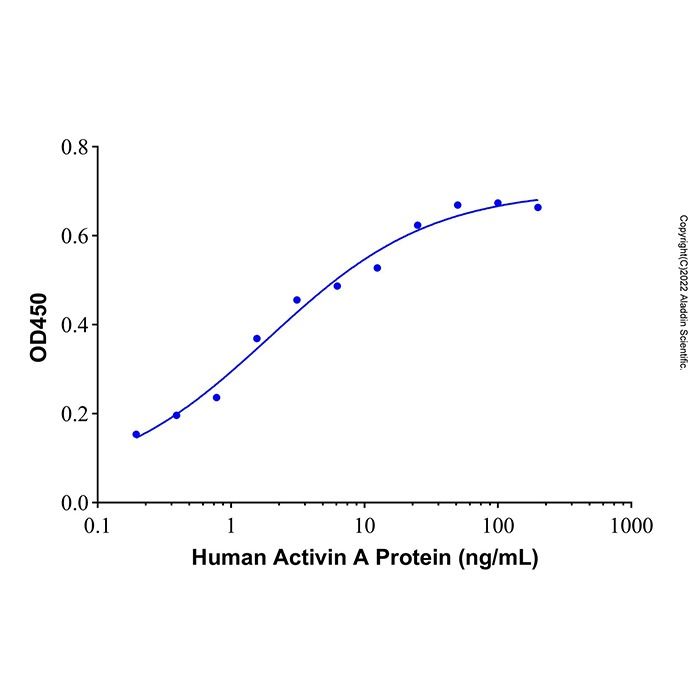
Recombinant Human Activin A Protein (rp142493) - Protein Bioactivity
Measured by its ability to induce hemoglobin expression in K562 human chronic myelogenous leukemia cells. The ED50 for this effect is 2.87 ng/mL.
ActiBioPure™,His标签,无动物源,无叠氮钠,无载体,生物活性,高性能 级 提供 ≥95%(SDS-PAGE) 纯度,适用于对基线干扰要求严格的色谱和分析工作流程。
-20°C储存,避免反复冻融。超低温运输 。请查阅批次 COA 获取详细规格。
SDS、COA、产品数据表及规格说明书均可下载。可通过批号查询获取批次 COA。
在色谱分析、有机合成和交叉偶联反应领域已被 0 篇同行评审文献引用。
Purity
≥95% (SDS-PAGE)
Endotoxin level
<0.1 EU/μg
Function
Activin and Inhibin are members of the TGF-beta superfamily of cytokines and are involved in a wide range of biological processes including tissue morphogenesis and repair, fibrosis, inflammation, neural development, hematopoiesis, reproductive system function, and carcinogenesis. Activin and Inhibin are produced as precursor proteins. Their amino terminal propeptides are proteolytically cleaved and facilitate formation of disulfide-linked dimers of the bioactive proteins. Activins are nonglycosylated homodimers or heterodimers of various beta subunits ( beta A, beta B, beta C, and beta E in mammals), while Inhibins are heterodimers of a unique alpha subunit and one of the beta subunits. Activin A is a widely expressed homodimer of two beta A chains. The beta A subunit can also heterodimerize with a beta B or beta C subunit to form Activin AB and Activin AC, respectively. The 14 kDa mature human beta A chain shares 100% amino acid sequence identity with bovine, feline, mouse, porcine, and rat beta A. Activin A exerts its biological activities by binding to the type 2 serine/threonine kinase Activin RIIA which then noncovalently associates with the type 1 serine/threonine kinase Activin RIB/ALK-4. Signaling through this receptor complex leads to Smad activation and regulation of activin-responsive gene transcription. The bioactivity of Activin A is regulated by a variety of mechanisms. BAMBI, Betaglycan, and Cripto are cell‑associated molecules that function as decoy receptors or limit the ability of Activin A to induce receptor complex assembly. The intracellular formation of Activin A can be prevented by the incorporation of the beta A subunit into Activin AC or Inhibin A. And the bioavailability of Activin A is restricted by its incorporation into inactive complexes with alpha 2-Macroglobulin, Follistatin, and FLRG. Activin A is involved in the differentiation of various cell and tissue types. The induction of definitive endoderm by Activin A is required in differentiation protocols of induced pluripotent stem cells (iPSCs). In vitro models of human gametogenesis use prolonged Activin A supplementation to human embryonic stem cells for differentiation into human primordial germ cell-like cells. Activin A can also be used to maintain cells in vitro, as is the case for iPSC-derived nephron cells that can then be used in disease modeling, drug screening and in regenerative medicine. Activin A is an important factor for tumor cells to evade the immune system as Activin A can act on surrounding immune cells to decrease their antitumor activity. Activin A also promotes migration and growth of tumors, making it a target for cancer therapies. Specifically, research has shown that interfering with Activin A activity can assist in overcoming CD8 T-cell exclusion and immunotherapy resistance. In bone marrow-derived stem cell transplants for treatment of diabetes, Activin A enhances migration and homing of stem cells towards pancreatic lineage.
Recombinant Human Activin A Protein (rp142493) - Protein Bioactivity
Measured by its ability to induce hemoglobin expression in K562 human chronic myelogenous leukemia cells. The ED50 for this effect is 2.87 ng/mL.
Recombinant Human Activin A Protein (rp142493) - SDS-PAGE
3 μg/lane of Recombinant Human Activin A Protein was resolved with SDS-PAGE under reducing (R) and non-reducing (N) conditions and visualized by Coomassie® Blue staining, showing the band at 13 - 16 kDa (mature) and 39 - 46 kDa (precursor) under reducing condition. Under non-reducing conditions, the migration rate of the mature protein is 27 kDa, and the migration rate of the precursor protein is 39 - 46 kDa, and there may also be a migration rate of 55 - 65 kDa (indicating the combination of the precursor and mature forms). These changes in migration rate are mainly due to the effects of glycosylation and interchain disulfide bonds.
通过匹配包装上的批号来查找并下载产品的 COA,每批产品都进行了严格的验证,您可放心使用!
| 批号(Lot Number) | 证书类型 | 货号 |
|---|---|---|
 ZJ24F1113619 |
分析证书 | rp142493 |
| ZJ24F1113620 |
分析证书 | rp142493 |
| ZJ24F1113621 |
分析证书 | rp142493 |
我们的级别选择指南涵盖了目录中所有的变体的纯度、稳定剂状态和应用适用性。
查看 Animal Free 级别指南 → 查看 Carrier Free 级别指南 → 查看 Bioactive 级别指南 → 查看 ActiBioPure™ 级别指南 → 查看 Azide Free 级别指南 → 查看 High Performance 级别指南 → 查看 His Tag 级别指南 →

 危险品化学品经营许可证(带存储)