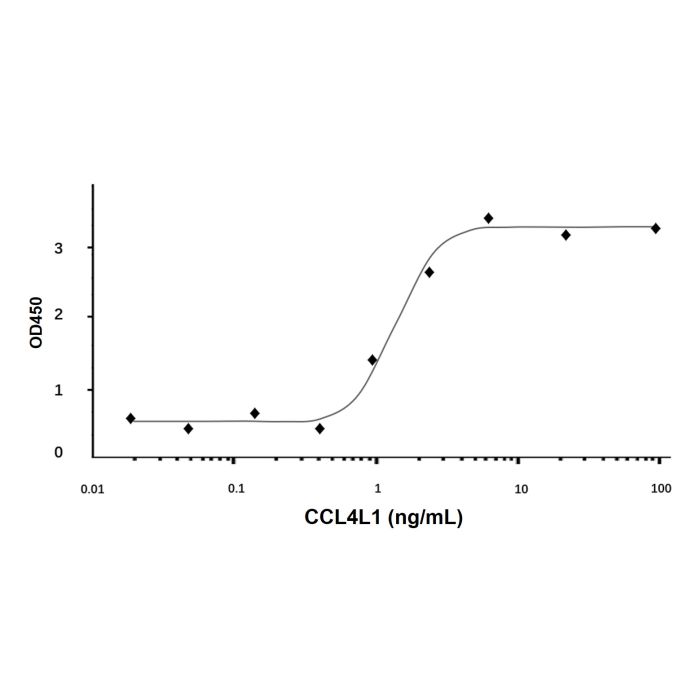
Fully biologically active when compared to standard. The ED50 as determined by a cell proliferation assay using human CCR5 transfected murine BaF3 cells is less than 2.0 ng/ml, corresponding to a specific activity of > 5.0 × 10⁵ IU/mg.
Function: Chemokine that induces chemotaxis of cells expressing CCR5 or CCR1. Inhibits HIV replication in peripheral blood monocytes that express CCR5.
Background: CCL4, also known as MIP-1 beta, is a 12 kDa beta chemokine that is secreted by activated leukocytes, lymphocytes, vascular endothelial cells, and pulmonary smooth muscle cells. CCL4 interacts with CCR5 to attract lymphocytes, NK cells, and immature dendritic cells to sites of inflammation. CCL4 also blocks the entry of HIV into CCR5-expressing cells. Human CCL4 and its variants are encoded by two paralogous genes, one of which (SCYA4) encodes CCL4 itself. The other gene (SCYA4L) is found in two alleles that give rise to CCL4L1 and CCL4L2, respectively. The human CCL4L1 cDNA encodes a 92 amino acid (aa) precursor with a 23 aa signal sequence. Alternate splicing yields an isoform with a 40 aa internal deletion. The second allele (SCYA4L2), encoding CCL4L2, is spliced into a variety of isoforms. Human CC4L1 shares greater than 98% aa sequence identity with CCL4 and CCL4L2. It shares 96% aa sequence identity with rhesus CCL4 and approximately 80 - 90% aa sequence identity with bovine, mouse, rabbit, and rat CCL4. The gene copy number for CCL4L1 varies from zero to five, but this is not associated with changes in mRNA or protein levels. CCL4 and CCL4L1 demonstrate comparable CCR5 binding, promotion of chemotaxis, and inhibition of HIV replication in stimulated PBMC. In vivo, the first two N-terminal amino acids of CCL4 are removed by DPPIV. The truncated form is as active as full-length CCL4 and gains the ability to bind CCR1 and CCR2b. Similar proteolytic processing of CCL4L1 has not been described.
Fully biologically active when compared to standard. The ED50 as determined by a cell proliferation assay using human CCR5 transfected murine BaF3 cells is less than 2.0 ng/ml, corresponding to a specific activity of > 5.0 × 10⁵ IU/mg.
Lyophilized from a 0.2 μm filtered concentrated solution in PBS.
复溶
We recommend that this vial be briefly centrifuged prior to opening to bring the contents to the bottom. Reconstitute in sterile distilled water or aqueous buffer containing 0.1 % BSA to a concentration of 1.0 mg/mL. Stock solutions should be apportioned into working aliquots and stored at ≤ -20 °C. Further dilutions should be made in appropriate buffered solutions with a NaCl concentration no less than 300 mM.
Recombinant Human CCL4L1 Protein (rp143752)-Protein Bioactivity Fully biologically active when compared to standard. The ED50 as determined by a cell proliferation assay using human CCR5 transfected murine BaF3 cells is less than 2.0 ng/mL, corresponding to a specific activity of > 5.0 × 10⁵ IU/mg.
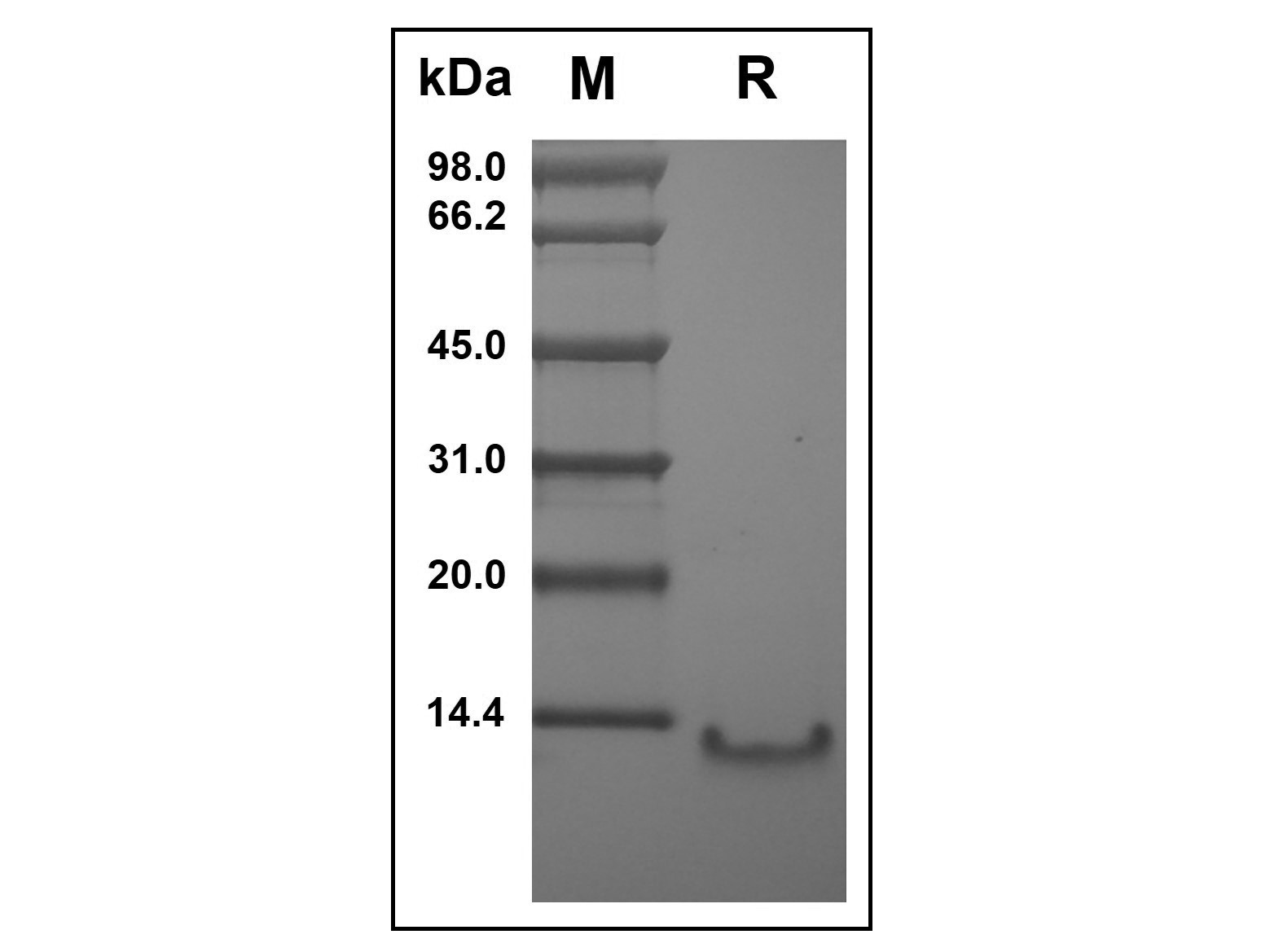
Recombinant Human CCL4L1 Protein (rp143752)-SDS-PAGE Recombinant Human CCL4L1 Protein was resolved with SDS-PAGE under reducing (R) and visualized by Coomassie® Blue staining. Showing a single band at 7.8 kDa.

 ZJ23F0700619


 危险品化学品经营许可证(带存储)