Effector cytokine of innate and adaptive immune system involved in antimicrobial host defense and maintenance of tissue integrity. Signals via IL17RA-IL17RC heterodimeric receptor complex, triggering homotypic interaction of IL17RA and IL17RC chains with TRAF3IP2 adapter. This leads to downstream TRAF6-mediated activation of NF-kappa-B and MAPkinase pathways ultimately resulting in transcriptional activation of cytokines, chemokines, antimicrobial peptides and matrix metalloproteinases, with potential strong immune inflammation. Plays an important role in connecting T cell-mediated adaptive immunity and acute inflammatory response to destroy extracellular bacteria and fungi. As a signature effector cytokine of T-helper 17 cells (Th17), primarily induces neutrophil activation and recruitment at infection and inflammatory sites (By similarity). In airway epithelium, mediates neutrophil chemotaxis via induction of CXCL1 and CXCL5 chemokines (By similarity). In secondary lymphoid organs, contributes to germinal center formation by regulating the chemotactic response of B cells to CXCL12 and CXCL13, enhancing retention of B cells within the germinal centers, B cell somatic hypermutation rate and selection toward plasma cells (By similarity). Effector cytokine of a subset of gamma-delta T cells that functions as part of an inflammatory circuit downstream IL1B, TLR2 and IL23A-IL12B to promote neutrophil recruitment for efficient bacterial clearance (By similarity). Effector cytokine of innate immune cells including invariant natural killer cell (iNKT) and group 3 innate lymphoid cells that mediate initial neutrophilic inflammation (By similarity). Involved in the maintenance of the integrity of epithelial barriers during homeostasis and pathogen infection. Upon acute injury, has a direct role in epithelial barrier formation by regulating OCLN localization and tight junction biogenesis (By similarity). As part of the mucosal immune response induced by commensal bacteria, enhances host's ability to resist pathogenic bacterial and fungal infections by promoting neutrophil recruitment and antimicrobial peptides release (By similarity). In synergy with IL17F, mediates the production of antimicrobial beta-defensins DEFB1, DEFB103A, and DEFB104A by mucosal epithelial cells, limiting the entry of microbes through the epithelial barriers (By similarity). Involved in antiviral host defense through various mechanisms (By similarity). Enhances immunity against West Nile virus by promoting T cell cytotoxicity (By similarity). May play a beneficial role in influenza A virus (H5N1) infection by enhancing B cell recruitment and immune response in the lung (By similarity). Contributes to influenza A virus (H1N1) clearance by driving the differentiation of B-1a B cells, providing for production of virus-specific IgM antibodies at first line of host defense (By similarity).
Post-translational: N-glycosylated. Found both in glycosylated and nonglycosylated forms.
生物活性
Measured by its ability to induce IL-6 secretion by NIH-3T3 mouse embryonic fibroblast cells. The ED50 for this effect is 3.9 ng/mL.
Lyophilized from 10mM PBS, 5% Trehalose, 5% Mannitol, pH7.4.
复溶
Reconstitute in sterile water to a concentration of 0.1-0.5 mg/ml.
储存条件
-20°C储存,避免反复冻融
运输条件
超低温运输
稳定性与储存
长期储存-20~-80℃(1年);复溶后建议分装,避免反复冻融。
图片
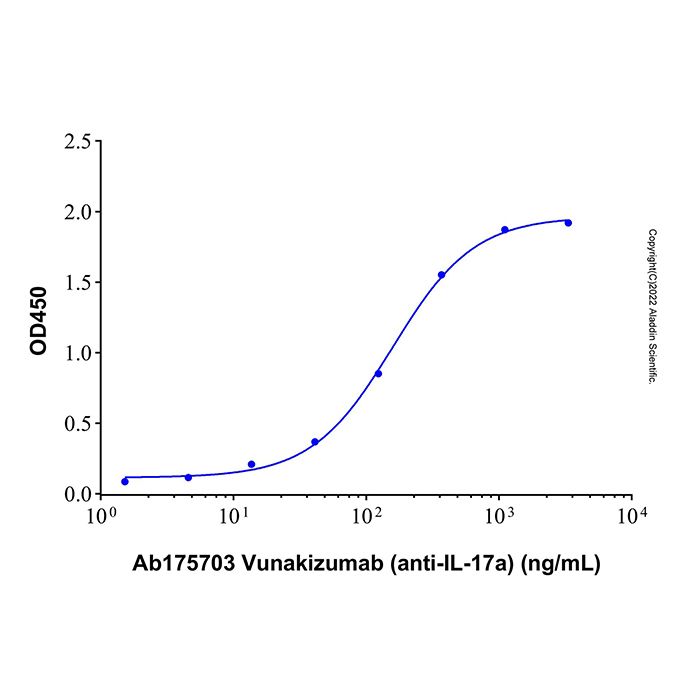
Recombinant Human IL-17A Protein (rp147421) - ELISA
Immobilized Recombinant Human IL-17A Protein (rp147421) at 1 μg/mL can bind Vunakizumab (anti-IL-17a) (Ab175703) with the EC50 of 156.5 ng/mL.
Recombinant Human IL-17A Protein (rp147421) - SDS-PAGE
2 μg/lane of Recombinant Human IL-17A Protein was resolved with SDS-PAGE under reducing (R) and non-reducing (N) conditions and visualized by Coomassie® Blue staining. As a result of different glycosylation, it migrates as approximately 16 - 21 kDa band in SDS-PAGE under reducing conditions and 16 - 21 & 28 - 39 kDa under non-reducing condition.
Recombinant Mouse CTLA-4 Protein (rp153837) - Protein Bioactivity
Measured by its ability to induce IL-6 secretion by NIH-3T3 mouse embryonic fibroblast cells. The ED₅₀ for this effect is 3.9 ng/mL.

 ZJ25F1129299


 危险品化学品经营许可证(带存储)