CHK1 / CHEK1 contains 1 protein kinase domain and belongs to the protein kinase superfamily, CAMK Ser/Thr protein kinase family, NIM1 subfamily. It is a member of checkpoint kinases (Chks). Chks Checkpoint kinases (Chks) are serine/threonine kinases that are involved in the control of the cell cycle. There are two subtypes of chks that have so far been identified, CHK1 / CHEK1 and Chk2. They are essential components to delay cell cycle progression in normal and damaged cells and can act at all three cell cycle checkpoints. Chks are activated by phosphorylation. ATR kinase phosphorylates CHK1 / CHEK1 in response to single strand DNA breaks and ATM kinase phosphorylates Chk2 in response to double strand breaks. Chks phosphorylate Cdc25 phosphatase at Ser216, which leads to Cdc25 sequestration in the cytoplasm. Chks have a role in the physiological stress of hypoxia/reoxygenation. CHK1 / CHEK1 is required for checkpoint mediated cell cycle arrest in response to DNA damage or the presence of unreplicated DNA. CHK1 / CHEK1 may also negatively regulate cell cycle progression during unperturbed cell cycles.
Post-translational: Phosphorylated by ATR in a RAD17-dependent manner in response to ultraviolet irradiation and inhibition of DNA replication (PubMed:10859164, PubMed:11390642, PubMed:12446774, PubMed:12588868, PubMed:12676583, PubMed:12676925, PubMed:12676962, PubMed:14681223, PubMed:14988723, PubMed:15650047, PubMed:15707391, PubMed:15870257, PubMed:25083873, PubMed:31316063).
Phosphorylated by ATM in response to ionizing irradiation (PubMed:12588868, PubMed:12676583).
ATM and ATR can both phosphorylate Ser-317 and Ser-345 and this results in enhanced kinase activity (PubMed:11390642, PubMed:12446774, PubMed:12588868, PubMed:12660173, PubMed:12676583, PubMed:12676962, PubMed:14657349, PubMed:15665856, PubMed:15707391, PubMed:15870257, PubMed:25083873).
Phosphorylation at Ser-345 induces a change in the conformation of the protein, activates the kinase activity and is a prerequisite for interaction with FBXO6 and subsequent ubiquitination at Lys-436 (PubMed:19716789).
Phosphorylation at Ser-345 also increases binding to 14-3-3 proteins and promotes nuclear retention (PubMed:12676962).
Conversely, dephosphorylation at Ser-345 by PPM1D may contribute to exit from checkpoint mediated cell cycle arrest (PubMed:15870257).
Phosphorylation at Ser-280 by AKT1/PKB, may promote mono and/or diubiquitination. Also phosphorylated at undefined residues during mitotic arrest, resulting in decreased activity (By similarity).By similarity18 publications
Ubiquitinated. Mono or diubiquitination promotes nuclear exclusion (By similarity).
The activated form (phosphorylated on Ser-345) is polyubiquitinated at Lys-436 by some SCF-type E3 ubiquitin ligase complex containing FBXO6 promoting its degradation. Ubiquitination and degradation are required to terminate the checkpoint and ensure that activated CHEK1 does not accumulate as cells progress through S phase, when replication forks encounter transient impediments during normal DNA replication. 'Lys-63'-mediated ubiquitination by TRAF4 at Lys-132 activates cell cycle arrest and activation of DNA repair (PubMed:32357935).By similarity12 publications
Proteolytically cleaved at the C-terminus by SPRTN during normal DNA replication, thereby promoting CHEK1 removal from chromatin and activating the protein kinase activity.
We recommend that this vial be briefly centrifuged prior to opening to bring the contents to the bottom. Reconstitute at 1.0 mg/mL in sterile distilled water. Stock solutions should be apportioned into working aliquots and stored at ≤ -20 °C. Further dilutions should be made in appropriate buffered solutions.
储存条件
-20°C储存,避免反复冻融
运输条件
超低温运输
稳定性与储存
-20℃保存 12个月;复溶后建议分装,避免反复冻融。
图片
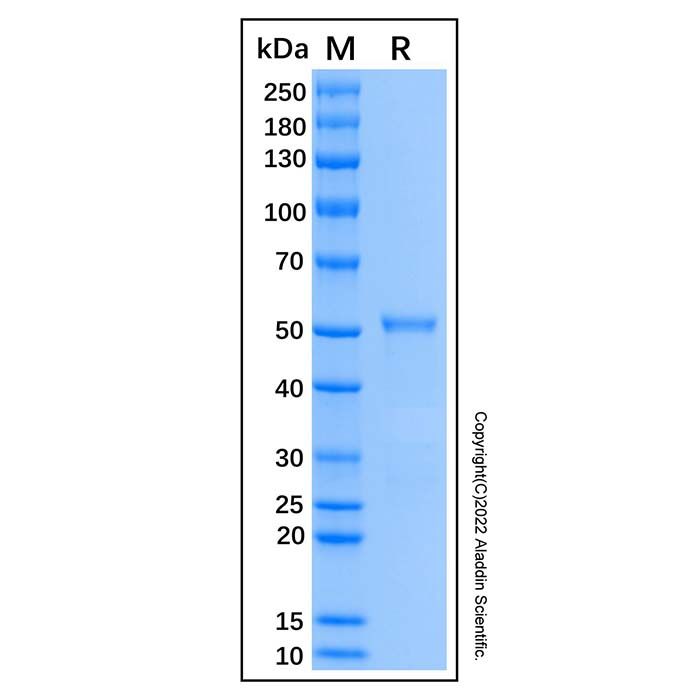
Recombinant Human Chk1 Protein (rp184097) - SDS-PAGE
2 μg/lane of Recombinant Human Chk1 Protein was resolved with SDS-PAGE under reducing (R) and non-reducing (N) conditions and visualized by Coomassie® Blue staining, showing a band at 52.3 kDa under reducing conditions.

 ZJ26F0535862


 危险品化学品经营许可证(带存储)