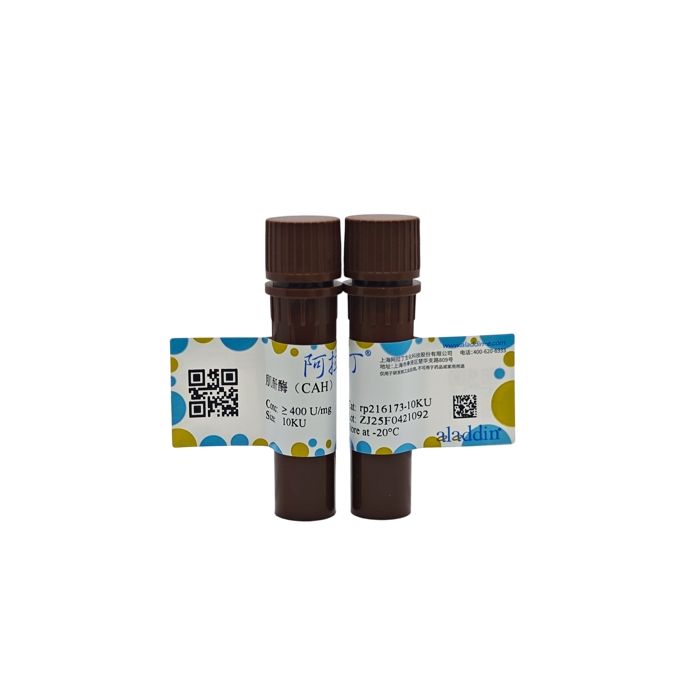
水解肌酐,用于酶法肌酐试剂的研发和大量配制。
酶学性质(注意-2、 2+、 3+ 为上标)
来源: 微生物
酶学委员会编号: EC 3.5.2.10
分子量: 29 kDa (SDS-PAGE)
等电点: 5.3
Km值: 5.0×10 -2 M (Creatinine),
8.0×10 -2 M (Creatine)
抑制剂: Hg2+,Cu2+,Fe3+
| 最适pH: | 7.0-8.0
| 图1 |
| 最适温度: | 65℃
| 图2 |
| pH稳定性: | pH 5.5-10.0 (25℃, 16 h)
| 图3 |
| 热稳定性: | 65℃以下稳定 (pH 8.0, 30 min)
| 图4 |
| 稳定性: | -25~-15℃静置保存
12 个月保持 90%以上活性
| 图5 |
| 保护剂: | 糖类以及 BSA
|


活性测定方法
1、原理

2、酶活定义
单位酶活定义为在下述条件下,每分钟催化反应生成1μmol 肌酸所需的酶量。
3、试剂准备
试剂 I:0.3 M磷酸钾缓冲液,pH 6.5
试剂 II:0.1 M肌酐溶液(1.13 g肌酐溶于100mL UP水中)
试剂 III:4% Na2CO3溶液(4.0 g Na2CO3溶于100mL UP水中)
试剂 IV:2% α-萘酚溶液(2.0 g α-萘酚溶于100 mL 99.5%乙醇中)
试剂 V:1.2 g NaOH和3.2 g Na2CO3溶于双蒸水中,定容至100 mL
试剂 VI:0.05%二乙酰溶液(0.05 mL二乙酰加水定容至100 mL)
酶稀释液:5 mM Tris-HCl pH 8.0
4、操作步骤
4.1. 在5 mL离心管中加入0.1 mL试剂 I,0.8mL试剂 II。
4.2. 37℃水浴5分钟。
4.3. 加入0.1 mL待测样品,37℃孵育10分钟。
4.4. 加入2.0 mL试剂III终止反应,取出置于冰上。
4.5. 在新的5 mL离心管中按顺序加入如下试剂:
第4步的溶液:80 μL
双蒸水:720 μL
试剂 IV:400 μL
试剂 V:400 μL
试剂 VI:400 μL
4.6. 25℃静置1 h后,加入2 mL双蒸水稀释。
4.7. 用分光光度计在525 nm检测吸光度。
*用酶稀释液替代酶液,其它步骤相同,所得溶液吸光度为空白吸光度(∆Aь)
∆A=∆As- ∆Aь
5、 活力计算

Vt:反应液总体积 (1.0mL)
Vs:酶液体积 (0.1mL)
t:反应时间 (10分钟)
df:稀释倍数
C:酶浓度 (mg/mL)
1.0:光路长度 (cm);
0.0704:标准反应条件下,生色基团在525nm 处毫摩尔吸光系数 (cm²/μmol)。
Hydrolyzed creatinine, used in the development and bulk formulation of enzymatic creatinine reagents.
Enzymatic properties
Source: Microorganism
Enzyme Committee No. : EC 3.5.2.10
Molecular weight: 29 kDa (SDS-PAGE)
Isoelectric point: 5.3
Km value: 5.0× 10⁻² M (Creatinine),
8.0× 10⁻² M (Creatine)
Inhibitors: Hg2+, Cu2+, Fe3+
Optimal pH: 7.0-8.0 Figure 1
Optimum temperature: 65℃ Figure 2
pH stability: pH 5.5-10.0 (25℃, 16 h) Figure 3
Thermal stability: stable below 65℃ (pH 8.0, 30 min) Figure 4
Stability: -25 ~ -15℃ standing storage
Maintain over 90% activity for 12 months Figure 5
Assay method for activity
1. Principle
2. Definition of enzyme activity
Unit enzyme activity is defined as the amount of enzyme required to catalyze a reaction to produce 1μmol creatine per minute under the following conditions.
3. Reagent preparation
Reagent I: 0.3M potassium phosphate buffer, pH 6.5.
Reagent II: 0.1M creatinine solution (1.13g creatinine dissolved in 100mL UP water).
Reagent III: 4% Na2CO3 solution (4.0g Na2CO3 dissolved in 100mL UP water).
Reagent IV: 2% alpha-naphthol solution (2.0g alpha-naphthol dissolved in 100 mL of 99.5% ethanol).
Reagent V: 1.2g NaOH and 3.2g Na2CO3 were dissolved in double steaming water at a constant volume of 100 mL.
Reagent VI: 0.05% diacetyl solution (0.05mL diacetyl with water to 100 mL).
Enzyme diluent: 5 mM Tris-HCl pH 8.0
4. Operation procedure
4.1. Add 0.1 mL reagent I and 0.8mL reagent II into a 5 mL centrifuge tube.
4.2. Water bath at 37℃ for 5 minutes.
4.3. Add 0.1 mL of the sample to be tested and incubate at 37℃ for 10 minutes.
4.4. Add 2.0mL reagent III to terminate the reaction, remove and place on ice.
4.5. Add the following reagents in the new 5 mL centrifuge tube in order:
The solution for step 4: 80 μL
Double steaming water: 720 μL
Reagent IV: 400 μL
Reagent V: 400 μL
Reagent VI: 400 μL
4.6. After standing at 25℃ for 1 h, add 2 mL of double steaming water to dilute.
4.7. Use a spectrophotometer to measure the absorbance at 525 nm.
* Replace enzyme liquid with enzyme diluent, other steps are the same, the absorbance of the resulting solution is blank absorbance (∆Ab)
∆A=∆As- ∆Ab
5. Vitality computing
Vt: Total volume of reaction liquid (1.0mL);
Vs: Enzyme liquid volume (0.1mL);
t: Reaction time (10 minutes);
df: Dilution ratio;
C: Enzyme concentration (mg/mL);
1.0: Optical path length (cm);
0.0704: Millimolar absorption coefficient (cm²/μmol) of chromophore at 525nm under standard reaction conditions.

 ZJ25F0421092


 危险品化学品经营许可证(带存储)