The neuregulin family of structurally related glycoproteins comprises products from four distinct but related genes, Nrg-1, Nrg-2, Nrg-3, and Nrg-4. Through alternative splicing or the use of alternative promoters, Nrg-1 encodes more than 14 soluble or transmembrane proteins. The extracellular domain of the transmembrane NRG1 isoforms can be proteolytically cleaved to release soluble growth factors. The alpha - or beta -splice variants differ in their C-terminal region. All NRG1 isoforms contain an EGF-like domain that is required for their direct binding to the ErbB3 or ErbB4 receptor tyrosine kinases. The ErbB3 or ErbB4 subsequently recruits and heterodimerizes with ErbB2, resulting in tyrosine phosphorylation and NRG1 signaling. NRG1 isoforms can be classified into three major subtypes. Type I (Neu Differentiation Factor, NDF; Heregulin, HRG; Acetylcholine Receptor Inducing Activity, ARIA) and type II (Glial Growth Factor, GGF). NRG1s have an immunoglobulin (Ig)-like domain N-terminal to the EGF-like domain. Type I NRG1s differ from type II NRG1s by having a glycosylation-rich domain between the Ig-like and the EGF-like domains. Type III NRG1 (Sensory and Motor neuron-Derived Factor) lacks the Ig-like domain but has a cysteine rich domain (CRD) instead. NRG1 isoforms show distinct spatial and temporal expression patterns. These proteins play important roles during development of both the nervous system and the heart. They have been shown to regulate the selective expression of neurotransmitter receptors in neurons and at the neuromuscular junction, and to promote the differentiation and development of Schwann cells from neural crest stem cells. NRG1s have also been shown to be involved in the establishment of the oligodendroglial lineage.
Post-translational: Proteolytic cleavage close to the plasma membrane on the external face leads to the release of the soluble growth factor form. N- and O-glycosylated. Extensive glycosylation precedes the proteolytic cleavage (By similarity).
生物活性
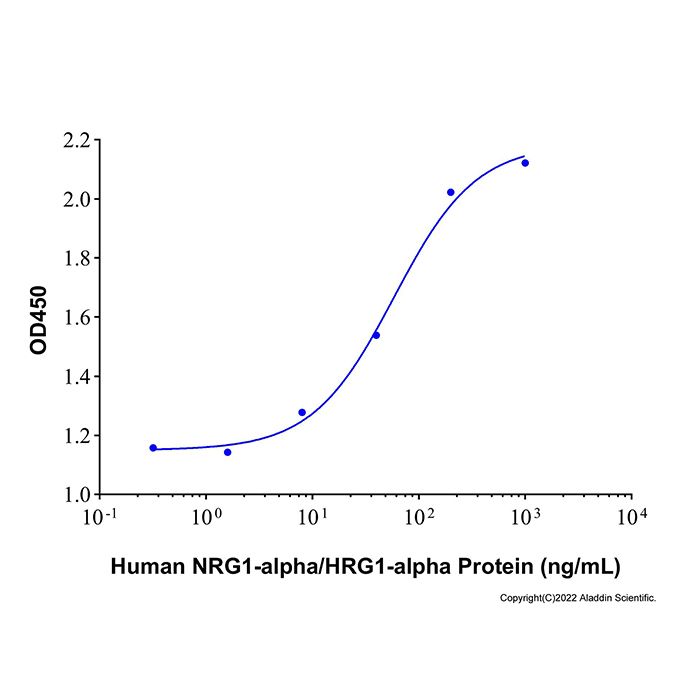
Measured in a cell proliferation assay using MCF‑7 human breast cancer cells. The ED₅₀ for this effect is 8.1 ng/mL.
We recommend that this vial be briefly centrifuged prior to opening to bring the contents to the bottom. Reconstitute at 1.0 mg/mL in sterile distilled water. Stock solutions should be apportioned into working aliquots and stored at ≤ -20 °C. Further dilutions should be made in appropriate buffered solutions.
储存条件
-20°C储存,避免反复冻融
运输条件
超低温运输
稳定性与储存
Store at -20℃ for 12 months. Upon reconstitution, it is recommended to aliquot. Avoid freeze/thaw cycle.
图片
Recombinant Human NRG1-alpha/HRG1-alpha Protein (rp156330) - Bioactivity Measured in a cell proliferation assay using MCF‑7 human breast cancer cells. The ED₅₀ for this effect is 58.6 ng/mL.
Recombinant Human NRG1-alpha/HRG1-alpha Protein (rp156330) - SDS-PAGE 3 μg/lane of Recombinant Human NRG1-alpha/HRG1-alpha Protein was resolved with SDS-PAGE under reducing (R) and non-reducing (N) conditions and visualized by Coomassie® Blue staining, showing a band at 45.0-55.0 kDa.

 ZJ25F0927638


 危险品化学品经营许可证(带存储)