Bid is a 195 amino acid member of the Bcl‑2 family of proteins that regulates outer mitochondrial membrane permeability. Bid is a pro-apoptotic member that causes cytochrome c to be released from the mitochondria intermembrane space into the cytosol. In healthy cells Bid is cytosolic. In response to Fas ligand or TNF Bid is cleaved by Caspase-8 and it then relocates to the mitochondria outer membrane. Cleavage of Bid by Caspase-8 generates a new N-terminal that contains a terminal glycine. It appears that the glycine is myristoylated and myristoylation serves to target Bid to the mitochondria. Bid may then interact with another pro-apoptotic Bcl‑2 family member Bak. Interaction of Bid with Bak causes altered mitochondrial membrane permeability. A 9-13 amino acid stretch called the BH3 region (Bcl‑2 homology region) appears to mediate the Bid interaction with other Bcl‑2 family members. Bid is neutralized by binding to the anti-apoptotic member Bcl‑xL.
Post-translational: TNF-alpha induces caspase-mediated cleavage into a major p15 and minor p13 and p11 products. Cleaved by CASP6 into a major p15 and minor p13 products, leading to release of cytochrome c and subsequent nonalcoholic steatohepatitis (By similarity). Ubiquitinated by ITCH; ubiquitination results in proteasome-dependent degradation.
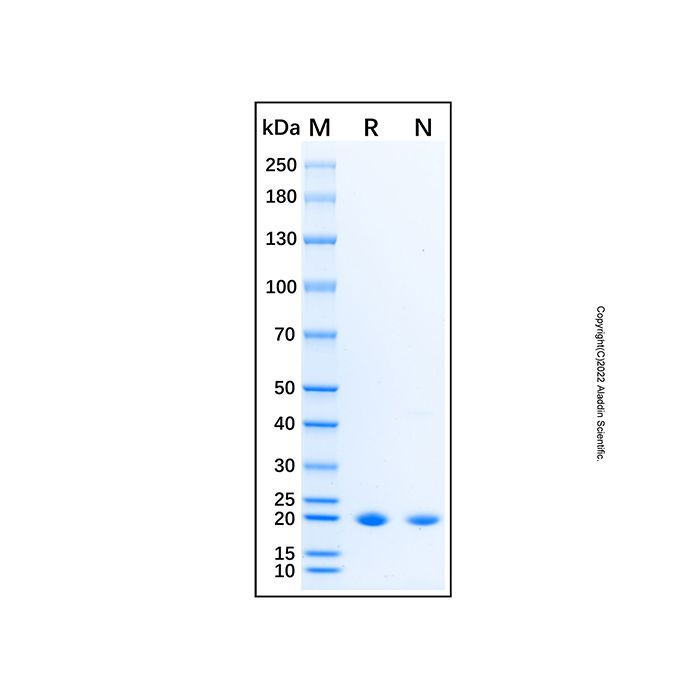
19.6 kDa, under reducing conditions; 19.6 kDa, under non-reducing conditions.
分子类型
蛋白质
产品线
生物产品
储存与运输
物理形态
冻干(Lyophilized)
储存缓冲液
Lyophilized from 10mM Tris, 250mM NaCl, 1mM EDTA, pH 8.0
浓度
expressed in E. coli; 见COA
复溶
We recommend that this vial be briefly centrifuged prior to opening to bring the contents to the bottom. Reconstitute at 1.0 mg/mL in sterile distilled water. Stock solutions should be apportioned into working aliquots and stored at ≤ -20 °C. Further dilutions should be made in appropriate buffered solutions.
储存条件
-20°C储存,避免反复冻融
运输条件
超低温运输
稳定性与储存
-20℃保存 12个月;复溶后建议分装,避免反复冻融。
图片
Recombinant Mouse BID Protein (rp221578) - SDS-PAGE
3 μg/lane of Recombinant Mouse BID Protein was resolved with SDS-PAGE under reducing (R) and non-reducing (N) conditions and visualized by Coomassie® Blue staining, showing a band at 19.6 kDa.

 ZJ26F0433971


 危险品化学品经营许可证(带存储)