Neuregulin is a signaling protein for ErbB2/ErbB4 receptor heterodimers on the cardiac muscle cells, playing an important role in heart structure and function through inducing ErbB2/ErbB4 receptor phosphorylation and cardiomyocyte differentiation. Research on molecular level discovered that recombinant neuregulin could make disturbed myocardial cell structure into order and strengthen the connection between myocardial cells by intercalated discs re-organization.
Post-translational:Proteolytic cleavage close to the plasma membrane on the external face leads to the release of the soluble growth factor form.N- and O-glycosylated. Extensive glycosylation precedes the proteolytic cleavage (By similarity).
生物活性
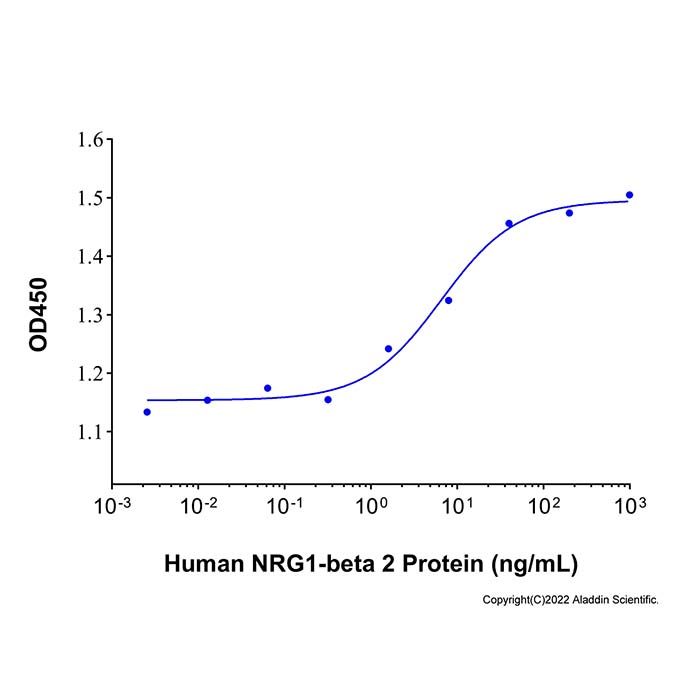
Measured in a cell proliferation assay using MCF-7 cells. The ED50 for this effect is typically 6.5 ng/mL.
7.0 &14.4 kDa, under reducing conditions; 10.0 & 15.2 & 19.2 kDa, under non-reducing conditions.
分子类型
蛋白质
产品线
生物产品
储存与运输
物理形态
冻干(Lyophilized)
储存缓冲液
Lyophilized from PBS, pH 7.4
浓度
见COA
复溶
We recommend that this vial be briefly centrifuged prior to opening to bring the contents to the bottom. Reconstitute at 1.0 mg/mL in sterile distilled water. Stock solutions should be apportioned into working aliquots and stored at ≤ -20 °C. Further dilutions should be made in appropriate buffered solutions.
储存条件
-20°C储存,避免反复冻融
运输条件
超低温运输
稳定性与储存
Store at -20℃ for 12 months. Upon reconstitution, it is recommended to aliquot. Avoid freeze/thaw cycle.
图片
Recombinant Human NRG1-beta 2 Protein (rp231124) - Protein Bioactivity Measured in a cell proliferation assay using MCF-7 cells. The ED₅₀ for this effect is typically 6.5 ng/mL.
Recombinant Human NRG1-beta 2 Protein (rp231124) - SDS-PAGE 3 μg/lane of Recombinant Human NRG1-beta 2 Protein was resolved with SDS-PAGE under reducing (R) and non-reducing (N) conditions and visualized by Coomassie® Blue staining, showing a band at 7.0 & 14.4 kDa under reducing conditions and 10.0 & 15.2 & 19.2 kDa under non-reducing conditions. The NRG1-beta 2 is a class of EGF-like signaling molecules. Its domain is rich in cysteine residues and disulfide bonds, potentially facilitating disulfide bond formation (Uniprot ID: Q02297-7).

 ZJ25F1129432


 危险品化学品经营许可证(带存储)