乙酸激酶(Acetokinase, ACK)主要存在于微生物中,催化乙酸和ATP生成乙酰磷酸和ADP,是细菌碳代谢和能量代谢的关键酶,尤其是在古细菌甲烷合成代谢中起着中枢作用。
测定原理:ACK催化乙酸钠和ATP生成乙酰磷酸和ADP,丙酮酸激酶催化ADP和PEP生成ATP 和丙酮酸,乳酸脱氢酶催化丙酮酸和NADH生成乳酸和NAD+,在340nm下测定NADH氧化生成NAD+速率,即可反映ACK 活性。
Component
| 48T
| 96T
| Storage
|
Extraction Buffer
| 60 mL
| 60 mL×2
| 2-8℃
|
ReagentⅠ
| 15 mL
| 30 mL
| 2-8℃
|
ReagentⅡ
| 1EA | 2EA | -20℃. Store in the dark.
|
Reagent III
| 25 μL
| 50 μL
| 2-8℃. Store in the dark. |
注意:正式检测前,建议选择2-3个预期差异较大的样本进行预实验。
自备仪器和用品
酶标仪或紫外分光光度计(能测340nm处的吸光度)
96孔UV板或微量石英比色皿、可调节式移液枪及枪头
恒温水浴锅、制冰机、离心机
去离子水
匀浆器(如果是组织样本)
试剂准备
Extraction Buffer:即用型;使用前,平衡到室温。4℃保存。
注意:Extraction Buffer 有毒且有刺激性气味,建议在通风橱进行实验。
ReagentⅠ:即用型;使用前,平衡到室温。4℃保存。
Working Reagent Ⅱ:临用前配制;取ReagentⅡ一瓶,加入11mL ReagentⅠ和19.8μL Reagent Ⅲ,充分混合溶解,现配现用。-20℃避光可保存一个月。
Reagent Ⅲ:即用型;使用前,平衡到室温。4℃避光保存。
样本制备
注意:推荐使用新鲜样本,如果不立即进行实验,样本可在-80℃保存1个月。测定时,应控制解冻的温度和时间。室温环境下解冻时,需在4h内完成样品解冻。
1、组织:称取约0.1g样本,加入1mL Extraction Buffer,冰浴匀浆,15,000g,4℃离心10min,取上清液,置冰上待测。
2、细胞或细菌:收集500万细胞或细菌到离心管内,用冷PBS清洗细胞,离心后弃上清,加入1mL Extraction Buffer,冰浴超声波破碎细胞或细菌(功率200W,超声3s,间隔10s,重复30次),然后15,000g,4℃离心10min,取上清液,置冰上待测。
3、血清(浆)等液体样本:直接测定。若溶液有浑浊则离心后取上清进行测定。
注意:如需测定蛋白浓度,推荐使用阿拉丁B665595 BCA蛋白定量试剂盒或R1491648 即用型BCA蛋白定量试剂盒进行样本蛋白质浓度测定。
实验步骤
1、酶标仪或紫外分光光度计预热30min,调节波长到340nm。紫外分光光度计用去离子水调零。 2、根据实验用量,取出部分配制好的Reagent Ⅱ置于37℃(哺乳动物)或25℃(其它物种)水浴5min;现配现用。
3、操作表(下述操作在96孔UV板或微量石英比色皿中进行):
| 试剂 | 测定孔(μL)
|
样本
| 20 |
Working Reagent Ⅱ
| 180 |
充分混匀,于340nm处测定10s的吸光值A1与190s的吸光值A2,计算ΔA=A1-A2。
注意:实验之前建议选择2-3个预期差异大的样本做预实验。如果ΔA小于0.05可适当加大样本量或适当延长反应时间至10min 或20min后检测。如果ΔA大于1.0,样本可用Extraction Buffer进一步稀释,计算结果乘以稀释倍数,或减少提取用样本量。
结果计算
注意:我们为您提供的计算公式,包括推导过程计算公式和简洁计算公式。两者完全相等。建议以加粗的简洁计算公式为最终计算公式。
1、使用96孔UV板测定的计算公式如下
1.1 按样本蛋白浓度计算
酶活定义:每mg组织蛋白每分钟消耗1nmol NADH定义为一个酶活力单位。
ACK (U/mg prot)=[ΔA×V 反总 ÷(ε×d)×10⁹]÷(V 样 ×Cpr)÷T=1072×ΔA÷Cpr
1.2 按样本质量计算
酶活定义:每g样品每分钟消耗1nmol NADH定义为一个酶活力单位。
ACK (U/g 鲜重)=[ΔA×V反总 ÷(ε×d)×10⁹]÷(V 样 ×W÷V 样总 )÷T=1072×ΔA÷W
1.3 按细菌或细胞密度计算
酶活定义:每10⁴个细菌或细胞在反应体系中每分钟消耗1nmol NADH定义为一个酶活力单位。 ACK (U/g 10⁴)=[ΔA×V 反总 ÷(ε×d)×10⁹]÷(500×V 样 ÷V 样总 )÷T=2.144×ΔA
1.4 按液体体积计算
酶活定义:每mL样本每分钟消耗1nmol NADH定义为一个酶活力单位。
ACK (U/mL)=[ΔA×V 反总 ÷(ε×d)×10⁹]÷V 样 ÷T=1072×ΔA
参数说明:
ε:NADH微摩尔消光系数,6.22×10³L/mol/cm
d:96孔UV板光径,0.5cm
V反总 :反应体系总体积,2×10⁻⁴L
V样 :反应体系中样本体积,0.02mL
V样总 :加入Extraction Buffer体积,1 mL
Cpr:样本蛋白浓度,mg/mL
W:样本质量,g
T: 反应时间,3min
500:细菌或细胞总数,5×10⁶。
2、使用微量石英比色皿测定的计算公式将上述计算公式中光径d:0.5cm调整为d:1cm进行计算即可。
注意事项
1、测定过程中样本和所有试剂在冰上放置,以免变性和失活。
2、反应液的温度必须保持37℃或25℃,比色皿测定时可取小烧杯一只装入一定量的37℃或25℃去离子水,将此烧杯放入37℃ 或25℃水浴锅中。在反应过程中把比色皿连同反应液放在此烧杯中。
3、本产品仅供科学研究使用,不适用于临床诊断。为了您的安全和健康,请穿实验服并戴一次性手套操作。
结果展示
本试剂盒测定小鼠肾脏和小鼠肌肉中ACK的活性

Acetate Kinase (ACK) is primarily found in microorganisms. It catalyzes the conversion of acetate and ATP to acetyl phosphate and ADP, serving as a key enzyme in bacterial carbon and energy metabolism, and plays a central role particularly in the methanogenesis metabolism of archaea.
Assay Principle
ACK catalyzes the synthesis of Acetyl Phosphate and ADP from Sodium Acetate and ATP. Pyruvate Kinase then catalyzes the conversion of ADP and Phosphoenolpyruvate (PEP) to ATP and Pyruvate. Subsequently, Lactate Dehydrogenase catalyzes the reduction of Pyruvate by NADH to produce Lactate and NAD⁺. The rate of oxidation of NADH to NAD⁺, measured by the decrease in absorbance at 340 nm, reflects ACK activity.
Component
| 48T
| 96T
| Storage
|
Extraction Buffer
| 60 mL
| 60 mL×2
| 2-8℃
|
ReagentⅠ
| 15 mL
| 30 mL
| 2-8℃
|
ReagentⅡ
| 1EA | 2EA | -20℃. Store in the dark.
|
Reagent III
| 25 μL
| 50 μL |
Note: It is recommended to perform a pilot experiment with 2-3 samples expected to have significant differences before formal testing.
Required Materials and Equipment (Not Provided)
Microplate reader or UV spectrophotometer (capable of measuring absorbance at 340 nm)
96-well UV plate or micro quartz cuvette
Adjustable pipettes and tips
Constant temperature water bath
Ice maker
Centrifuge
Deionized water
Homogenizer (for tissue samples)
Reagent Preparation
Extraction Buffer: Ready-to-use. Equilibrate to room temperature (RT) before use. Store at 4°C.
Caution: Extraction Buffer is toxic and has a pungent odor. It is recommended to handle it within a fume hood.
Reagent Ⅰ: Ready-to-use. Equilibrate to RT before use. Store at 4°C.
Working Reagent Ⅱ: Prepare immediately before use. For one vial of Reagent Ⅱ, add 11 mL of Reagent Ⅰ and 19.8 μL of Reagent III. Mix thoroughly to dissolve. Prepare fresh for each use. Can be stored protected from light at -20°C for one month.
Reagent Ⅲ: Ready-to-use. Equilibrate to RT before use. Store at 4°C protected from light.
Sample Preparation
*Note: The use of fresh samples is recommended. If not used immediately, samples can be stored at -80°C for up to one month. Control the temperature and time during thawing. If thawed at room temperature, complete the process within 4 hours.*
1.Tissues: Weigh approximately 0.1 g of sample. Add 1 mL of Extraction Buffer and homogenize on ice. Centrifuge the homogenate at 15,000 g, 4°C for 10 min. Collect the supernatant and keep it on ice for assay.
2.Cells or Bacteria: Collect 5 million cells or bacteria by centrifugation. Wash the pellet with cold PBS, centrifuge, and discard the supernatant. Add 1 mL of Extraction Buffer. Disrupt the cells/bacteria by sonication on ice (200W power, pulse 3s on/10s off, repeat 30 times). Centrifuge the lysate at 15,000 g, 4°C for 10 min. Collect the supernatant and keep it on ice for assay.
3.Serum (Plasma) or other liquid samples: Assay directly. If the solution is turbid, centrifuge first and use the supernatant for assay.
Note: To determine protein concentration, Aladdin's BCA Protein Quantification Kit (B665595) or Ready-to-Use BCA Protein Quantification Kit (R1491648) is recommended.
Assay Procedure
1.Preheat the microplate reader or spectrophotometer for 30 min. Set the wavelength to 340 nm. Zero the spectrophotometer with deionized water.
2.Pre-warm a sufficient volume of the prepared Working Reagent Ⅱ at 37°C (for mammalian samples) or 25°C (for other species) for 5 minutes. Use immediately.
3.Assay Setup (perform in a 96-well UV plate or micro quartz cuvette):
| Reagent | Test Well (μL)
|
Sample
| 20 |
Working Reagent Ⅱ
| 180 |
Mix thoroughly immediately after addition. Measure the absorbance at 340 nm at 10 seconds (A₁) and again at 190 seconds (A₂). Calculate ΔA = A₁ - A₂.
Note: It is advised to run a pilot test with 2-3 samples showing expected significant variation beforehand. If ΔA is less than 0.05, consider increasing the sample volume or extending the reaction time to 10 or 20 minutes before measurement. If ΔA is greater than 1.0, dilute the sample further with Extraction Buffer (multiply the result by the dilution factor) or reduce the amount of sample used for extraction.
Result Calculation
Note: Both the derived and simplified calculation formulas are provided and are equivalent. The simplified formulas (in bold) are recommended for final calculation.
1. Calculation for 96-Well UV Plate
General Parameters for 96-Well Plate:
ε (NADH molar extinction coefficient) = 6.22 × 10³ L/mol/cm
d (Light path of 96-well plate) = 0.5 cm
Vₜₒₜₐₗ (Total reaction volume) = 0.0002 L (200 μL)
Vₛₐₘₚₗₑ (Sample volume in reaction) = 0.02 mL (20 μL)
T (Reaction time) = 3 min
Vₛₐₘₚₗₑₜₒₜₐₗ (Total extraction volume) = 1 mL
Cpr (Sample protein concentration, mg/mL)
W (Sample mass, g)
500 (Cell/Bacteria count in millions: 5 × 10⁶)
1.1 Based on Sample Protein Concentration:
Definition: One unit of activity is defined as the amount of enzyme that consumes 1 nmol of NADH per minute per mg of protein.
Calculation:
ACK Activity (U/mg prot) = [ΔA × Vₜₒₜₐₗ ÷ (ε × d) × 10⁹] ÷ (Vₛₐₘₚₗₑ × Cpr) ÷ T
Simplified Formula: ACK (U/mg prot) = 1072 × ΔA ÷ Cpr
1.2 Based on Sample Mass:
Definition: One unit of activity is defined as the amount of enzyme that consumes 1 nmol of NADH per minute per gram of fresh sample.
Calculation:
ACK Activity (U/g fresh weight) = [ΔA × Vₜₒₜₐₗ ÷ (ε × d) × 10⁹] ÷ (W × Vₛₐₘₚₗₑ / Vₛₐₘₚₗₑₜₒₜₐₗ) ÷ T
Simplified Formula: ACK (U/g fresh weight) = 1072 × ΔA ÷ W
1.3 Based on Bacterial or Cell Density:
Definition: One unit of activity is defined as the amount of enzyme that consumes 1 nmol of NADH per minute per 10⁴ cells/bacteria in the reaction system.
Calculation (for 5 million cells in 1 ml extract):
ACK Activity (U/10⁴) = [ΔA × Vₜₒₜₐₗ ÷ (ε × d) × 10⁹] ÷ (500 × Vₛₐₘₚₗₑ / Vₛₐₘₚₗₑₜₒₜₐₗ) ÷ T
Simplified Formula: ACK (U/10⁴) = 2.144 × ΔA
1.4 Based on Liquid Volume:
Definition: One unit of activity is defined as the amount of enzyme that consumes 1 nmol of NADH per minute per milliliter of sample.
Calculation:
ACK Activity (U/mL) = [ΔA × Vₜₒₜₐₗ ÷ (ε × d) × 10⁹] ÷ Vₛₐₘₚₗₑ ÷ T
Simplified Formula: ACK (U/mL) = 1072 × ΔA
2. Calculation for Micro Quartz Cuvette
Use the formulas above but adjust the light path *d* from 0.5 cm to 1.0 cm.
Precautions
1. Keep samples and all reagents on ice during the assay procedure to prevent denaturation and loss of activity.
2. The temperature of the reaction mixture must be maintained at 37°C or 25°C. When using a cuvette, a small beaker filled with deionized water pre-warmed to 37°C or 25°C (placed in a water bath) can be used to hold the cuvette and maintain temperature during the reaction.
3. This product is for scientific research use only. It is not intended for clinical diagnosis. For your safety and health, please wear a lab coat and disposable gloves during operation.



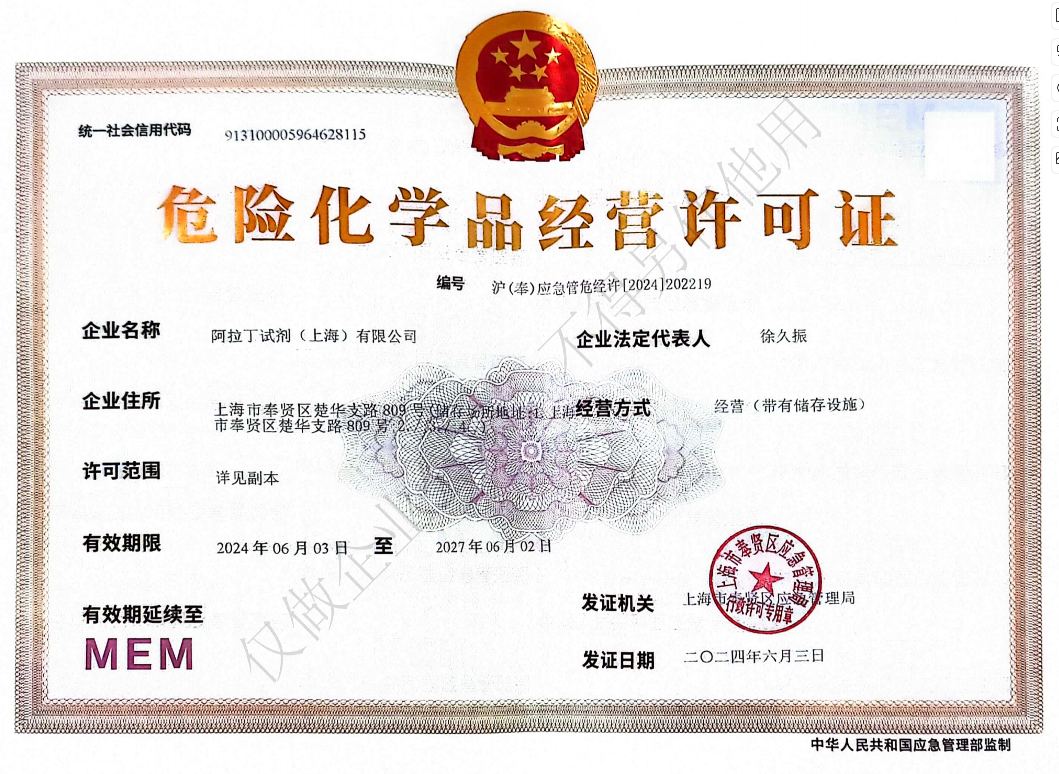 危险品化学品经营许可证(带存储)