
计算溶液所需的质量、体积或浓度。
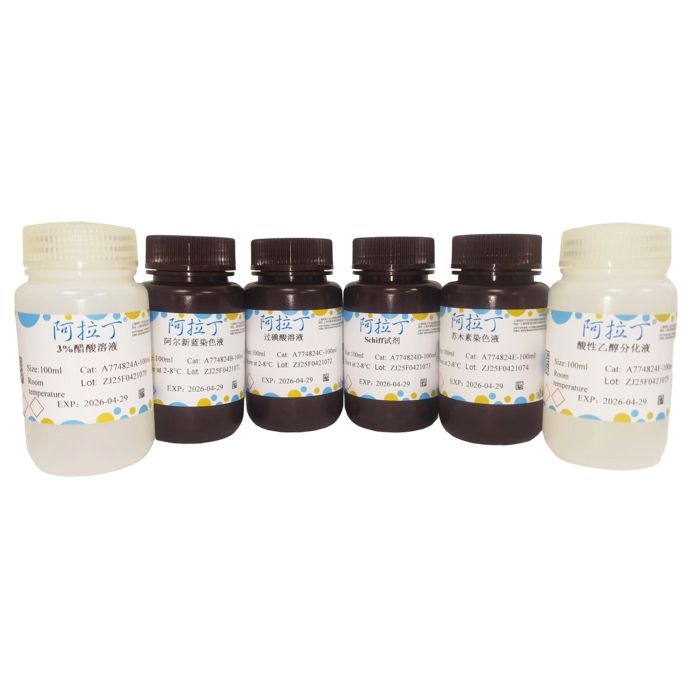
AB-PAS染色试剂盒
有货
BioReagent,生物染色剂,用于显微镜 级 ,适用于对基线干扰要求严格的色谱和分析工作流程。
2-8°C储存,避光。低温运输 。请查阅批次 COA 获取详细规格。
SDS、COA、产品数据表及规格说明书均可下载。可通过批号查询获取批次 COA。
在色谱分析、有机合成和交叉偶联反应领域已被 0 篇同行评审文献引用。
阿利新蓝 (又称阿尔辛蓝、爱先蓝等) 和PAS技术联合使用可鉴别同一组织切片中的中性黏蛋白和酸性黏蛋白。这种技术也常用作广泛检测黏蛋白的手段,切片先经标准阿利新蓝 (pH=2.5) 染色再使用PAS技术。阿利新蓝可将唾液黏蛋白、硫黏蛋白和蛋白多糖染成蓝色。PAS技术可将中性黏蛋白染成深红或红紫色,同时将既含中性黏蛋白又含酸性黏蛋白的组织和细胞染成深浅不同的紫色,这是由于阿利新蓝与Schiff试剂结合并发生反应。上述染色常可出现在含有中性黏蛋白和唾液黏蛋白的小肠杯状细胞中。阿利新蓝的染色原理在于是类铜钛花青染料,这种阳离子染料与酸性基团结合,也即阿利新蓝与组织内含有的阴离子基团如羧基和硫酸根形成不溶性复合物。分子中带正电荷的盐键与酸性黏多糖物质中带负电荷的酸性基团结合形成不溶性的复合物而呈蓝色,再与PAS进行复合染色,就能显示三种不同黏液物质成分。
|
使用说明:
1、组织经固定,常规脱蜡至水,蒸馏水洗1-2min。
2、入3%醋酸溶液 3min。
3、不经水洗,入阿尔新蓝染色液中染色15-30min。
4、蒸馏水洗3次,每次1-2min。
5、入过碘酸溶液,氧化5-10min。
6、流水稍冲洗,蒸馏水洗2次。
7、入Schiff试剂中浸染10-20min。
8、亚硫酸液冲洗3次,每次2min。
9、流水冲洗2min,蒸馏水洗2次。
10、入苏木素染色液,染核1-2min。
11、用酸性分化液分化2-5s,充分水洗。
12、流水冲洗返蓝。
13、常规无水乙醇脱水。二甲苯透明,中性树胶封固。
注意事项:
1、切片脱蜡应尽量干净,否则影响染色效果。
2、过碘酸氧化时间不宜过久,氧化时的温度以18-22°C最佳。
3、阿尔新蓝染色液、过碘酸溶液、Schiff试剂、苏木素溶液均应置于2-8°C密闭保存,使用时避免接触过多阳光和空气。使用前最好提前30min取出恢复至室温,避光暗处使用。
4、酸性分化液应经常更换新液,分化时间应该依据切片厚薄、组织类别和酸性分化液的新旧而定,另外分化后自来水冲洗时间应该足够。
5、切片在过碘酸溶液和Schiff试剂中作用时间非常重要,该依据切片厚薄、组织类别等决定。
6、用苏木素染色液复染细胞核时应淡染,以免影响阳性物质AB的观察。目的是防止胞浆或黏蛋白着色而掩盖阿利新蓝的颜色。
7、阿尔新蓝-PAS联合技术的染色顺序可影响最终结果。PAS技术在阿尔辛蓝染色之前时,中性黏蛋白和糖原可染成紫色。与此相反,阿利新蓝染色在PAS技术之前时,则可将这些物质染成预期的紫红色。
8、亚硫酸液配制:1mol/L稀盐酸7.5mL,10%偏重亚硫酸钠7.5mL,蒸馏水130mL,混合配制而成。
9、为了您的安全和健康,请穿实验服并戴一次性手套操作。
染色结果:
|
备注:含有中性黏蛋白和酸性黏蛋白的细胞或组织可染成不同程度的蓝紫色至紫色。
Alcian blue (also known as Alcian blue, Alcian blue, etc.) and PAS technique can be used together to identify neutral mucin and acidic mucin in the same tissue section. This technique is also commonly used as a means to extensively detect mucin. The section is first stained with standard Alcian blue (pH=2.5) and then subjected to the PAS technique. Alcian blue stains sialomucin, sulfomucin, and proteoglycans blue. The PAS technique stains neutral mucin deep red or reddish-purple, while staining tissues and cells containing both neutral and acidic mucin in varying shades of purple. This is due to the combination and reaction of Alcian blue with Schiff reagent. The above staining often appears in small intestinal goblet cells containing neutral mucin and sialomucin. The staining principle of Alcian blue lies in its being a copper phthalocyanine dye. This cationic dye binds to acidic groups, meaning Alcian blue forms insoluble complexes with anionic groups in tissues, such as carboxyl and sulfate groups. The positively charged salt bonds in the molecule combine with the negatively charged acidic groups in acidic mucopolysaccharides to form insoluble complexes that appear blue. When combined with PAS for composite staining, it can display three different mucus substance components.
| A774824 | Component | 6×50 mL | 6×100 mL | Storage |
| A774824A | 3% Acetic Acid Solution | 50 mL | 100 mL | RT. |
| A774824B | Alcian Blue Staining Solution | 50 mL | 100 mL | 2-8℃. Store in the dark |
| A774824C | Periodic Acid Solution | 50 mL | 100 mL | 2-8℃. Store in the dark |
| A774824D | Schiff Reagent | 50 mL | 100 mL | 2-8℃. Store in the dark |
| A774824E | Hematoxylin Staining Solution | 50 mL | 100 mL | 2-8℃. Store in the dark |
| A774824F | Acidic Ethanol Differentiation Solution | 50 mL | 100 mL | RT. |
Instructions for Use
Fix the tissue, deparaffinize routinely to water, and rinse with distilled water for 1–2 min.
Place in 3% acetic acid solution for 3 min.
Without water rinsing, place in Alcian blue staining solution for 15–30 min.
Rinse with distilled water three times, each for 1–2 min.
Place in periodic acid solution for oxidation for 5–10 min.
Rinse slightly under running water, then rinse with distilled water twice.
Immerse in Schiff reagent for 10–20 min.
Rinse with sulfite solution three times, each for 2 min.
Rinse under running water for 2 min, then rinse with distilled water twice.
Place in hematoxylin staining solution for nuclear staining for 1–2 min.
Differentiate with acidic differentiation solution for 2–5 s, then rinse thoroughly with water.
Rinse under running water until blue color returns.
Dehydrate routinely with absolute ethanol. Clear with xylene and mount with neutral balsam.
Precautions
Deparaffinization of sections should be as thorough as possible; otherwise, staining results may be affected.
Oxidation time with periodic acid should not be too long. The optimal temperature for oxidation is 18–22°C.
Alcian blue staining solution, periodic acid solution, Schiff reagent, and hematoxylin solution should be stored tightly sealed at 2–8°C. Avoid excessive exposure to sunlight and air during use. It is best to take them out 30 minutes before use to allow them to return to room temperature, and use them in a dark place away from light.
Acidic differentiation solution should be replaced frequently with fresh solution. Differentiation time should be determined based on section thickness, tissue type, and the freshness of the acidic differentiation solution. Additionally, the rinsing time with tap water after differentiation should be sufficient.
The action time of sections in periodic acid solution and Schiff reagent is crucial and should be determined based on section thickness, tissue type, etc.
When counterstaining cell nuclei with hematoxylin staining solution, staining should be light to avoid affecting the observation of AB-positive substances. The purpose is to prevent cytoplasmic or mucin staining from masking the color of Alcian blue.
The staining sequence of the Alcian blue-PAS combined technique can affect the final results. When the PAS technique is performed before Alcian blue staining, neutral mucin and glycogen may stain purple. Conversely, when Alcian blue staining is performed before the PAS technique, these substances can be stained in the expected reddish-purple color.
Preparation of sulfite solution: Mix 7.5 mL of 1 mol/L dilute hydrochloric acid, 7.5 mL of 10% sodium metabisulfite, and 130 mL of distilled water.
For your safety and health, please wear a lab coat and disposable gloves during operation.
Staining Results
| Glycogen, neutral mucin, various glycoproteins | Reddish-purple |
| Acidic mucin (sulfomucin and sialomucin) | Blue |
| Proteoglycans and hyaluronic acid | Blue |
Note: Cells or tissues containing both neutral and acidic mucin may stain in varying shades from bluish-purple to purple.
通过匹配包装上的批号来查找并下载产品的 COA,每批产品都进行了严格的验证,您可放心使用!
| 批号(Lot Number) | 证书类型 | 货号 |
|---|---|---|
 G2623253 G2623253 |
分析证书 | A774824 |
| ZJ26F0635945 |
分析证书 | A774824 |
| ZJ25F0421075 |
分析证书 | A774824 |
| ZJ25F0421074 |
分析证书 | A774824 |
| ZJ25F0421073 |
分析证书 | A774824 |
| ZJ25F0421071 |
分析证书 | A774824 |
| ZJ25F0421072 |
分析证书 | A774824 |
| ZJ25F0421070 |
分析证书 | A774824 |
我们的级别选择指南涵盖了目录中所有的变体的纯度、稳定剂状态和应用适用性。
查看 BioReagent 级别指南 → 查看 Biological Stain 级别指南 → 查看 for Microscopy 级别指南 →

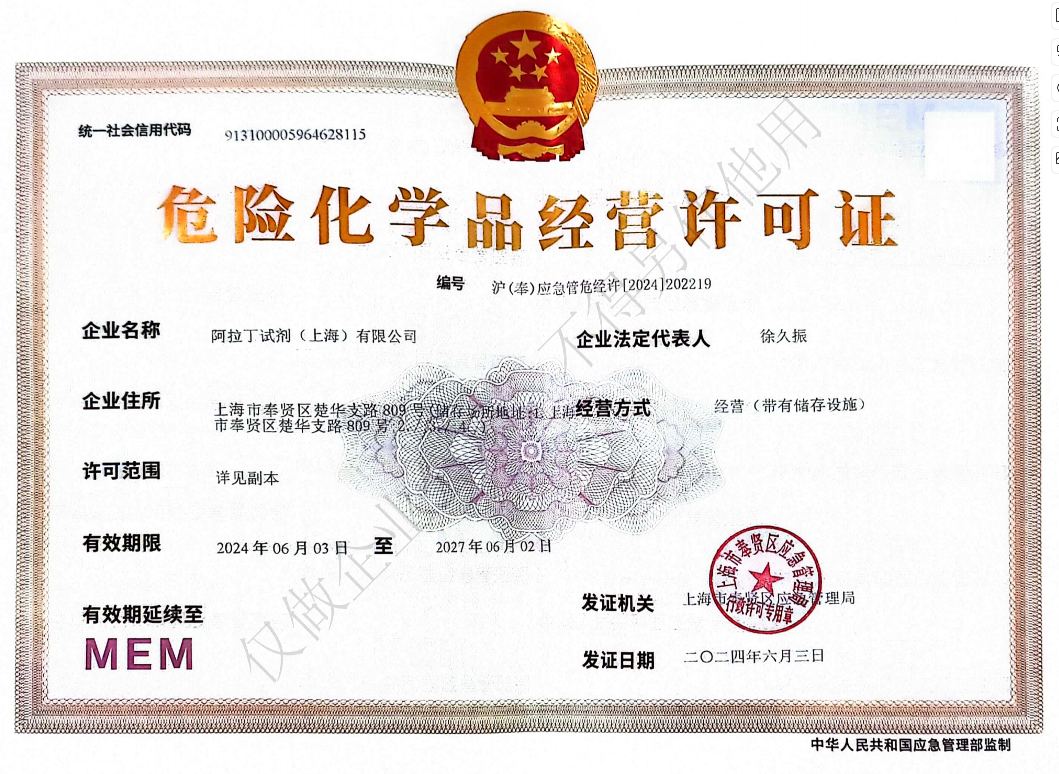 危险品化学品经营许可证(带存储)