Caspase 3 活性检测试剂盒(Caspase 3 Activity Assay Kit)是采用分光光度法检测细胞或组织裂解液中caspase 3酶活性或纯化的caspase 3酶活性的试剂盒。
Caspase(Cysteine-requiring Aspartate Protease)是一个在细胞凋亡过程中起重要作用的蛋白酶家族。Caspase 3属于caspase家族的CED-3亚家族,是哺乳动物细胞中研究最多的一个caspase。Caspase 3可以剪切procaspase 3、6、7和9,并可以直接特异性剪切许多caspase底物,这些由caspase 3介导的蛋白剪切是细胞凋亡分子机制的重要组成部分。另外,caspase 3在细胞核凋亡过程中也起到了关键作用,包括染色质固缩(chromatin condensation),DNA片段化(DNA fragmentation)等。
本Caspase 3 活性检测试剂盒是基于caspase 3可以催化底物Ac-DEVD-pNA(acetyl-Asp-Glu-Val-Asp p-nitroanilide)产生黄色的pNA(p-nitroaniline),从而可以通过测定吸光度来检测caspase 3的活性。pNA在405nm附近有强吸收。试剂盒中提供了caspase 3催化产生的黄色产物pNA,可以作为定量caspase 3酶活性的标准品。
C1373312 | Component | 20 T | 50 T | 100T | Storage conditions |
C1373312A | Lysis Buffer | 8 mL | 20 mL | 40 mL | -20℃. |
C1373312B | Assay Buffer | 8 mL | 20 mL | 40 mL | -20℃. |
C1373312C | Ac-DEVD-pNA(2 mM) | 200 μL | 500 μL | 1000 μL | -20℃.Store in the dark. |
C1373312D | pNA(10 mM) | 120 μL | 300 μL | 600 μL | -20℃.Store in the dark. |
C1373312E | DTT(100×) | 160 μL | 400 μL | 800 μL | -20℃.Store in the dark. |
C1373312F | Protease Inhibitor Cocktail(100×) | 80 μL | 200 μL | 400 μL | -20℃.Store in the dark. |
使用方法
1. 试剂准备
(1) Lysis Buffer:使用前,立即加入DTT和Protease Inhibitor Cocktail,每1 mL Lysis Buffer分别加入10 μL DTT (100×)和10 μL Protease Inhibitor Cocktail(100×),根据实验样本数量现配现用,冰上备用。
(2) Assay Buffer:使用前立即加入DTT,每1 mL Assay Buffer分别加入10 μL DTT (100×),根据实验样本数量现配现用,至于冰上备用。
(3) Ac-DEVD-pNA (2 mM):使用前置于冰上备用。根据实验样本数量适量分装,避免反复冻融。
(4) pNA (10 mM):使用前置于冰上备用。根据实验样本数量适量分装,避免反复冻融。
2. pNA标准曲线的设置
标准品稀释液的配制:按照每0.9 mL Assay Buffer加入0.1 mL Lysis Buffer的比例配制适量的标准品稀释液。
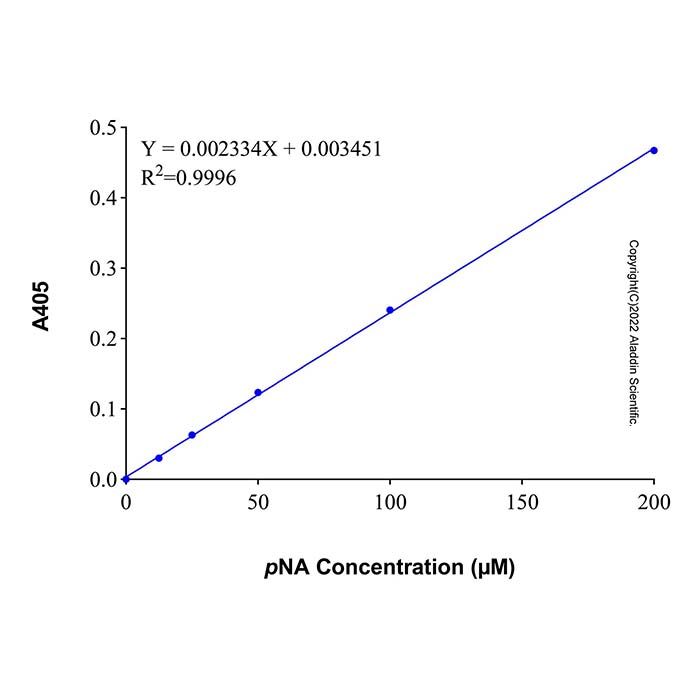
取6支EP管,第一支EP管中加入294 μL标准品稀释液,其他每管中加入150 μL标准品稀释液,从pNA (10 mM)标准品中吸取6 μL到第一支EP管中,混匀配成200 μM pNA标准溶液,吸取150 μL到第2支EP管,混匀后吸取150 μL到第3支EP管,按此步骤往后依次稀释,最后一支EP管为150 μL标准品稀释液。此时,标准品的浓度依次为200、100、50、25、12.5、0 μM。立即测定A405,并制作标准曲线。
3. 样本制备
(1)对于悬浮细胞:把没有诱导凋亡的对照样品和诱导凋亡的样品,600g 4℃离心5分钟收集细胞,小心吸除上清。PBS洗涤细胞一次后按照每200万细胞加入100微升裂解液的比例加入裂解液(如果裂解不充分,可以把裂解液的用量提高至150或200微升),重悬沉淀,冰浴裂解15分钟。
(2)对于贴壁细胞:用胰酶消化贴壁细胞,并收集至细胞培养液中。600g 4℃离心5分钟收集细胞,小心吸除上清。PBS洗涤细胞一次后按照每200万细胞加入100微升裂解液的比例加入裂解液(如果裂解不充分,可以把裂解液的用量提高至150或200微升),重悬沉淀,冰浴裂解15分钟。
(3)对于组织样本:按照每3-10 mg组织加入100微升裂解液的比例加入裂解液,在冰浴上用玻璃匀浆器匀浆。然后把匀浆液转移到1.5 mL离心管中,冰浴再裂解5分钟。
根据样本类型,按照上述步骤裂解细胞后,4℃ 16,000-20,000 g离心10-15分钟。把上清转移到预冷的离心管中,避免吸到沉淀或靠近沉淀的粘稠层。若样本粘稠度太大,可在冰浴上进行短促的脉冲超声,4℃ 16,000-20,000g离心10-15分钟,取上清用于检测。
立即测定caspase 3的酶活性或-70℃保存样品。同时可以取少量样品用Bradford法测定蛋白浓度,尽量使蛋白浓度达到1-3 mg/mL。
4. 活性检测
按照下表设置反应体系。在设置反应体系时先加检测缓冲液,再加待测样品,适当混匀,注意避免在混匀时产生气泡,最后再加入10 μL Ac-DEVD-pNA (2 mM)。
| Blank Control | Sample |
Assay Buffer | 40 μL | 40 μL |
Samples | - | 50 μL |
Lysis Buffer | 50 μL | - |
Ac-DEVD-pNA (2 mM) | 10 μL | 10 μL |
Total volume | 100 μL | 100 μL |
37℃孵育60-120分钟。发现颜色变化比较明显时即可测定A405。如果颜色变化不明显,可以适当延长孵育时间,甚至可以孵育过夜。样品的A405扣除空白对照的A405,即为样品中caspase 3催化产生的pNA产生的吸光度。通过标准曲线的对比就可以计算出样品中催化产生了多少量的pNA。
参考Chemicon公司的caspase 3酶活力单位的定义:One unit is the amount of enzyme that will cleave 1.0 nmol of the colorimetric substrate Ac-DEVD-pNA per hour at 37℃ under saturated substrate concentrations。即一个酶活力单位定义为当底物饱和时,在37℃一个小时内可以剪切1 nmol Ac-DEVD-pNA产生1 nmol pNA的caspase 3的酶量。这样就可以计算出样品中含有多少个酶活力单位的caspase 3。
注意事项
1. Ac-DEVD-pNA需尽量避免反复冻融,请注意适当分装。
2. 测定蛋白浓度需Bradford蛋白浓度测定试剂盒。建议样品用水稀释1倍后再用Bradford法测定蛋白浓度,以降低DTT对蛋白浓度测定的干扰。
3. pNA(中文名为4-硝基苯胺)对人体有毒,为了您的安全和健康,请穿实验服并戴一次性手套操作。
The Caspase 3 Activity Assay Kit is designed to measure caspase 3 enzyme activity in cell or tissue lysates, as well as the activity of purified caspase 3, using a spectrophotometric method.
Caspases (Cysteine-requiring Aspartate Proteases) are a family of proteases that play essential roles in apoptosis. Caspase 3, a member of the CED-3 subfamily within the caspase family, is the most extensively studied caspase in mammalian cells. It cleaves procaspases 3, 6, 7, and 9, and directly and specifically cleaves numerous caspase substrates. The protein cleavages mediated by caspase 3 are critical components of the molecular mechanism of apoptosis. Additionally, caspase 3 plays a pivotal role in nuclear events of apoptosis, including chromatin condensation and DNA fragmentation.
This Caspase 3 Activity Assay Kit is based on the ability of caspase 3 to catalyze the cleavage of the substrate Ac-DEVD-pNA (acetyl-Asp-Glu-Val-Asp p-nitroanilide), resulting in the release of the yellow chromophore pNA (p-nitroaniline). The activity of caspase 3 can thus be determined by measuring the absorbance of pNA, which exhibits strong absorption at approximately 405 nm. The kit includes the yellow pNA product generated by caspase 3 catalysis, which serves as a standard for quantifying caspase 3 enzyme activity.
C1373312 | Component | 20 T | 50 T | 100T | Storage conditions |
C1373312A | Lysis Buffer | 8 mL | 20 mL | 40 mL | -20℃. |
C1373312B | Assay Buffer | 8 mL | 20 mL | 40 mL | -20℃. |
C1373312C | Ac-DEVD-pNA(2 mM) | 200 μL | 500 μL | 1000 μL | -20℃.Store in the dark. |
C1373312D | pNA(10 mM) | 120 μL | 300 μL | 600 μL | -20℃.Store in the dark. |
C1373312E | DTT(100×) | 160 μL | 400 μL | 800 μL | -20℃.Store in the dark. |
C1373312F | Protease Inhibitor Cocktail(100×) | 80 μL | 200 μL | 400 μL | -20℃.Store in the dark. |
Usage Protocol
1. Reagent Preparation
1) Lysis Buffer: Immediately before use, add DTT and Protease Inhibitor Cocktail to the Lysis Buffer. For each 1 mL of Lysis Buffer, add 10 μL of DTT (100×) and 10 μL of Protease Inhibitor Cocktail (100×). Prepare fresh according to the number of experimental samples and keep on ice.
2) Assay Buffer: Immediately before use, add DTT to the Assay Buffer. For each 1 mL of Assay Buffer, add 10 μL of DTT (100×). Prepare fresh according to the number of experimental samples and keep on ice.
3) Ac-DEVD-pNA (2 mM): Aliquot an appropriate amount based on the number of experimental samples to avoid repeated freeze-thaw cycles. Keep on ice before use.
4) pNA (10 mM): Aliquot an appropriate amount based on the number of experimental samples to avoid repeated freeze-thaw cycles. Keep on ice before use.
2. Setup of pNA Standard Curve
Preparation of Standard Diluent: Prepare an adequate volume of standard diluent by mixing 0.9 mL of Assay Buffer with 0.1 mL of Lysis Buffer.
Take six microcentrifuge tubes. Add 294 μL of standard diluent to the first tube and 150 μL to each of the remaining five tubes. Pipette 6 μL from the pNA (10 mM) stock into the first tube and mix thoroughly to prepare a 200 μM pNA standard solution. Then, transfer 150 μL from the first tube to the second tube and mix. Continue this serial dilution by transferring 150 μL from the second tube to the third, and so on. The final tube contains 150 μL of standard diluent only. The resulting pNA standard concentrations are 200, 100, 50, 25, 12.5, and 0 μM.
3. Sample Preparation
1) For Suspension Cells: Collect both non-apoptotic control and apoptotic-induced samples by centrifugation at 600 × g for 5 minutes at 4°C. Carefully aspirate the supernatant. Wash the cell pellet once with PBS. Then, add Lysis Buffer to resuspend the pellet, using 100 μL of Lysis Buffer per 2 × 10⁶ cells (the volume may be increased to 150 or 200 μL if lysis is insufficient). Lyse the cells by incubating on ice for 15 minutes.
2) For Adherent Cells: Detach adherent cells using trypsin and collect them into culture medium. Collect the cells by centrifugation at 600 × g for 5 minutes at 4°C. Carefully aspirate the supernatant. Wash the cell pellet once with PBS. Then, add Lysis Buffer to resuspend the pellet, using 100 μL of Lysis Buffer per 2 × 10⁶ cells (the volume may be increased to 150 or 200 μL if lysis is insufficient). Lyse the cells by incubating on ice for 15 minutes.
3) For Tissue Samples: Add Lysis Buffer at a ratio of 100 μL per 3-10 mg of tissue. Homogenize the tissue using a glass homogenizer on ice. Transfer the homogenate to a 1.5 mL microcentrifuge tube and lyse further on ice for 5 minutes.
Following lysis according to the sample type, centrifuge the lysates at 16,000-20,000 × g for 10-15 minutes at 4°C. Carefully transfer the supernatant to a pre-chilled tube on ice, avoiding the pellet and any viscous layer adjacent to it. If the sample is highly viscous, perform brief pulse sonication on ice, followed by centrifugation at 16,000-20,000 × g for 10-15 minutes at 4°C, and then collect the supernatant for assay.
Determine the caspase-3 enzyme activity immediately, or store the samples at -70°C. A small aliquot of the sample can be taken to determine the protein concentration using the Bradford method; it is recommended to adjust the final protein concentration to 1-3 mg/mL.
4. Activity Assay
Set up the reaction mixture according to the table below. When preparing the reactions, first add the Assay Buffer, followed by the test sample. Mix gently, avoiding bubble formation. Finally, initiate the reaction by adding 10 μL of Ac-DEVD-pNA (2 mM).
Blank Control | Sample |
Assay Buffer | 40 μL | 40 μL |
Samples | - | 50 μL |
Lysis Buffer | 50 μL | - |
Ac-DEVD-pNA (2 mM) | 10 μL | 10 μL |
Total volume | 100 μL | 100 μL |
Incubate the reaction mixture at 37°C for 60–120 minutes. Measure the absorbance at 405 nm when a significant color change is observed. If the color change is subtle, the incubation time may be extended appropriately, or even carried out overnight if necessary. The net A405 resulting from pNA generated by caspase-3 catalysis is obtained by subtracting the A405 of the blank control from that of the sample. The amount of pNA produced can be quantified by comparing the net A405 to the pNA standard curve.
According to the caspase-3 enzyme activity unit defined by Chemicon: *One unit is the amount of enzyme that will cleave 1.0 nmol of the colorimetric substrate Ac-DEVD-pNA per hour at 37°C under saturated substrate concentrations. Thus, one unit of enzyme activity is defined as the amount of caspase-3 required to cleave 1 nmol of Ac-DEVD-pNA, yielding 1 nmol of pNA, per hour under saturated substrate conditions at 37°C. Based on this definition, the number of caspase-3 enzyme activity units present in the sample can be calculated.
Precautions
1. Ac-DEVD-pNA should be aliquoted appropriately to avoid repeated freeze-thaw cycles.
2. A Bradford Protein Assay Kit is required for determining protein concentration. To minimize interference from DTT, it is recommended to dilute the sample with an equal volume of water prior to measurement using the Bradford method.
3. pNA (chemical name: 4-nitroaniline) is toxic to humans. For your safety and health, please wear a lab coat and disposable gloves when handling this reagent.

 ZJ26F0332458


 危险品化学品经营许可证(带存储)