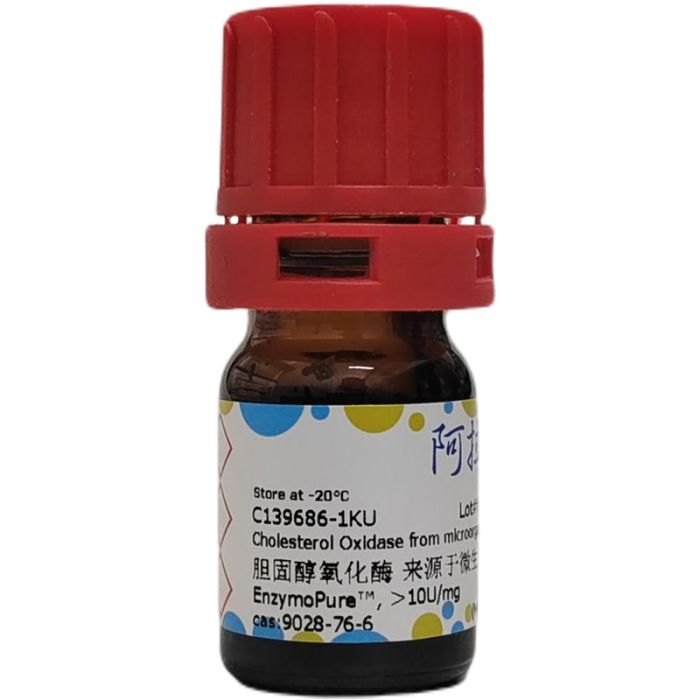
This product is a cholesterol oxidase preparation extracted from bacteria.
Catalysis
Cholesterol + O₂ → Cholest-4-en-3-one + H₂O₂
Specification and Preparation
Activity: ≥10 U/mg enzyme powder
Contaminant: Catalase activity ≤ 0.5%
Appearance: Light yellow to yellowish orange powder, lyophilized
Additives: Saccharose
Characteristics
Molecular weight: 64,000 (SDS-PAGE)
Isoelectric point: 4.7
Km: 3.0×10⁻⁵ M
Optimum pH: 7.0
pH stability: 5.0–9.0 (37°C, 1hr)
Optimum temperature: 45–50°C
Thermal stability: up to 40°C (4hr, dissolved in purified water)
Activator: Sodium cholate
Stabilizer: Sodium cholate
Application: Used for enzymatic determination of cholesterol in serum by coupling with cholesterol esterase in clinical diagnosis.
Safe Handling
1. Do not inhale.
2. In case of direct contact with skin or eyes, immediately wash or rinse with plenty of water.
General properties
The following results demonstrate the activities of enzyme solution prepared in various buffers.
Enzyme activity may vary under different experimental conditions.
Assay method
Principle
The appearance of quinoneimine dye formed by coupling with 4-aminoantipyrine and phenol is measured at 500 nm byspectrophotometry.
Unit Definition
One unit is defined as the enzyme quantity which oxidizes one µ mole of cholesterol per minute under the conditions described below.
Reagents
A. 4-Aminoantipyrine solution (5 mg/ml deionized water)
B. Triton X-100 stock solution (50 mg/ml deionized water)
C. Phenol solution (50 mg/ml deionized water)
D. 0.1M Phosphate buffer (KH₂PO₄-NaOH, pH 7.0)
E. 0.1% Triton-X Solution
Dilute Triton X-100 stock solution (B) to 0.1% concentration with deionized water.
F. Aminoantipyrine-phenol solution
Mix 5.5 ml of 4-Aminoantipyrine solution (A), 5.5 ml of Phenol solution (C) and 29 ml of TritonX-100 stock solution (B), then fill up to 500 ml with 0.1 M Phosphate buffer (D). After preparation, release the lid of the container and allow the solution to stand under refrigeration for 24 hours before use. (Can be used for 3 months in light-shielded and refrigerated storage)
G. Substrate solution
Weigh 23 mg of cholesterol and dissolve in 10 ml of 2-propanol. (Can be used for 5 days at room temperature)
H. Peroxidase solution
Dissolve 330 units of Peroxidase in 2ml of chilled 0.1 M Phosphate buffer (D). (Can be used for 2 weeks at 2-8℃)
I. Working solution
Mix 1ml of Substrate solution (G) and 58 ml of Aminoantipyrine-phenol solution (F), then add 1 ml of Peroxidase solution (H) and mix. (Can be used for 18 days in light-shielded and refrigerated storage)
J. Enzyme solution
Weigh 20 mg of Cholesterol Oxidase and dissolve in 5 ml of deionized water and keep the solution at 37±0.5℃ in a water bath for 4 hours. Then, after cooling down in an ice bath, dilute the solution with chilled 0.1% Triton X-100 solution (E). Enzyme solution should be prepared so that the value of ΔOD/minute becomes in the range of 0.020±0.005.
Procedure
Put 3ml of Working solution (I) into a quartz cell (d = 10 mm) and keep at 37±0.5℃ for 10 minutes. Then, pipette 0.1 ml of Enzyme Solution (J) into the quartz cell and mix well immediately. Keep the reaction mixture at 37±0.5℃. Exactly at 3 minutes and 6 minutes after the addition of Enzyme solution (J), measure the absorbances of the reaction mixture at 500 nm (A3 and A6). As a blank, pipette 0.1% Triton X-100 solution (E) into another quartz cell instead of Enzyme solution (J) and take the same procedure described above (Ab3 and Ab6).
Calculation
3: Reaction time
13.6: Millimolar absorption coefficient of quinoneimine dye
2: Conversion factor (1 mole of quinoneimine dye equivalent to 2 mole of cholesterol)
3.1: Volume of the reaction mixture
0.1: Volume of Enzyme solution
n: Dilution factor of Enzyme solution



 G2408506

 危险品化学品经营许可证(带存储)