
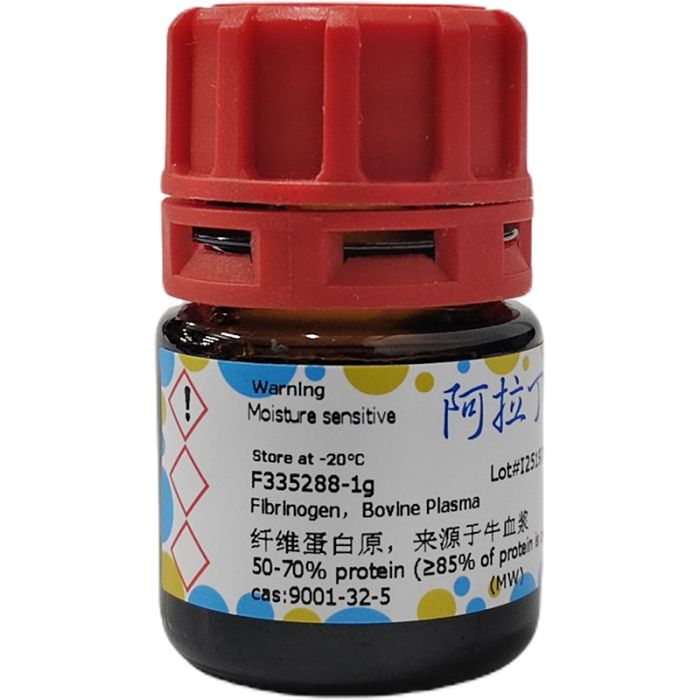
纤维蛋白原(Fibrinogen,Fg),即凝血因子 I,分子量约为 340 kDa。纤维蛋白原为共价二聚体,由 2 条 α 链、2 条 β 链、2 条 γ 链三对不同的多肽链组成,各肽链之间通过二硫键相连。α 链分子量 63.5 kDa,β 链分子量 56 kDa,γ 链分子量 47 kDa;两个对称亚基在肽链 N 端附近通过三对二硫键相连,形成中间球状结构。
纤维蛋白原参与凝血的原理:在凝血酶作用下,α 链与 β 链分别释放 A 肽与 B 肽,生成纤维蛋白单体。在此过程中,酸性多肽被释放,分子负电性下降,单体易于聚合形成纤维蛋白多聚体;此时单体之间依靠氢键、疏水键结合,该多聚体可溶于稀酸与尿素溶液。进一步在 Ca²⁺和活化 XIII 因子(谷氨酰胺转移酶,纤维蛋白稳定因子)作用下,单体之间形成共价交联,转变为稳定、不可溶的纤维蛋白凝块,完成凝血过程。此外,纤维蛋白原还参与体内炎症、组织损伤、组织修复等一系列生理及病理过程。
Fibrinogen (Fg), also known as Coagulation Factor I, has a molecular weight of approximately 340 kDa. Fibrinogen is a covalent dimer composed of three pairs of distinct polypeptide chains: two α chains, two β chains and two γ chains. The peptide chains are linked to one another via disulfide bonds. The molecular weight of the α chain is 63.5 kDa, the β chain is 56 kDa, and the γ chain is 47 kDa. The two symmetric subunits are connected by three pairs of disulfide bonds near the N-termini of the polypeptide chains to form a central globular region.
Mechanism of fibrinogen in coagulation: Under the action of thrombin, peptide A and peptide B are released from the α chains and β chains respectively, generating fibrin monomers. During this process, the release of acidic peptides reduces the negative charge, which facilitates the polymerization of monomers into fibrin polymers. At this stage, monomers are connected by hydrogen bonds and hydrophobic interactions, and the polymer is soluble in dilute acid and urea solutions. Subsequently, in the presence of Ca²⁺ and activated Factor XIII (transglutaminase, fibrin-stabilizing factor), the monomers are covalently cross-linked to form stable insoluble fibrin clots, completing the coagulation cascade. In addition, fibrinogen participates in a series of physiological and pathological processes including inflammation, tissue injury and tissue repair in vivo.
