
 G2629091
计算溶液所需的质量、体积或浓度。
为什么选择此级别
,适用于对基线干扰要求严格的色谱和分析工作流程。
储存与运输
室温。 。请查阅批次 COA 获取详细规格。
质量文档
SDS、COA、产品数据表及规格说明书均可下载。可通过批号查询获取批次 COA。
文献证明
在色谱分析、有机合成和交叉偶联反应领域已被 211 篇同行评审文献引用。
概述
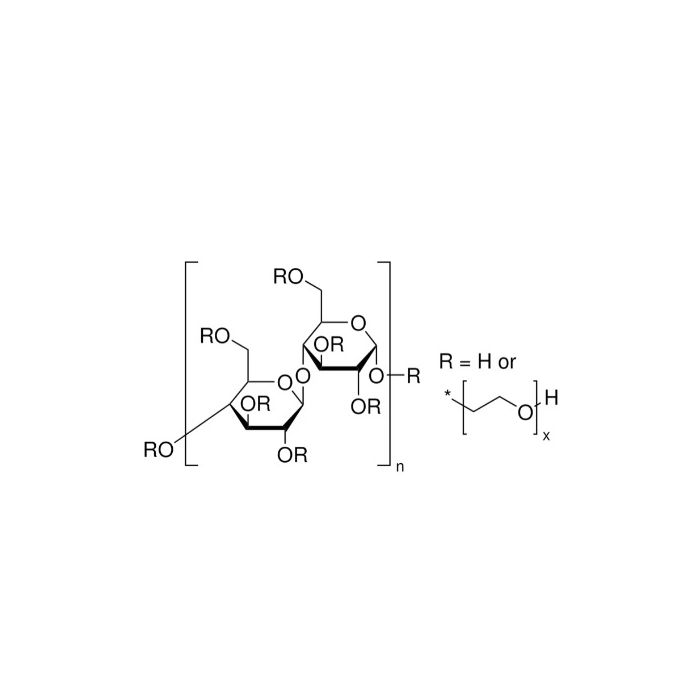
2-羟乙基纤维素(HEC)是一种水溶性生物聚合物,主要用作增稠剂和粘合剂。具有保水性能和良好的成膜能力,用于保护性覆盖物。 非离子型水溶性聚合物。水溶液为假塑性的。易于分散,不会结块。
应用
增稠剂、保护胶体、粘合剂、稳定剂和悬浮剂。
2-Hydroxyethyl cellulose (HEC) is a water soluble biopolymer that is majorly used as a thickener and an adhesive. It has water retention properties and good film forming ability for protective covering. Non-ionic water soluble polymer. Aqueous solutions are pseudoplastic. Readily disperses without lumping.
Application
Thickener, protective colloid, binder, stabilizer and suspending agent.
规格
英文别名
H11622 | Hydroxyethyl-cellulose | 2-Hydroxyethyl cellulose | DTXSID60873934 | 2-O-(2-Hydroxyethyl)-4-O-methylhexopyranosyl-(1->4)-[4-O-methylhexopyranosyl-(1->6)]hexopyranosyl-(1->5)-2,6-anhydro-1-deoxyheptitol | FT-0627136 | SCHEMBL23306563 | 5-[6-[[3,4-
规格或纯度
average Mv ~90,000
英文名称
2-Hydroxyethyl cellulose
储存条件
室温
名称和识别符
PubChem SID
EC号
618-387-5
分子类型
聚合物
IUPAC Name
5-[6-[[3,4-dihydroxy-6-(hydroxymethyl)-5-methoxyoxan-2-yl]oxymethyl]-3,4-dihydroxy-5-[4-hydroxy-3-(2-hydroxyethoxy)-6-(hydroxymethyl)-5-methoxyoxan-2-yl]oxyoxan-2-yl]oxy-6-(hydroxymethyl)-2-methyloxane-3,4-diol
INCHI
1S/C29H52O21/c1-10-15(34)16(35)24(13(8-33)45-10)49-28-20(39)18(37)25(50-29-26(43-5-4-30)21(40)23(42-3)12(7-32)47-29)14(48-28)9-44-27-19(38)17(36)22(41-2)11(6-31)46-27/h10-40H,4-9H2,1-3H3
InChi Key
CWSZBVAUYPTXTG-UHFFFAOYSA-N
Smiles
CC1C(C(C(C(O1)CO)OC2C(C(C(C(O2)COC3C(C(C(C(O3)CO)OC)O)O)OC4C(C(C(C(O4)CO)OC)O)OCCO)O)O)O)O
Isomeric SMILES
CC1C(C(C(C(O1)CO)OC2C(C(C(C(O2)COC3C(C(C(C(O3)CO)OC)O)O)OC4C(C(C(C(O4)CO)OC)O)OCCO)O)O)O)O
Reaxy-Rn
24866087
Reaxys-RN link address
https://www.reaxys.com/reaxys/secured/hopinto.do?context=S&query=IDE.XRN=24866087&ln=
技术文档
高级数据
系统学分类
分类树(Taxonomy Tree)
-
界(kingdom)
有机化合物
-
超类(Superclass)
有机氧化合物
-
类(Class)
有机氧化合物
- 亚类(Subclass) 碳水化合物和碳水化合物结合物
-
类(Class)
有机氧化合物
-
超类(Superclass)
有机氧化合物
| 界(kingdom) | 有机化合物 |
|---|---|
| 超类(Superclass) | 有机氧化合物 |
| 类(Class) | 有机氧化合物 |
| 亚类(Subclass) | 碳水化合物和碳水化合物结合物 |
| 中间层级节点(Intermediate Tree Nodes) | 暂无 |
| 直接上位类(Direct Parent) | 寡糖 |
| 其他上位类(Alternative Parents) | O-糖基化合物 氧烷 仲醇 氧环化合物 二烷基醚 缩醛 伯醇 碳氢化合物衍生物 |
| 分子骨架(Molecular Framework) | 脂肪族杂单环化合物 |
| 取代基(Substituents) | 乙醛酸 - 羟基苯甲酸酯 - 脂肪族杂单环化合物 - 二烷基醚 - 乙醚 - 糖基化合物 - 烃衍生物 - O-羧基化合物 - 萜类化合物 - 有机杂环化合物 - 氧杂环 - 氧杂环丁烷 - 初级醇 - 醛基 |
| 描述(Description) | 该化合物属于有机化合物中的寡糖类。这类碳水化合物由3至10个单糖单元通过糖苷键相互连接构成。 |
| 外部描述符(External Descriptors) | 暂无 |
三维结构
交互式化学结构模型
化学和物理性质
密度
0.6g/mLat 25°C (lit.)
熔点
288-290°C
分子量
736.700 g/mol
XLogP3
-7.700
氢键供体数Hydrogen Bond Donor Count
11
氢键受体数Hydrogen Bond Acceptor Count
21
可旋转键计数Rotatable Bond Count
15
精确质量Exact Mass
736.3 Da
单同位素质量Monoisotopic Mass
736.3 Da
拓扑极表面积Topological Polar Surface Area
315.000 Ų
重原子数Heavy Atom Count
50
形式电荷Formal Charge
0
复杂度Complexity
999.000
同位素原子数Isotope Atom Count
0
定义的原子立体中心计数Defined Atom Stereocenter Count
0
未定义的原子立体中心计数Undefined Atom Stereocenter Count
20
定义的键立体中心计数Defined Bond Stereocenter Count
0
未定义的键立体中心计数Undefined Bond Stereocenter Count
0
所有立体化学键的总数The total count of all stereochemical bonds
0
共价键合单元计数Covalently-Bonded Unit Count
1
安全和危险性(GHS)
象形图
信号词
警告
危险声明
H315: 引起皮肤刺激
预防措施声明
P261: 避免吸入灰尘/烟雾/气体/雾/蒸汽/喷雾
P264: 处理后要彻底洗手。
P271: 仅在室外或通风良好的地方使用。
P280: 戴防护手套/穿防护服/戴防护眼罩/戴防护面具。
P302+P352: 如皮肤沾染:用水充分清洗。
P304+P340: 如误吸入:将人转移到空气新鲜处,保持呼吸舒适体位。
P305+P351+P338: 如进入眼睛:用水小心冲洗几分钟。如戴隐形眼镜并可方便地取出,取出隐形眼镜。继续冲洗。
P362+P364: 脱掉沾污的衣服,清洗后方可重新使用。
P405: 密闭存放
P403+P233: 存放在通风良好的地方。保持容器密闭。
P501: 将内容物/容器处理到。。。
WGK Germany
1
RTECS
FJ5958000
Merck Index
4673
个人防护装备
Eyeshields,Gloves,type N95 (US),type P1 (EN143) respirator filter
质检证书(CoA,COO,BSE/TSE 和分析图谱)
C of A & Other Certificates(BSE/TSE, COO):
输入批号以搜索分析图谱:
技术文档和文章
Microcrystalline Cellulose (MCC): A Comprehensive Primer and Selection Guide—Structural Features, Key Performance Metrics, and Application Scenarios
目录: 技术文章
Understanding Hydrophilic Polymers in Aqueous Systems: Hydration Mechanisms, Structural Knobs, and Task-Oriented Selection Guide (Including Tables 1–3)
目录: 技术文章
Applications and Selection of Acrylic Resins in Coatings: Analysis of Architectural, Industrial, and Supporting Materials
目录: 技术文章
Natural Resins in Coating Formulations: Functional Positioning, Structure–Property Relationships, and Selection Validation
目录: 技术文章
Waterborne Resin Technology Explained: Waterborne Forms, Performance Balance, and a Technology Map
目录: 技术文章
Waterborne Resin Application Guide: Formulation Synergy, Troubleshooting, and Technology Development Trends
目录: 技术文章
Why LABSA (Sulfonic Acid) Is Commonly Used in Household Cleaning Formulations: Neutralization Mechanism, Detergency Action, and Formulation Application Points
目录: 技术文章
From Structure to Performance: Conditioning, Film-Forming, Thickening, and Chelating Applications of Functional Ingredients in Personal Care and Home Care
目录: 技术文章
From Structure to Rheology: How Carbomer Forms Gel Structures and Enables Thickening, Suspension, and Auxiliary Emulsion Stabilization
目录: 技术文章
What Is the Difference Between Triethanolamine and Diethanolamine: Understanding Their Formulation Functions, Application Differences, and Selection Logic from a Molecular-Structure Perspective
目录: 技术文章
Thickening, Suspension, Auxiliary Stabilization, and Agglomeration Mechanisms of Xanthan Gum in Personal Care Formulations: From Molecular Structure to Processing Applications
目录: 技术文章
Dispersants, Anti-Redeposition Agents, and Scale-Control Materials in Household Cleaning Formulations: Mechanisms of Action, Selection Logic, and Representative Products
目录: 技术文章
AES (Fatty Alcohol Polyoxyethylene Ether Sulfate) in Personal and Home-Care Cleansing Formulations: An Analysis of Structure, Performance, and Low-Temperature Flowability
目录: 技术文章
Understanding CAPB from Its Structure: How Cocamidopropyl Betaine Improves Foam, Enhances Mildness, and Supports Thickening
目录: 技术文章
From Structure to Rheology: Thickening, Stabilization, and Selection Logic of Cellulose Ethers for Personal Care Applications
目录: 技术文章
How to Select Thickeners for Strongly Acidic Cleaning Systems: Comparison of Thickening Mechanisms and Application Considerations for Fatty Amine Ethoxylates
目录: 技术文章
Analysis of the Production Process of Hydroxypropyl Methylcellulose (HPMC) for Putty: Understanding Differences in Substitution Structure and Gelation Temperature from High-Ratio and Low-Ratio Formulations
目录: 技术文章
Why Are Daily Chemical Products Prone to Viscosity Thinning in Summer? Core Mechanisms, Troubleshooting Methods, and Solutions
目录: 技术文章
Types, Mechanisms of Action, Key Quality Indicators, and Selection and Application of Common Cellulose Ethers in Wall Putty
目录: 技术文章
Influencing Factors and Control Strategies for Blistering in Neutral Wall Putty: An Experimental Analysis Based on HPMC Dosage, Viscosity, and Ground Calcium Carbonate Fineness
目录: 技术文章
How to Select Binding/Gel Materials for Neutral Wall Putty? A Comparison of Pregelatinized Starch, PVA, and Redispersible Polymer Powder Based on Four Application Trials
目录: 技术文章
耐水腻子打磨脱层的原因与机理分析
目录: 技术文章
What Are the Differences Between Polyvinyl Alcohol 1788, 2488, and 2699? Understanding Workability, Bonding Strength, and Relative Water Resistance from the Perspective of Degree of Polymerization and Degree of Hydrolysis
目录: 技术文章
Common Problems and Formulation Adjustment Strategies for Neutral Putty Under High Summer Temperatures
目录: 技术文章
Differences and Application Selection of Cassava- and Corn-Based Pregelatinized Starch in Neutral Putty Formulations
目录: 技术文章
The Role, Selection, Cracking Risk Analysis, and Dosage Control of Bentonite in Neutral Putty
目录: 技术文章
Dispersants, Anti-Redeposition Agents, and Scale-Control Materials in Household Cleaning Formulations: Mechanisms of Action, Selection Logic, and Representative Products
目录: 技术文章
此产品的引用文献
溶液计算器
相关产品
羟乙基纤维素(HEC)-100~200mpa.s,25℃,CAS:9004-62-0
羟乙基纤维素(HEC)-3400~5000mpa.s,25℃,CAS:9004-62-0
羟乙基纤维素(HEC)-250~450mpa.s,25℃,CAS:9004-62-0
羟乙基纤维素(HEC)-1000~1500mpa.s,25℃,CAS:9004-62-0
羟乙基纤维素(HEC)-1500~2500mpa.s,25℃,用于羟乙基纤维素在药物固体、液体制剂中具有表面活性、增稠、悬浮、粘合、乳化、成膜、分散、保水及提供保护作用。各种应用,CAS:9004-62-0
羟乙基纤维素(HEC)-2600~3300mpa.s,25℃,用于羟乙基纤维素在药物固体、液体制剂中具有表面活性、增稠、悬浮、粘合、乳化、成膜、分散、保水及提供保护作用。各种应用,CAS:9004-62-0
羟乙基纤维素(HEC)-5000~6400mpa.s,25℃,用于羟乙基纤维素在药物固体、液体制剂中具有表面活性、增稠、悬浮、粘合、乳化、成膜、分散、保水及提供保护作用。各种应用,CAS:9004-62-0
羟乙基纤维素(HEC)-100~200mpa.s,25℃ ,Cu<30ppm,Fe<30ppm,Zn<30ppm,Ca<100ppm,CAS:9004-62-0
2-羟乙基纤维素(HEC)-average Mw~380,000,CAS:9004-62-0
2-羟乙基纤维素(HEC)-average Mv ~720,000,CAS:9004-62-0
2-羟乙基纤维素(HEC)-average Mv ~1,300,000,CAS:9004-62-0
羟乙基纤维素(HEC)-800-1,500mPa·s, 20℃时2%的水溶液,CAS:9004-62-0
产品仅提供给经过验证的企业、机构和合格的专业人员用于研发。不适用于人类、动物、诊断或治疗。
Copyright © 2023至今 上海阿拉丁生化科技股份有限公司 保留所有权利。


 危险品化学品经营许可证(带存储)