NAD (Nicotinamide adenine dinucleotide,烟酰胺腺嘌呤二核苷酸)是所有细胞中都存在的一种辅酶,包括NAD+ (氧化型)和NADH (还原型)两种形式。NAD+既是氧化还原反应过程中传递电子的辅酶,又可以作为很多酶的底物来参与细胞内反应。NAD+在细胞和体内发挥着重要的功能,其合成和降解及其产物参与细胞凋亡、代谢调控和基因表达的调控等,并且NAD+的减少是细胞死亡的主要因素之一。NAD+在调节细胞氧化还原状态方面的重要性以及调控信号通路及转录方面的功能,使得NAD+及其合成和消耗的酶成为多种疾病的潜在药物靶点。
本试剂盒可检测样品中的NAD+、NADH以及它们的比值,具体原理如下:乙醇在乙醇脱氢酶的作用下氧化生成乙醛,在这一反应过程中NAD+被还原为NADH。生成的NADH在电子耦合试剂1-mPMS的作用下将WST-8还原生成橙黄色的formazan,在450 nm左右有最大吸收峰。反应体系中生成的formazan与样品中NAD+或NADH的量呈比例关系。利用NAD⁺和NADH在极端pH环境下稳定性相反的特性,通过酸性提取液稳定并提取NAD⁺,通过碱性提取液稳定并提取NADH。通过二者的数值也可计算出NAD+/NADH的比值。
产品组分
N1373343 | 组件 | 物理外观 | 100 T | 储存 | 单次测试使用量 |
N1373343A | 乙醇脱氢酶 | 液体 | 200 μL | -20℃.避光 | 2 μL |
N1373343B | 无水乙醇 | 液体 | 200 μL | -20℃.避光 | 2 μL |
N1373343C | 检测缓冲液 | 液体 | 20 mL | -20℃ | 86 μL |
N1373343D | NADH标准品(5 mg) | 粉末 | 5 mg | -20℃.避光 | 按需 |
N1373343E | NADH配制液 | 液体 | 2 mL | -20℃ | 按需 |
N1373343F | 显色液 | 液体 | 200 μL | -20℃.避光 | 2 μL |
N1373343G | NADH提取液 | 液体 | 30 mL | -20℃ | 按需 |
N1373343H | NAD+提取液 | 液体 | 30 mL | -20℃ | 按需 |
使用方法
1. 样本制备
推荐使用新鲜样本,如果不立即进行实验,样本可在-80℃短期保存。当准备好进行该项实验时,将样本从-80℃拿出后,冰上解冻,但是请注意,这可能会影响样本的稳定性,实验结果可能会低于预期。
(1)组织样本的提取
冰上预冷的PBS洗涤组织后,称取约20 mg的组织样品,用剪刀剪碎,置于匀浆器中。
提取NAD+:加入100 µL NAD+提取液匀浆样本。60℃加热5 min,冰上冷却后加入20 µL检测缓冲液和100 µL NADH提取液中和提取物。4℃,14000 rpm离心5 min,将上清转移到新离心管,冰上待测。
提取NADH:加入100 µL NADH提取液匀浆样本。60℃加热5 min,冰上冷却后加入20 µL检测缓冲液和100 µL NAD+提取液中和提取物。4℃,14000 rpm离心5 min,将上清转移到新离心管,冰上待测。
(2)细胞或细菌样本的提取
收集细胞或细菌样本(样本量建议为1×10⁶个/次),用冷PBS清洗细胞或细菌,低速离心5 min,弃上清液。
提取NAD+:加入100 µL NAD+提取液,超声波破碎5 min(功率20%或 200 W,超声3 s,间隔7 s,重复30 次),60℃加热5 min,冰上冷却后加入20 µL检测缓冲液和100 µL NADH提取液中和提取物。4℃,14000 rpm离心5 min,将上清转移到新离心管,冰上待测。
提取NADH:加入100 µL NADH提取液,超声波破碎5 min(功率20%或200 W,超声3 s,间隔7s,重复30 次),60℃加热5 min,冰上冷却后加入20 µL检测缓冲液和100 µL NAD+提取液中和提取物。4℃,14000 rpm 离心5 min,将上清转移到新离心管,冰上待测。
2. 标准品的配制
(1)吸取705 μL NADH配制液,充分溶解本试剂盒提供的5 mg NADH后即得到10 mM NADH标准品。请适当分装后-80℃避光保存,禁止反复冻融。
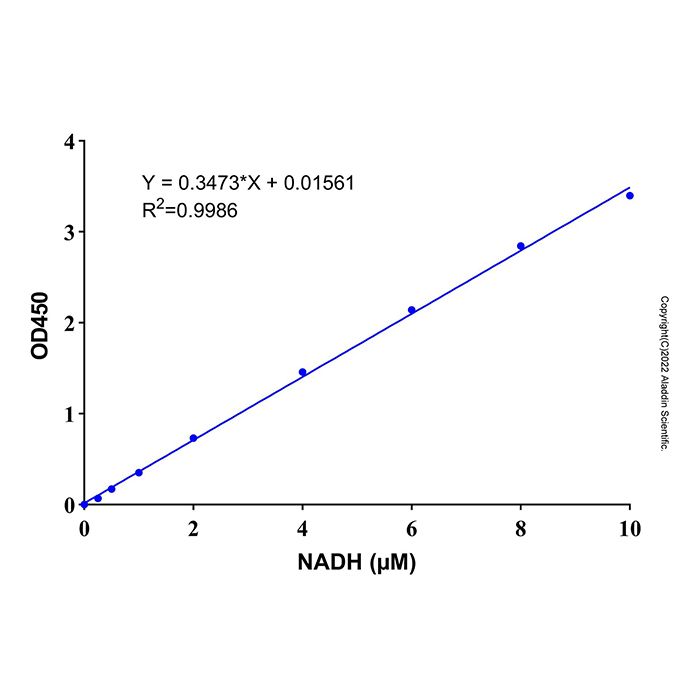
(2)NADH标准曲线的设置:取2 μL的10 mM的NADH标准品加入到1.998 mL的检测缓冲液中,稀释成10 μM。将10 μM的NADH标准品按照下表稀释成0、0.25、0.5、1、2、4、6、8、10 μM这几个浓度。检测时96孔板中每孔加入20 μL的标准品,相当于每孔为0、5、10、20、40、80、120、160、200 pmol的NADH。由于NADH很不稳定,故配制后需尽快使用。
序号 | 浓度(μM) | 标准品(μL) | 检测缓冲液(μL) |
1 | 10 | 80 | 0 |
2 | 8 | 64 | 16 |
3 | 6 | 48 | 32 |
4 | 4 | 32 | 48 |
5 | 2 | 16 | 64 |
6 | 1 | 8 | 72 |
7 | 0.5 | 4 | 76 |
8 | 0.25 | 2 | 78 |
NC | 0 | 0 | 80 |
3. 工作液的配置
(1)乙醇脱氢酶工作液的配置:吸取2 μL乙醇脱氢酶和2 μL无水乙醇加入到86 μL的检测缓冲液中,即可获得90 μL的乙醇脱氢酶工作液。每个标准品或样品的检测需要使用90 μL的乙醇脱氢酶工作液,请根据所需检测的标准品和样品的数量,配制适量的乙醇脱氢酶工作液,并注意现配现用。
(2)显色液工作液的配置:吸取2 μL的显色液加入到8 μL的检测缓冲液中得到10 μL的显色工作液。每个标准品或样品的检测需要使用10 μL的显色工作液,请根据所需检测的标准品和样品的数量,配制适量的显色工作液,并注意现配现用。
4. 样品测定
(1)请参考下表使用96孔板设置空白对照孔、标准品孔和样品孔。加入乙醇脱氢酶工作液后充分混匀。37℃避光孵育5分钟,将样品中的NAD+转化为NADH。
试剂 | 空白孔 | 标准孔 | 测定孔 |
待测样品 | - | - | 20 μL |
不同浓度标准品 | - | 20 μL | - |
检测缓冲液 | 20 μL | - | - |
乙醇脱氢酶工作液 | 90 μL | 90 μL | 90 μL |
(2)取出稀释好的显色工作液,每孔加入10 μL,混匀,37ºC避光孵育15-20分钟。测量450 nm处的吸光度。如果显色较浅,也可以适当延长孵育时间至30-60分钟。
5. 结果计算
计算ΔA测=A测-A空,ΔA标=A标-A空。以标准品浓度为X轴,ΔA标为Y轴,绘制标准曲线。将ΔA测代入方程得到X值(µM)。按照如下公司计算样本NAD+或NADH的含量。
(1)按样本质量计算:
NAD+ 或 NADH (nmol/g 鲜重) =(X×V 样)÷(W×V 样÷V 提取)×n=0.22×X÷W×n
(2)按样本蛋白浓度计算:
NAD+ 或 NADH (nmol/mg prot)=(X×V 样)÷(V样×Cpr)×n=X÷Cpr×n
(3)按细胞或细菌数量计算:
NAD+ 或 NADH (nmol/104)=(X×V 样)÷(N×V 样÷V提取)×n=0.22×X÷N×n
其中,x:带入标曲得到的NADH浓度(1 μM=1 nmol/mL);V 样:加入样本体积( 0.02 mL );V 提取:提取液总体积(0.22 mL);Cpr:样本蛋白质浓度(mg/mL);W:样本质量(g);N:细胞或细菌数量,以 104为单位(例如细胞数量为 1×10⁶,N=100);n:稀释倍数。
注意事项
1. 当仅检测样品中NAD+或NADH的量时,一个本试剂盒可以进行100次检测;当检测NAD+/NADH的比值时,一个本试剂盒可以进行50次检测。
2. 正式检测前,建议选择 2-3 个预期差异较大的样本进行预实验。。
3. NADH配制成溶液后,须适当分装后-80℃保存。所有试剂避免反复冻融。
4. 乙醇脱氢酶不稳定,请勿长时间室温放置。
NAD (Nicotinamide adenine dinucleotide) is a coenzyme present in all cells, existing in two forms: NAD⁺ (oxidized form) and NADH (reduced form). NAD⁺ not only serves as a coenzyme that transfers electrons in redox reactions but also acts as a substrate for many enzymes involved in intracellular reactions. NAD⁺ plays important roles in cellular and physiological functions, and its synthesis, degradation, and related products are involved in apoptosis, metabolic regulation, and gene expression regulation. A decrease in NAD⁺ is one of the major factors leading to cell death. The importance of NAD⁺ in regulating cellular redox status and its functions in modulating signaling pathways and transcription make NAD⁺ and the enzymes involved in its synthesis and consumption potential drug targets for various diseases.
This kit can detect NAD⁺, NADH, and their ratio in samples. The specific principle is as follows: Ethanol is oxidized to acetaldehyde by alcohol dehydrogenase, during which NAD⁺ is reduced to NADH. The generated NADH then reduces WST-8 to an orange-yellow formazan dye in the presence of the electron coupling reagent 1-mPMS, which has a maximum absorption peak at approximately 450 nm. The amount of formazan generated is proportional to the amount of NAD⁺ or NADH in the sample. By utilizing the opposite stability of NAD⁺ and NADH under extreme pH conditions, NAD⁺ is stabilized and extracted using an acidic extraction buffer, while NADH is stabilized and extracted using an alkaline extraction buffer. The NAD⁺/NADH ratio can also be calculated from the obtained values.
Components
N1373343 | Components | Appearance | 100 T | Storage | Quantity Per Test |
N1373343A | Alcohol Dehydrogenase | Liquid | 200 μL | -20°C, dark | 2 μL |
N1373343B | Absolute ethanol | Liquid | 200 μL | -20°C, dark | 2 μL |
N1373343C | Assay Buffer | Liquid | 20 mL | -20°C | 86 μL |
N1373343D | NADH Standard (5 mg) | Powder | 5 mg | -20°C, dark | As needed |
N1373343E | NADH Diluent | Liquid | 2 mL | -20℃ | As needed |
N1373343F | Chromogenic Solution | Liquid | 200 μL | -20°C, dark | 2 μL |
N1373343G | NADH Extraction Buffer | Liquid | 30 mL | -20℃ | As needed |
N1373343H | NAD+ Extraction Buffer | Liquid | 30 mL | -20℃ | As needed |
Usage Protocol
1. Sample Preparation
Fresh samples are recommended. If the experiment is not performed immediately, samples can be stored at –80 °C for a short period. When ready to perform the experiment, thaw samples on ice after removing from –80 °C. However, please note that this may affect sample stability, and the experimental results may be lower than expected.
1) Extraction from Tissue Samples
After washing the tissue with pre‑cooled PBS on ice, weigh approximately 20 mg of tissue, cut it into small pieces with scissors, and place it into a homogenizer.
Extraction of NAD⁺: Add 100 µL of NAD⁺ Extraction Buffer and homogenize the sample. Heat at 60 °C for 5 min. After cooling on ice, add 20 µL of Assay Buffer and 100 µL of NADH Extraction Buffer to neutralize the extract. Centrifuge at 4 °C and 14,000 rpm for 5 min, transfer the supernatant to a new centrifuge tube, and keep on ice for testing.
Extraction of NADH: Add 100 µL of NADH Extraction Buffer and homogenize the sample. Heat at 60 °C for 5 min. After cooling on ice, add 20 µL of Assay Buffer and 100 µL of NAD⁺ Extraction Buffer to neutralize the extract. Centrifuge at 4 °C and 14,000 rpm for 5 min, transfer the supernatant to a new centrifuge tube, and keep on ice for testing.
2) Extraction from Cell or Bacterial Samples
Collect cells or bacteria (recommended sample amount: 1 × 10⁶ per sample), wash with cold PBS, centrifuge at low speed for 5 min, and discard the supernatant.
Extraction of NAD⁺: Add 100 µL of NAD⁺ Extraction Buffer and perform ultrasonic disruption for 5 min (power 20% or 200 W, sonicate for 3 s, pause for 7 s, repeat 30 times). Heat at 60 °C for 5 min. After cooling on ice, add 20 µL of Assay Buffer and 100 µL of NADH Extraction Buffer to neutralize the extract. Centrifuge at 4 °C and 14,000 rpm for 5 min, transfer the supernatant to a new centrifuge tube, and keep on ice for testing.
Extraction of NADH: Add 100 µL of NADH Extraction Buffer and perform ultrasonic disruption for 5 min (power 20% or 200 W, sonicate for 3 s, pause for 7 s, repeat 30 times). Heat at 60 °C for 5 min. After cooling on ice, add 20 µL of Assay Buffer and 100 µL of NAD⁺ Extraction Buffer to neutralize the extract. Centrifuge at 4 °C and 14,000 rpm for 5 min, transfer the supernatant to a new centrifuge tube, and keep on ice for testing.
2. Preparation of Standard
1) Pipette 705 μL of NADH Diluent to fully dissolve the 5 mg NADH provided in the kit, thereby obtaining a 10 mM NADH standard. Aliquot appropriately, store at –80 °C protected from light, and avoid repeated freeze‑thaw cycles.
2) Setting of NADH Standard Curve: Take 2 μL of the 10 mM NADH standard and add it to 1.998 mL of Assay Buffer to dilute to 10 μM. Dilute the 10 μM NADH standard according to the table below to obtain concentrations of 0, 0.25, 0.5, 1, 2, 4, 6, 8, and 10 μM. For detection, add 20 μL of the standard per well in a 96‑well plate, which corresponds to 0, 5, 10, 20, 40, 80, 120, 160, and 200 pmol of NADH per well. Since NADH is very unstable, use it as soon as possible after preparation.
No. | Concentration (μM) | Standard (μL) | Assay Buffer (μL) |
1 | 10 | 80 | 0 |
2 | 8 | 64 | 16 |
3 | 6 | 48 | 32 |
4 | 4 | 32 | 48 |
5 | 2 | 16 | 64 |
6 | 1 | 8 | 72 |
7 | 0.5 | 4 | 76 |
8 | 0.25 | 2 | 78 |
NC | 0 | 0 | 80 |
3. Preparation of Working Solutions
1) Preparation of Alcohol Dehydrogenase Working Solution
Pipette 2 μL of Alcohol Dehydrogenase and 2 μL of absolute ethanol into 86 μL of Assay Buffer to obtain 90 μL of Alcohol Dehydrogenase Working Solution. Each standard or sample requires 90 μL of Alcohol Dehydrogenase Working Solution. Prepare an appropriate amount according to the number of standards and samples to be tested, and use it freshly prepared.
2) Preparation of Chromogenic Working Solution
Pipette 2 μL of Chromogenic Solution into 8 μL of Assay Buffer to obtain 10 μL of Chromogenic Working Solution. Each standard or sample requires 10 μL of Chromogenic Working Solution. Prepare an appropriate amount according to the number of standards and samples to be tested, and use it freshly prepared.
4. Sample Measurement
1) Refer to the table below to set up blank control wells, standard wells, and sample wells in a 96 well plate. After adding the Alcohol Dehydrogenase Working Solution, mix thoroughly. Incubate at 37 °C in the dark for 5 minutes to convert NAD⁺ in the sample to NADH.
Reagent | Blank Well | Standard Well | Sample Well |
Sample | - | - | 20 μL |
Different concentrations of standard | - | 20 μL | - |
Assay Buffer | 20 μL | - | - |
Alcohol Dehydrogenase Working Solution | 90 μL | 90 μL | 90 μL |
2) Take the diluted Chromogenic Working Solution, add 10 μL to each well, mix, and incubate at 37 °C in the dark for 15‑20 minutes. Measure the absorbance at 450 nm. If the color development is weak, the incubation time may be appropriately extended to 30‑60 minutes.
5. Result Calculation
Calculate ΔAsample = Asample – Ablank, and ΔAstandard = Astandard – Ablank. Plot a standard curve with the standard concentration as the Xaxis and ΔAstandard as the Yaxis. Substitute ΔAsample into the equation to obtain the X value (µM). Calculate the NAD⁺ or NADH content in the sample according to the following formulas:
1) Calculated by sample mass:
NAD⁺ or NADH (nmol/g fresh weight) = (X × Vsample) ÷ (W × Vsample ÷ Vextraction) × n = 0.22 × X ÷ W × n
2) Calculated by sample protein concentration:
NAD⁺ or NADH (nmol/mg prot) = (X × Vsample) ÷ (Vsample × Cpr) × n = X ÷ Cpr × n
3) Calculated by cell or bacteria number:
NAD⁺ or NADH (nmol/10⁴) = (X × Vsample) ÷ (N × Vsample ÷ Vextraction) × n = 0.22 × X ÷ N × n
Where:
X: NADH concentration obtained from the standard curve (1 µM = 1 nmol/mL);
Vsample: sample volume added, 0.02 mL;
Vextraction: total extraction volume (0.22 mL);
Cpr: protein concentration of the sample (mg/mL);
W: sample mass (g);
N: cell or bacteria number, in units of 10⁴ (e.g., for 1×10⁶ cells, N = 100);
n: dilution factor.
Precautions
1. When measuring only the amount of NAD⁺ or NADH in samples, one kit can perform 100 tests; when measuring the NAD⁺/NADH ratio, one kit can perform 50 tests.
2. Before formal testing, it is recommended to perform a preliminary experiment using 2–3 samples with expected large differences.
3. After preparing the NADH solution, aliquot appropriately and store at –80 °C. Avoid repeated freeze‑thaw cycles for all reagents.
4. Alcohol dehydrogenase is unstable; do not leave it at room temperature for extended periods.

 ZJ26F1039697


 危险品化学品经营许可证(带存储)