植物体内的碳素营养状况以及农产品的品质形状,常以糖含量作为重要指标,单糖和某些寡糖(如麦芽糖)含有游离的醛基或酮基,具有还原性,属于还原糖;多糖和蔗糖等属于非还原糖,可以利用非还原糖能被酸水解为单糖的特性通过测定水解后的单糖含量对总糖进行测定。
检测原理:还原糖在碱性加热条件下被氧化成糖酸,3,5-二硝基水杨酸被还原为棕红色的氨基化合物,在一定范围内还原糖的量与棕红色产物的颜色深浅程度呈一定比例关系,在540nm处用分光光度计测定棕红色物质的吸光度,该吸光度值与还原糖含量呈线性关系,利用标准曲线计算样品中的还原糖和总糖的含量。该试剂盒仅用于科研领域,不适用于临床诊断或其他用途。
适用样本:植物
组分表:
| 组分货号 | 组分名称 | 物理外观 | 50T | 100T | 储存温度 | 单次测试使用量 | | P1509414A | Glu标准 (1mg/mL) | 无色透明液体 | 4 mL | 4 mL | 2-8℃ | 按需求使用 | | P1509414B | DNS检测液 | 黄色透明液体 | 50 mL | 100 mL | RT. 避光. | 每次反应需使用1 mL | | P1509414C | 显色液 (总糖使用) | 棕色液体 | 5 mL | 10 mL | RT. 避光. | 每次反应需使用50 μL |
备注:整套试剂盒未拆封时于2-8°C 避光保存,自生产之日起有效期 1 年;拆封后各组分稳定性不同,部分组分可转至 RT保存(有效期仍为 1 年),其余需继续冷藏。请严格按照组分表标注温度分类存放,保障试剂性能。 |
自备仪器和试剂
- 分光光度计(能测540nm处的吸光度)
- 50ml离心管、5ml离心管、离心机、水浴锅或恒温箱、比色杯、水浴锅
- 蒸馏水、盐酸溶液、氢氧化钠溶液
操作步骤(仅供参考)
1、还原糖的提取
1.1 称取植物样品0.5~3g,剪碎,加入蒸馏水约3mL匀浆,转移至烧杯或三角瓶中,用12mL蒸馏水冲洗研磨器2~3次,洗出液也转移至该容器。
1.2 50℃水浴30min,并不时搅拌,以便还原糖彻底浸出。
1.3 将沉淀和浸出液转移至50mL离心管,4000g离心5min。
1.4 留取上清液,向沉淀中加入20mL蒸馏水,混匀,再次4000g离心5min。
1.5 留取上清液,将2次获得的上清液合并,用蒸馏水定容至100mL(提取液),混匀,作为还原糖待测液。
2、总糖的水解和提取
2.1 称取植物样品0.5~3g,剪碎,加入蒸馏水约3mL匀浆,转移至烧杯或三角瓶中,用12mL蒸馏水冲洗研磨器2~3次,洗出液也转移至该容器。
2.2 向容器中加入10mL 6M盐酸溶液,搅拌均匀,然后置于沸水浴中加热水解30min,并不时搅拌。
2.3 取2滴滴加于载玻片上,滴加1滴显色液(约50μL),检查水解是否完全,如已经水解完全,则不显示蓝色。
2.4 水解完毕后,冷却至室温,加入6M 氢氧化钠溶液,使溶液pH至7.4,用蒸馏水定容至100mL,混匀,4000g离心5min或过滤。
2.5 取上清或滤液10mL,用蒸馏水定容至100mL,成稀释10倍的总糖水解液(提取液),取0.5mL总糖水解液,测定其还原糖的含量。
3、葡萄糖标准品配制
取干净离心管或试管,按下表操作,依次获得系列浓度的Glu标准。
标准品工作液
| Glu标准 (1mg/mL)(mL)
| 蒸馏水 (mL) | 标准葡萄糖浓度 (mg/mL) |
| 1 | 0.1 | 0.4 | 0.2 |
| 2 | 0.2 | 0.3
| 0.4 |
| 3 | 0.3 | 0.2
| 0.6 |
| 4 | 0.4 | 0.1
| 0.8 |
| 5 | 0.5 | 0 | 1.0 |
4、加样
取5mL离心管,按照下表设置空白管、标准管、测定管,溶液应按照顺序依次加入,并注意避免产生气泡,小心混匀;如果样品中的糖浓度过高,可以减少样品用量或适当稀释后再进行测定,样品的检测最好能设置2~3平行管,求平均值。
| 试剂(mL) | 空白管 | 标准管 | 测定管 |
| 蒸馏水 | 0.5 | /
| /
|
| 系列Glu标准品(1-5号) | /
| 0.5
| /
|
| 提取液 | / | /
| 0.5
|
| DNS检测液 | 1
| 1
| 1 |
沸水浴中准确煮沸5min,取出,自来水冷却至室温,补加蒸馏水2.5mL。
5、还原糖测定
混匀,以空白管调零,比色杯光径1cm,分光光度计测定540nm处标准管、测定管的吸光度。
6、结果计算
6.1 标准曲线的绘制
以Glu标准品(1-5),即标准葡萄糖浓度(mg/mL)为横坐标,以相应的吸光度为纵坐标,作图得标准曲线,根据提取液得吸光度在标准曲线上查出相应得葡萄糖浓度。
6.2 含量计算
还原糖的百分含量:
100g样品中还原糖含量(g)=(c×VT)/(m×1000)×100= (c×VT)/(m×10)
总糖的百分含量:
100g样品中总糖含量(g)=(c×N×VT)/(m×1000)×100×0.9=(c×N×VT)/(m×10)×0.9
参数说明:
c:从标准曲线查的糖量(mg/mL)
VT:提取液的总体积,100mL
m:植物样品的质量,g
N:总糖水解液的稀释倍数,10
注意事项
1、上述低温试剂避免反复冻融,以免失效或效率下降。
2、待测样品如不能及时测定,应置于2~8℃保存,3天内稳定。
3、如果样品还原糖浓度过高,应用蒸馏水稀释后重测,结果乘以稀释倍数。
4、总糖计算公式在测定干扰杂质很少、还原糖含量相对总糖含量很少时使用,×0.9是为了从测定出的总糖水解成单糖中,扣除水解时所消耗的水量。
5、6M盐酸配制:一般市售的浓盐酸为11.6~12M,用蒸馏水或去离子水与浓盐酸1:1混合即配制成6M,盐酸溶于水会放热,应小心操作,避免伤人。
6、6M氢氧化钠配制:氢氧化钠24g溶解于蒸馏水或去离子水,补至100mL,氢氧化钠溶于水会放热,应小心操作,避免伤人。
7、试剂开封后请尽快使用,以防影响后续实验效果。
附录
标准曲线制作:按说明书操作,通过分光光度计对系列标准进行吸光度的测定,其数值及标准曲线如下(仅供参考):
标准葡萄糖浓度 (mg/mL)
| 0.2
| 0.4 | 0.6 | 0.8 | 1.0 |
吸光度
| 0.256
| 0.635
| 1.043
| 1.409
| 1.746 |
The carbon nutritional status in plants and the quality characteristics of agricultural products are often assessed using sugar content as a key indicator. Monosaccharides and some oligosaccharides (such as maltose) contain free aldehyde or ketone groups, possess reducing properties, and are classified as reducing sugars. Polysaccharides and sucrose are non-reducing sugars. Total sugar content can be determined by measuring the monosaccharide content after hydrolysis, utilizing the property that non-reducing sugars can be hydrolyzed to monosaccharides by acid.
Detection Principle
Under alkaline heating conditions, reducing sugars are oxidized to sugar acids, while 3,5-dinitrosalicylic acid (DNS) is reduced to a brownish-red aminocompound. Within a certain range, the amount of reducing sugar is proportionally related to the intensity of the brownish-red color. The absorbance of this brownish-red product is measured at 540 nm using a spectrophotometer. This absorbance value shows a linear relationship with the reducing sugar content. The reducing sugar and total sugar contents in the sample are calculated using a standard curve. This kit is for research use only and is not suitable for clinical diagnosis or other purposes.
Applicable Samples: Plants
Component
| Component No. | Component Name | Appearance | 50T | 100T | Storage | Quantity Per Test | | P1509414A | Glu standard (1mg/mL) | Colourless clear liquid | 4 mL | 4 mL | 2-8℃ | Use as per requirements | | P1509414B | DNS Detection Solution
| Yellow clear liquid | 50 mL | 100 mL | RT. Store in the dark. | 1 mL for 1 reaction | | P1509414C | Color developing solution (total sugar usage)
| Brown liquid | 5 mL | 10 mL | RT. Store in the dark. | 50 μL for 1 reaction |
Note: The entire kit should be stored at 2–8°C, protected from light, and unopened for up to 1 year from the date of manufacture. After opening, components have different stabilities—some may be transferred to room temperature (RT) storage (still valid for 1 year), while others must remain refrigerated. Please store components strictly according to the indicated temperatures in the component list to ensure reagent performance. |
Reagents, consumables and Equipments not provided
- Spectrophotometer (capable of measuring absorbance at 540 nm)
- 50 mL centrifuge tubes, 5 mL centrifuge tubes, centrifuge, water bath or incubator, cuvettes, water bath
- Distilled water, hydrochloric acid solution, sodium hydroxide solution
Operating Steps (For Reference Only)
1. Extraction of Reducing Sugars
1.1 Weigh 0.5–3 g of plant sample, cut into pieces, add about 3 mL of distilled water, and homogenize. Transfer to a beaker or conical flask. Rinse the homogenizer 2–3 times with 12 mL of distilled water and transfer the rinses to the same container.
1.2 Incubate in a 50°C water bath for 30 minutes, stirring occasionally to allow thorough extraction of reducing sugars.
1.3 Transfer the mixture (precipitate and extract) to a 50 mL centrifuge tube. Centrifuge at 4000 g for 5 minutes.
1.4 Collect the supernatant. Add 20 mL of distilled water to the precipitate, mix well, and centrifuge again at 4000 g for 5 minutes.
1.5 Collect the supernatant. Combine the supernatants from the two steps and dilute to 100 mL with distilled water (extraction solution). Mix well. This is the reducing sugar test solution.
2. Hydrolysis and Extraction of Total Sugars
2.1 Weigh 0.5–3 g of plant sample, cut into pieces, add about 3 mL of distilled water, and homogenize. Transfer to a beaker or conical flask. Rinse the homogenizer 2–3 times with 12 mL of distilled water and transfer the rinses to the same container.
2.2 Add 10 mL of 6 M hydrochloric acid solution to the container, stir to mix thoroughly, then place in a boiling water bath to heat and hydrolyze for 30 minutes, stirring occasionally.
2.3 Place 2 drops of the hydrolysate on a glass slide, add 1 drop (about 50 µL) of the Chromogenic Solution, and check for complete hydrolysis. If hydrolysis is complete, no blue color appears.
2.4 After hydrolysis, cool to room temperature. Add 6 M sodium hydroxide solution to adjust the pH to 7.4. Dilute to 100 mL with distilled water, mix well, and centrifuge at 4000 g for 5 minutes or filter.
2.5 Take 10 mL of the supernatant or filtrate and dilute to 100 mL with distilled water to obtain a 10-fold diluted total sugar hydrolysate (extraction solution). Take 0.5 mL of this total sugar hydrolysate to measure its reducing sugar content.
3. Preparation of Glucose Standards
Using clean centrifuge tubes or test tubes, prepare a series of Glu standards according to the table below.
Standard Working Solution
| Glu Standard (1 mg/mL) (mL)
| Distilled Water (mL)
| Standard Glucose Concentration (mg/mL)
|
| 1 | 0.1 | 0.4 | 0.2 |
| 2 | 0.2 | 0.3
| 0.4 |
| 3 | 0.3 | 0.2
| 0.6 |
| 4 | 0.4 | 0.1
| 0.8 |
| 5 | 0.5 | 0 | 1.0 |
4. Sample Addition
Take 5 mL centrifuge tubes. Set up blank, standard, and test tubes according to the table below. Add solutions in the specified order, taking care to avoid bubbles. Mix gently. If the sugar concentration in the sample is too high, reduce the sample volume or dilute appropriately before measurement. It is recommended to set up 2–3 replicate tubes per sample and take the average.
Reagent (mL)
| Blank Tube
| Standard Tube
| Test Tube
|
Distilled Water
| 0.5 | /
| /
|
Series Glu Standards (1-5)
| /
| 0.5
| /
|
Extraction Solution
| / | /
| 0.5
|
DNS Detection Solution
| 1
| 1
| 1 |
Heat in a boiling water bath for exactly 5 minutes. Remove, cool to room temperature with tap water, then add 2.5 mL of distilled water to each tube.
5. Reducing Sugar Measurement
Mix well. Zero the spectrophotometer with the blank tube. Using a 1 cm pathlength cuvette, measure the absorbance of the standard and test tubes at 540 nm.
6. Result Calculation
6.1 Standard Curve Plotting
Using the Glu standards (1-5), i.e., the standard glucose concentrations (mg/mL) as the x-axis and the corresponding absorbance values as the y-axis, plot the standard curve. Determine the corresponding glucose concentration for the extraction solution based on its absorbance from the standard curve.
6.2 Content Calculation
Percentage content of reducing sugars:
Reducing sugar content in 100 g sample (g) = (c × VT) / (m × 1000) × 100 = (c × VT) / (m × 10)
Percentage content of total sugars:
Total sugar content in 100 g sample (g) = (c × N × VT) / (m × 1000) × 100 × 0.9 = (c × N × VT) / (m × 10) × 0.9
Parameter Explanation:
c: Sugar concentration obtained from the standard curve (mg/mL)
VT: Total volume of the extraction solution, 100 mL
m: Mass of the plant sample (g)
N: Dilution factor of the total sugar hydrolysate, 10
Precautions
Avoid repeated freeze-thaw cycles for the low-temperature reagents mentioned above to prevent loss of efficacy or reduced efficiency.
If test samples cannot be measured immediately, store at 2–8°C. They are stable for up to 3 days.
If the reducing sugar concentration in the sample is too high, dilute with distilled water and repeat the measurement. Multiply the result by the dilution factor.
The total sugar calculation formula is used when interfering impurities are minimal and the reducing sugar content is relatively very small compared to the total sugar content. The factor ×0.9 accounts for the water consumed during the hydrolysis of total sugars to monosaccharides.
Preparation of 6 M HCl: Commercial concentrated hydrochloric acid is typically 11.6–12 M. Mix equal volumes of concentrated hydrochloric acid and distilled/deionized water to prepare 6 M HCl. Dissolving HCl in water is exothermic. Handle with care to avoid injury.
Preparation of 6 M NaOH: Dissolve 24 g of sodium hydroxide in distilled or deionized water and make up to 100 mL. Dissolving NaOH in water is exothermic. Handle with care to avoid injury.
Please use reagents as soon as possible after opening to avoid affecting subsequent experimental results.
Appendix
Standard Curve Preparation: Following the manual instructions, measure the absorbance of the standard series using a spectrophotometer. The values and standard curve are as follows (for reference only):
Standard Glucose Concentration (mg/mL)
| 0.2
| 0.4 | 0.6 | 0.8 | 1.0 |
Absorbance
| 0.256
| 0.635
| 1.043
| 1.409
| 1.746 |

 ZJ26F1040013

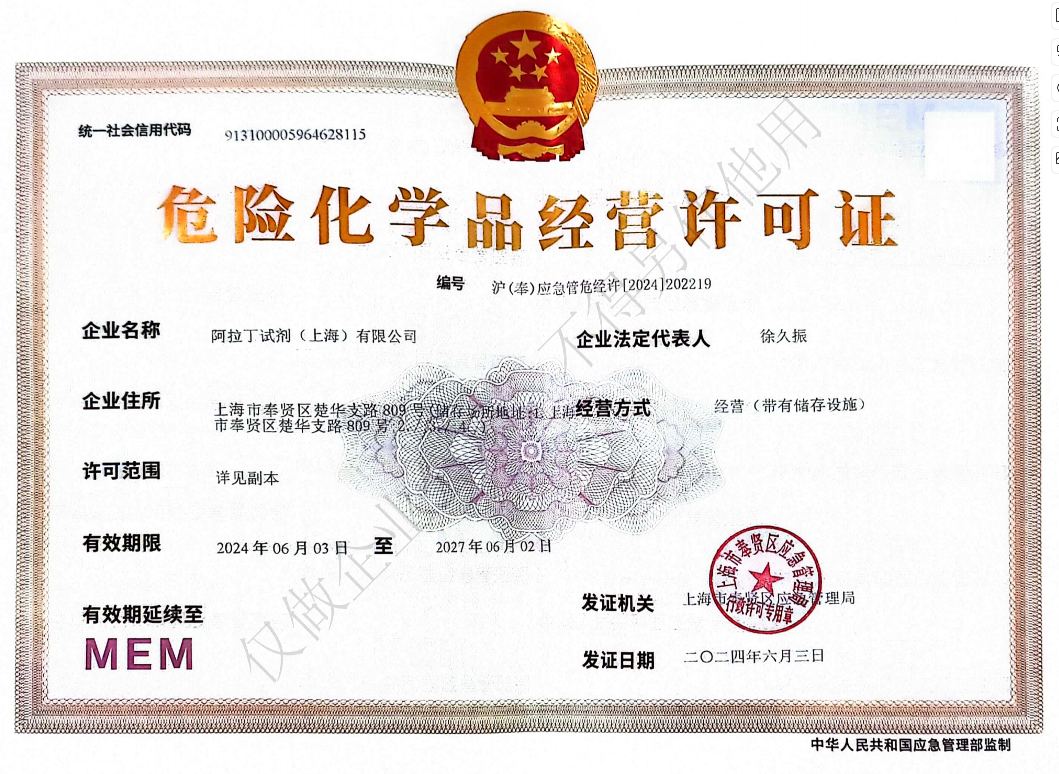 危险品化学品经营许可证(带存储)