
计算溶液所需的质量、体积或浓度。
为什么选择此级别
,适用于对基线干扰要求严格的色谱和分析工作流程。
储存与运输
2-8°C储存,充氩。低温运输 。请查阅批次 COA 获取详细规格。
质量文档
SDS、COA、产品数据表及规格说明书均可下载。可通过批号查询获取批次 COA。
文献证明
在色谱分析、有机合成和交叉偶联反应领域已被 92 篇同行评审文献引用。
概述
注意事项:不要冷冻。
Do not freeze.
Description
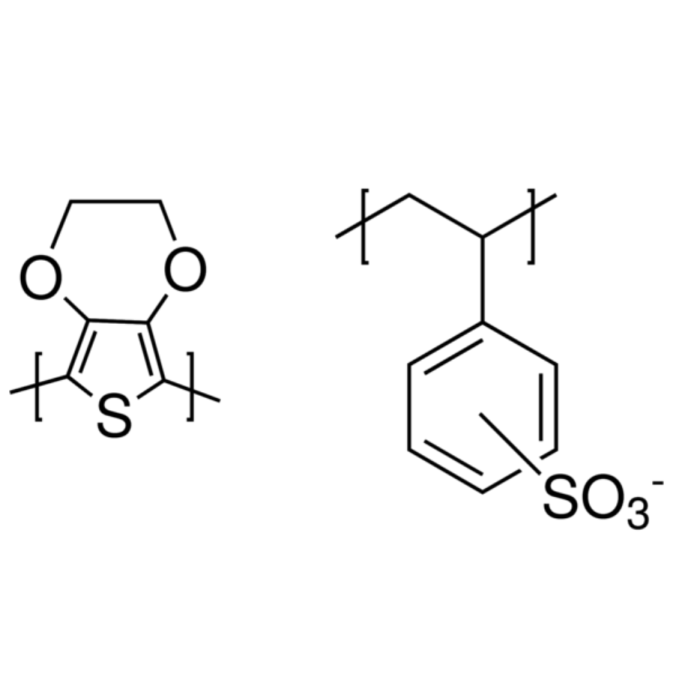
Poly(3,4-ethylenedioxythiophene)-poly(styrenesulfonate) (PEDOT:PSS) is a conductive polymer that is formed by electropolymerizing 3,4-ethylenedioxythiophene in a solution of poly(styrenesulfonate) (PSS). PEDOT is doped with positive ions and PSS with negative ions. It is mainly used in organic electronics due to the properties, which includelow band gapgood optical propertieshigh conductivitylow redox potentialeasy processingtunable film forming abilityHigh-conductivity grade.PEDOT:PSS can be used as an electrode material with high mobility for charge carriers. It can be used for a wide range of energy based applications such as organic photovoltaics (OPV), dye sensitized solar cells (DSSCs), organic light emitting diodes (OLEDs), supercapacitors and biomedical sensors.Orgacon™S315 is ready-to-use and made with conductive polymer PEDOT:PSS. Typical application processes are slot die, Meyer bar and gravure coating. It is particularly designed for optimal properties on PET and meet the requirements of several transparent electrodes applications as alternative to ITO.ITO substitution coating.ITO-free OPV.Surface electrical resistance (SER) at 90% VLT* (visual light transmission): 125 Ω/square.*Typical properties on PET with bar coater. Thermal cured at 130 °C/ 6 min. VLT according to ASTM D 1003, excludes substrate.Stability ratio R/R_0 (500 hr at 60 °C, 95% RH) : 1.3.
Preparation instructions
Dilute with DI water or compatible solvent if needed.Pre-treated substrate with corona- or plasma treatment increase adhesion.
规格
别名
聚乙撑二氧噻吩-聚(苯乙烯磺酸盐)
英文别名
POLY(3,4-ETHYLENEDIOXYTHIOPHENE)-POLY(STYRENESULFONATE),1.3-1.7% IN WATER | A883673 | E82258
规格或纯度
1% Pedot/PSS
英文名称
Poly(3,4-ethylenedioxythiophene)-poly(styrenesulfonate)(PEDOT:PSS)
储存条件
2-8°C储存,充氩
运输条件
低温运输
法律信息
Orgacon is a trademark of Agfa-Gevaert N.V.
名称和识别符
PubChem SID
EC号
629-200-1
分子类型
聚合物
IUPAC Name
2,3-dihydrothieno[3,4-b][1,4]dioxine;(E)-2-phenylethenesulfonic acid
INCHI
1S/C8H8O3S.C6H6O2S/c9-12(10,11)7-6-8-4-2-1-3-5-8;1-2-8-6-4-9-3-5(6)7-1/h1-7H,(H,9,10,11);3-4H,1-2H2/b7-6+;
InChi Key
BGAWZPQKJPTIEA-UHDJGPCESA-N
Smiles
C1COC2=CSC=C2O1.C1=CC=C(C=C1)C=CS(=O)(=O)O
Isomeric SMILES
C1COC2=CSC=C2O1.C1=CC=C(C=C1)/C=C/S(=O)(=O)O
技术文档
高级数据
三维结构
交互式化学结构模型
化学和物理性质
敏感性
对湿度敏感
折光率
n20/D 1.334
安全和危险性(GHS)
象形图
信号词
危险
危险声明
H315: 引起皮肤刺激
H319: 引起严重眼睛刺激
预防措施声明
P260: 不要吸入灰尘/烟雾/气体/雾/蒸汽/喷雾。
P264: 处理后要彻底洗手。
P280: 戴防护手套/穿防护服/戴防护眼罩/戴防护面具。
P321: 特殊处理(请参阅此标签上的...)。
P363: 再次使用之前,请清洗受污染的衣物。
P301+P330+P331: 如误吞咽:漱口。不要诱导呕吐。
P304+P340: 如误吸入:将人转移到空气新鲜处,保持呼吸舒适体位。
P405: 密闭存放
P501: 将内容物/容器处理到。。。
P264+P265: 处理后彻底洗手[和…]。不要触摸眼睛。
P305+P354+P338: 如果进入眼睛:立即用水冲洗几分钟。取下隐形眼镜(如果有的话),并且操作简单。继续冲洗。
P317: 寻求紧急医疗救助。
P302+P361+P354: 如果接触皮肤:立即脱掉所有被污染的衣服。立即用水冲洗几分钟。
P316: 立即寻求紧急医疗救助。
质检证书(CoA,COO,BSE/TSE 和分析图谱)
C of A & Other Certificates(BSE/TSE, COO):
输入批号以搜索分析图谱:
通过匹配包装上的批号来查找并下载产品的 COA,每批产品都进行了严格的验证,您可放心使用!
| 批号(Lot Number) | 证书类型 | 货号 |
|---|---|---|
 I2624597 |
分析证书 | P476790 |
| I2624598 |
分析证书 | P476790 |
| I2624599 |
分析证书 | P476790 |
| I2311533 |
分析证书 | P476790 |
| I2311534 |
分析证书 | P476790 |
| I2311535 |
分析证书 | P476790 |
| I2311676 |
分析证书 | P476790 |
| C2627180 |
分析证书 | P476790 |
| L2416489 |
分析证书 | P476790 |
| L2416490 |
分析证书 | P476790 |
| I2311532 |
分析证书 | P476790 |
| J2428267 |
分析证书 | P476790 |
技术文档和文章
用于有机电子应用的无机界面层油墨
目录: 技术文章
Materials Can “Switch”: How Smart Polymers Respond to Temperature, pH, and Light (with Experimental Selection Tips & Product Navigation)
目录: 技术文章
Light-Emitting Polymers (LEPs): A Practical Panorama - A Core PL/EL Mechanistic Framework, Material Family Map, and Structural “Design Knobs” (including Product Tables 1–4 and a selection guide)
目录: 技术文章
Optical & Optoelectronic Materials Selection Guide:Positioning materials, key metrics, and validation paths along “Generation → Guiding → Control → Readout” (with product navigation and Tables 1–4)
目录: 技术文章
What Is Thiophene? Structural Features, Application Value, and Research-Oriented Selection Strategies
目录: 技术文章
Metal Halide Perovskite Solar Cells: Sources of High Efficiency, Stability Bottlenecks, and Experimental Decision Logic
目录: 技术文章
From ICMA to ICBA/ICTA: Structural Modulation and Device Performance of Indene-C60 Adduct Acceptors
目录: 技术文章
From Molecular Design to Morphology Control: How Small-Molecule Donors Improve the Efficiency, Stability, and Processability of Organic Solar Cells
目录: 技术文章
How ZnO Nanoparticle Electron Transport Layers Reduce Dark Current in Organic Photodetectors: Mechanisms, Film Quality, and Material Selection
目录: 技术文章
此产品的引用文献
溶液计算器
相关产品
聚(3,4-亚乙二氧基噻吩)-聚(苯乙烯磺酸)(PEDOT:PSS)-PEDOT:PSS=1:6, 1.5% in water,CAS:155090-83-8
聚(3,4-亚乙基二氧噻吩)-聚(苯乙烯磺酸盐)(PEDOT:PSS)-H₂O、中性pH、高导电等级中的1.5%,CAS:155090-83-8
聚(3,4-亚乙二氧基噻吩)-聚(苯乙烯磺酸)(PEDOT:PSS)-5.0 wt.%,导电丝网印刷油墨,CAS:155090-83-8
聚(3,4-乙烯二氧噻吩)-聚(苯乙烯磺酸盐)(PEDOT:PSS)-1%-1.3% in water,导电率≥850S/cm,CAS:155090-83-8
聚(3,4-乙烯二氧噻吩)-聚(苯乙烯磺酸盐)(PEDOT:PSS)-DRY;可再分散颗粒,CAS:155090-83-8
聚(3,4-亚乙二氧基噻吩)-聚(苯乙烯磺酸)(PEDOT:PSS)-H₂O中的1.1%,无表面活性剂,高导电等级,CAS:155090-83-8
产品仅提供给经过验证的企业、机构和合格的专业人员用于研发。不适用于人类、动物、诊断或治疗。
Copyright © 2023至今 上海阿拉丁生化科技股份有限公司 保留所有权利。


 危险品化学品经营许可证(带存储)