activation inducer molecule (AIM/CD69) | Activation inducer molecule | AIM | BL-AC/P26 | CD69 antigen (p60, early T-cell activation antigen) | CD69 antigen | CD69 molecule | CD69 | CLEC2CC-type lectin domain family 2 member C | C-type lectin domain family
规格或纯度
无动物源,无载体,His标签,PBS Only,≥95%(SDS-PAGE),见COA
生化机理
Early activation antigen CD69, also known as activation inducer molecule (AIM), is a single-pass type II membrane protein. Recently, cDNA clones encoding human and mouse CD69 were isolated and showed CD69 to be a member of the C-type lectin superfamily. It is one of the earliest cell surface antigens expressed by T cells following activation. Once expressed, CD69 acts as a costimulatory molecule for T cell activation and proliferation. In addition to mature T cells, CD69 is inducibly expressed by immature thymocytes, B cells, natural killer (NK) cells, monocytes, neutrophils and eosinophils, and is constitutively expressed by mature thymocytes and platelets. CD69 is involved in lymphocyte proliferation and functions as a signal transmitting receptor in lymphocytes, natural killer (NK) cells, and platelets. The structure, chromosomal localization, expression and function of CD69 suggest that it is likely a pleiotropic immune regulator , potentially important in the activation and differentiation of a wide variety of hematopoietic cells. This membrane molecule transiently expresses on activated lymphocytes, and its selective expression in inflammatory infiltrates suggests that it plays a role in the pathogenesis of inflammatory diseases. CD69 plays a crucial role in the pathogenesis of allergen-induced eosinophilic airway inflammation and hyperresponsiveness and that CD69 could be a possible therapeutic target for asthmatic patients.
Post-translational: Constitutive Ser/Thr phosphorylation in both mature thymocytes and activated T-lymphocytes.
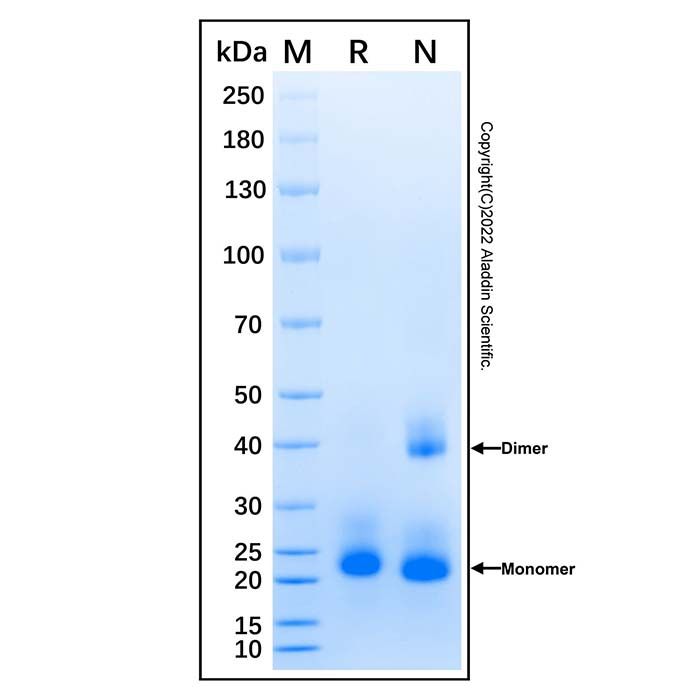
22.7 & 28.0 kDa, under reducing conditions; 21.8 & 26.0 & 39.4 kDa, under non-reducing conditions.
分子类型
蛋白质
产品线
生物产品
储存与运输
物理形态
冻干(Lyophilized)
储存缓冲液
Lyophilized from PBS, pH 7.4.
浓度
见COA
复溶
We recommend that this vial be briefly centrifuged prior to opening to bring the contents to the bottom. Reconstitute at 0.5 mg/mL in sterile distilled water. Stock solutions should be apportioned into working aliquots and stored at ≤ -20 °C. Further dilutions should be made in appropriate buffered solutions.
储存条件
-20°C储存,避免反复冻融
运输条件
超低温运输
稳定性与储存
-20℃保存 12个月;复溶后建议分装,避免反复冻融。
图片
Recombinant Human CD69 Protein (rp181591) - SDS-PAGE 3 μg/lane of Recombinant Human CD69 Protein was resolved with SDS-PAGE under reducing (R) and non-reducing (N) conditions and visualized by Coomassie® Blue staining, showing a band at 22.7 kDa under reducing conditions and 21.8 & 39.4 kDa under non-reducing conditions. The observation of CD69 Protein as both dimers and monomers under non-reducing (NR) conditions suggests that a portion of the protein forms dimers. This dimerization may be mediated by (or stabilized by) disulfide bonds (PubMed:37039481).

 ZJ25F0825077


 危险品化学品经营许可证(带存储)