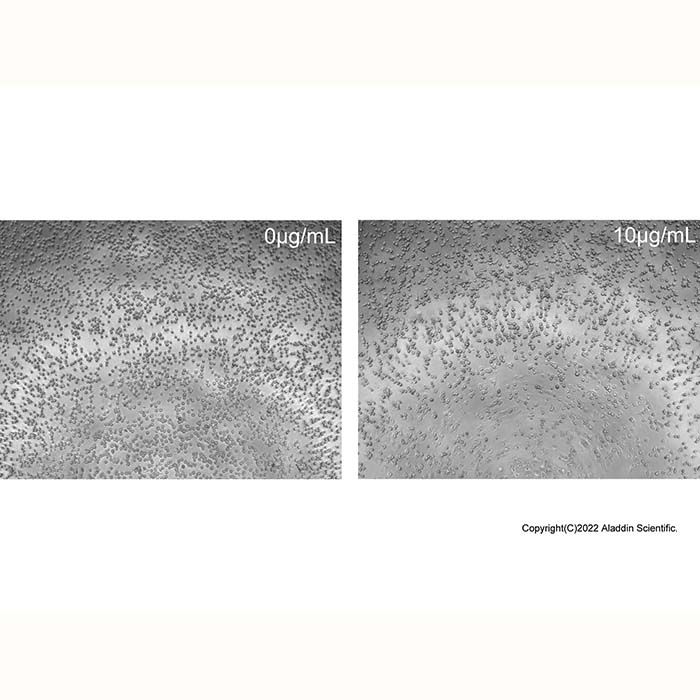
Measured by the ability of the immobilized protein to support the adhesion of SK-N-SH human neuroblastoma cells. The ED50 for this effect is 1.0 - 10.0 μg/mL. Measured by its binding ability in a functional ELISA. Immobilized Human NCAM-1/CD56 Protein (rp175917) at 1.0 μg/mL can bind Lorvotuzumab (anti-CD56) with the EC50 of 28.65 ng/mL.
Purity: ≥95%, by SDS-PAGE visualized with Coomassie® Blue Staining. Description: Neural cell adhesion molecule 1 (NCAM-1) is a multifunctional member of the Ig superfamily. It belongs to a family of membrane-bound glycoproteins that are involved in Ca++ independent cell matrix and homophilic or heterophilic cell-cell interactions. NCAM-1 specifically binds to heparan sulfate proteoglycans, the extracellular matrix protein agrin, and several chondroitin sulfate proteoglycans that include neurocan and phosphocan. There are three main forms of human NCAM-1 that arise by alternate splicing. These are designated NCAM-120/NCAM-1 (761 amino acids [aa]), NCAM‑140 (848 aa), and NCAM-180 (1120 aa). NCAM-120 is GPI-linked, while NCAM‑140 and NCAM-180 are type I transmembrane glycoproteins. Additional alternate splicing adds considerable diversity to all three forms, and extracellular proteolytic processing is possible for NCAM-180. NCAM-1 is synthesized as a 761 aa preproprecursor that contains a 19 aa signal sequence, a 722 aa GPI-linked mature region, and a 20 aa C-terminal prosegment. The molecule contains five C-2 type Ig-like domains and two fibronectin type-III domains. Human to mouse, NCAM-1 is 93% aa identical. NCAM-1 appears to be highly sialylated. The polysialyation of NCAM-1 reduces its adhesive property and increases its neurite outgrowth promoting features. NCAM-1 in the adult brain shows a decline of sialylation relative to earlier developmental periods. In regions that retain a high degree of neuronal plasticity, however, the adult brain continues to express polysialylation-NCAM-1, suggesting sialylation of NCAM-1 is involved in regenerative processes and synaptic plasticity.
Measured by the ability of the immobilized protein to support the adhesion of SK-N-SH human neuroblastoma cells. The ED50 for this effect is 1.0 - 10.0 μg/mL. Measured by its binding ability in a functional ELISA. Immobilized Human NCAM-1/CD56 Protein (rp175917) at 1.0 μg/mL can bind Lorvotuzumab (anti-CD56) with the EC50 of 28.65 ng/mL.
We recommend that this vial be briefly centrifuged prior to opening to bring the contents to the bottom. Reconstitute at 1.0 mg/mL in sterile distilled water. Stock solutions should be apportioned into working aliquots and stored at ≤ -20 °C. Further dilutions should be made in appropriate buffered solutions.
储存条件
-20°C储存,避免反复冻融
运输条件
超低温运输
稳定性与储存
在 -20°C 下可稳定保存 1 年。避免冷冻/解冻循环。
图片
Recombinant Human NCAM-1/CD56 Protein (rp185696) - Protein Bioactivity Measured by the ability of the immobilized protein to support the adhesion of SK-N-SH human neuroblastoma cells. The ED
₅₀
for this effect is 1.0 - 10.0 μg/mL.
ELISA: Recombinant Human NCAM-1/CD56 Protein (rp185696) Measured by its binding ability in a functional ELISA. Immobilized Human NCAM-1/CD56 Protein (rp185696) at 1.0 μg/mL can bind Lorvotuzumab (anti-CD56) with the EC50 of 28.65 ng/mL.
Recombinant Human NCAM-1/CD56 Protein (rp185696) - SDS-PAGE 3 μg/lane of Recombinant Human NCAM-1/CD56 Protein was resolved with SDS-PAGE under reducing (R) and non-reducing (N) conditions and visualized by Coomassie® Blue staining, showing a band at 92.1-121.6 kDa under reducing conditions and 77.5-110.5 kDa under non-reducing conditions.

 ZJ24F0606474


 危险品化学品经营许可证(带存储)