EGF is the prototypic member of a family of growth factors that also includes amphiregulin, betacellulin, epigen, epiregulin, HB-EGF, neuregulins-1 through -6, and TGF-alpha. These proteins contain EGF-like domains with three intramolecular disulfide bonds between conserved cysteines. EGF family members are synthesized as transmembrane preproproteins with varying numbers of EGF-like domains. The extracellular region of human Pro-EGF contains nine LDL R class B repeats and nine EGF-like domains. Within this region, human Pro-EGF shares 69% amino acid sequence identity with mouse and rat Pro-EGF and 82% with canine, feline, and porcine Pro-EGF. Mature epidermal growth factor is derived from the juxtamembrane EGF-like domain. EGF binds ErbB1 and induces the formation of homodimers or heterodimers containing ErbB2. Pro-EGF is most highly expressed in the submaxillary gland and kidney. In the kidney, the 160 kDa preproprotein is shed by membrane-associated serine proteases, liberating the extracellular region which is subsequently processed into smaller fragments including the 6 kDa mature EGF. The various cleavage products produced in the kidney also are present in urine. In the submaxillary gland, however, nearly all EGF is processed intracellularly and stored in secretory vesicles. The soluble precursor binds EGF R and induces cellular proliferation, although it is significantly less potent than mature EGF. In human thyroid carcinoma cells, a splice variant of Pro-EGF with a deletion in the cytoplasmic domain induces increased proliferative activity relative to wild type Pro-EGF. EGF stimulates the growth of various epidermal and epithelial tissues in vivo and in vitro and of some fibroblasts in cell culture. Magnesiotropic hormone that stimulates magnesium reabsorption in the renal distal convoluted tubule via engagement of EGFR and activation of the magnesium channel TRPM6. Can induce neurite outgrowth in motoneurons of the pond snail Lymnaea stagnalis in vitro (PubMed:10964941).
Post-translational: O-glycosylated with core 1-like and core 2-like glycans. It is uncertain if Ser-954 or Thr-955 is O-glycosylated. The modification here shows glycan heterogeneity: HexHexNAc (major) and Hex2HexNAc2 (minor).
Post-translational: O-glycosylated with core 1-like and core 2-like glycans. It is uncertain if Ser-954 or Thr-955 is O-glycosylated. The modification here shows glycan heterogeneity: HexHexNAc (major) and Hex2HexNAc2 (minor).
生物活性
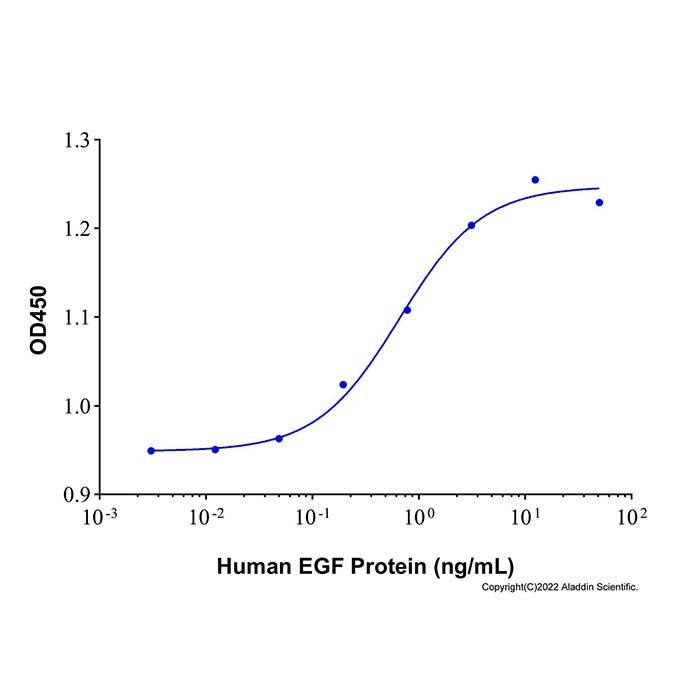
Measured in a cell proliferation assay using Balb/3T3 mouse embryonic fibroblast cells. The ED50 for this effect is 0.6 ng/mL.
10.0 kDa, under reducing conditions; 10.0 & 11.4 kDa, under non-reducing conditions.
分子类型
蛋白质
产品线
生物产品
储存与运输
物理形态
冻干(Lyophilized)
储存缓冲液
Lyophilized from PBS, pH 7.4
浓度
见COA
复溶
We recommend that this vial be briefly centrifuged prior to opening to bring the contents to the bottom. Reconstitute at 1.0 mg/mL in sterile distilled water. Stock solutions should be apportioned into working aliquots and stored at ≤ -20 °C. Further dilutions should be made in appropriate buffered solutions.
储存条件
-20°C储存,避免反复冻融
运输条件
超低温运输
稳定性与储存
Store at -20°C for 1 year. Avoid freeze/thaw cycle.
图片
Recombinant Human EGF Protein (rp215069) - Bioactivity Measured in a cell proliferation assay using Balb/3T3 mouse embryonic fibroblast cells. The ED₅₀ for this effect is 0.6 ng/mL.
Recombinant Human EGF Protein (rp215069) - SDS-PAGE 3 μg/lane of Recombinant Human EGF Protein was resolved with SDS-PAGE under reducing (R) and non-reducing (N) conditions and visualized by Coomassie® Blue staining, showing a band at 10.0 kDa under reducing conditions and 10.0 & 11.4 kDa under non-reducing conditions.

 ZJ26F0838500


 危险品化学品经营许可证(带存储)