储存缓冲液: 1×PBS, 20% (v/v) Ethanol
本产品利用生物素与链霉亲和素配体之间的相互作用纯化生物素或生物素化的蛋白、抗体等物质。链霉亲和素与生物素之间的亲和力很强,需要在变性条件下洗脱,而链霉亲和素对亚氨基生物素的亲和力相对较弱,可以在pH 9.5-11.0结合,pH 4.0时洗脱,不需要使用变性剂,所以能更好的保持亲和素偶联物的活性。链霉亲和素亲和层析介质采用高度交联的6%琼脂糖介质,可耐受较高的流速及化学稳定性,适合大规模纯化。
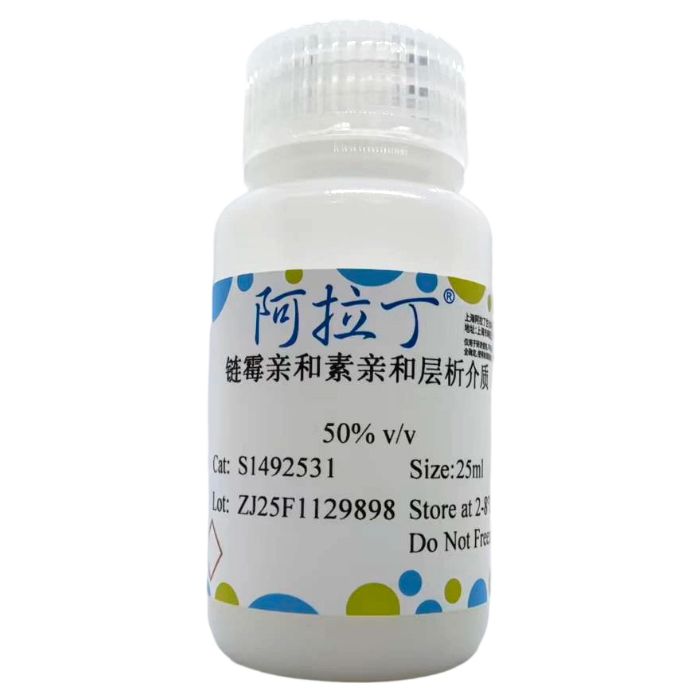
阿拉丁链霉亲和素亲和层析介质储存在含20%乙醇的1×PBS中,凝胶和保护液的体积比为1:1,我司产品规格为实际凝胶的体积。
参数
| 指标
|
基质
| 高度交联的6%琼脂糖微球
|
配基
| 链霉亲和素
|
粒径范围
| 45~165 μm |
载量
| >200 nmol Biotin/mL 介质
|
最大压力
| 0.3 MPa,3 bar
|
pH 稳定范围
| 4-9 |
储存
| 含20%乙醇的1×PBS,2~8℃
|
保质期
| 2年 |
使用说明
1、缓冲液的准备
所用水和缓冲液在使用之前建议用0.22μm或0.45μm滤膜过滤。
生物素或生物素化物质的纯化
平衡/洗杂液:20 mM NaH₂PO₄, 0.15 M NaCl, pH 7.4
洗脱液:8M 盐酸胍,pH1.5
亚氨基生物素标签物质的纯化
平衡/洗杂液:50mM 碳酸铵,0.5M NaCl,pH10.0
洗脱液:50mM 碳酸铵,0.5M NaCl,pH4.0
2、样品准备
上柱前要确保样品溶液有合适的离子强度和pH值,可以用平衡/洗杂液对血清样品、腹水或细胞培养液稀释,或者样品用平衡/洗杂液透析。
样品在上样前建议离心或用0.22μm或0.45μm滤膜过滤,减少杂质,提高蛋白纯化效率和防止堵塞柱子。
3、链霉亲和素亲和层析介质装填
3.1 重力柱的装填
(1) 取合适规格的重力层析柱,装入下垫片,加入适量纯水润洗柱管和垫片,关闭下出口。
(2) 将链霉亲和素亲和层析混合均匀,用枪头吸取适量浆液加入至重力柱中(介质实际体积占悬液的一半),打开下出口流干保护液。
(3) 加入适量纯水冲洗介质,待柱管中液体重力流干后,关闭下出口。
(4) 装入润洗后的上垫片,确保垫片与填料之前没有空隙,且保持水平。
(5) 装填好的重力柱可以直接加入平衡液进行平衡,暂不使用时则加入保护液,2-8℃保存。
3.2 中压层析柱的装填
链霉亲和素亲和层析被广泛应用于工业纯化,因此,涉及到各种中压色谱层析柱的填装,下面介绍填装层析柱的方法。装柱前根据层析柱直径计算柱子底面积,根据所需装柱高度计算所需介质体积,公式如下:
V = 1.15 × π × r² × h
V:所需介质体积,ml
1.15:压缩系数
r:柱管半径,cm
h:装填高度,cm
注意:所取悬液体积应为介质体积的两倍,因为介质体积只占悬液总体积的一半,另一半为保护液。
(1) 用去离子水冲洗层析柱底筛板与接头,确保柱底筛板上无气泡,关闭柱底出口,并在柱底部留出1-2cm的去离子水。
(2) 将介质悬浮起来,小心的将浆液连续地倒入层析柱中。用玻璃棒沿着柱壁倒入浆液可减少气泡的产生。
(3) 如果使用储液器,应立即在层析柱和储液器中加满水,将进样分配器放置于浆液表面,连接至泵上,避免在分配器或进样管中产生气泡。
(4) 打开层析柱底部出口,开启泵,使其在设定的流速下进行。最初应让缓冲液缓慢流过层析柱,然后缓慢增加至最终流速,这样可避免液压对所形成柱床的冲击,也可以避免柱床形成的不均匀。如果达不到推荐的压力或流速,可以用你所使用泵的最大流速,这样也可以得到一个很好的装填效果。(注意:在随后的色谱程序中,不要超过最大装柱流速的75%)当柱床高度稳定后,在最后的装柱流速下至少再上 3 倍柱床体积的去离子水。标上柱床高度。
(5) 关闭泵,关闭层析柱出口。
(6) 如果使用储液器,去除储液器,将分配器置于层析柱中。
(7) 将分配器推向柱子至标记的柱床高度处。允许装柱液进入分配器,锁紧分配器接头。
(8) 将装填好的层析柱连接至泵或色谱系统中,开始平衡。如果需要可以重新调整分配器。
4、样品纯化
4.1 孵育法纯化
(1) 根据纯化的样品量,取适量链霉亲和素亲和层析介质加入离心管中,1000rpm离心1min,吸弃上清;也可加入重力柱中,流干保护液。
(2) 向离心管中加入5倍介质体积的平衡液清洗介质,1000rpm离心1min,吸弃上清;如使用重力柱,则直接在重力柱中清洗,直接重力流干平衡液;重复两次以上。
(3) 加入样品,封闭离心管或重力柱管,4℃振荡孵育2-4h或者37℃孵育30min-2h。
(4) 孵育结束后,1000rpm离心1min,吸弃上清,或过滤收集介质,上清保留作为流穿,用于电泳鉴定。
(5) 用5倍介质体积的洗杂液清洗介质,1000rpm离心1min或重力柱管过滤,去除上清(注意不要吸到介质),重复3-5次,中间建议更换新离心管。
(6) 加入3-5倍柱体积的洗脱液进行洗脱,室温孵育5min,1000rpm离心1min或重力柱管收集洗脱液,可重复2-3次。
4.2 重力柱法纯化
(1) 将装填好的链霉亲和素亲和层析介质重力柱用5倍柱体积平衡液进行平衡,使填料处于与目的蛋白相同的缓冲液体系下,重复2-3次。
(2) 将样品加到平衡好的重力柱中,样品保留时间至少2min,保证样品和介质充分接触,收集流出液,可以反复上样增加结合效率。
(3) 用10-15倍柱体积的洗杂液进行洗杂,去除非特异性吸附的杂蛋白,收集洗杂液。
(4) 使用5-10倍柱体积的洗脱液洗脱,分段收集,每一个柱体积收集一管,分别检测,既可以保证所有结合的目的蛋白被洗脱,又可以得到高纯度和高浓度的蛋白。
4.3 中压层析柱法纯化
链霉亲和素亲和层析介质装填好后,可以用各种常规的中低压色谱系统。
(1) 将泵管道中注满去离子水。去掉上塞子,将层析柱连接至色谱系统中,打开下出口,将预装柱接到色谱系统中,并旋紧。
(2) 用3-5倍柱体积的去离子水冲洗出储存缓冲液。
(3) 使用至少5倍柱床体积的平衡液平衡色谱柱。
(4) 利用泵或样品环上样。注:样品的粘度增加使得即使上样体积很少,也会导致层析柱很大的反压。上样量不要超过柱子的结合能力。大 量的样品体积也可能造成很大的反压,使得进样器更难使用。
(5) 用洗杂液冲洗柱子,直到紫外吸收达到一个稳定的基线(一般至少10-15个柱体积)。
(6) 使用5-10倍柱体积的洗脱液洗脱,收集洗脱液,即目的蛋白组分。介质洗脱结束后,用平衡液冲洗5-10柱体积,然后用纯水冲洗5-10个柱体积,再用20%乙醇冲洗2个柱体积,置于2-8℃保存。
5、SDS-PAGE 检测
将使用纯化产品得到的样品(包括流出组分、洗杂组分和洗脱组分)以及原始样品使用SDS-PAGE检测纯化效果。
6、填料清洗
链霉亲和素亲和层析介质在使用过程中,随着非特异性结合的蛋白的增多和蛋白的聚集,往往造成流速和结合载量都下降,这时可按照下面方法对填料进行清洗。
去除一些沉淀或变性物质,建议使用下面的方法:用2倍柱体积的0.1M NaOH或6M盐酸胍或8M尿素溶液进行清洗,然后立即用5倍柱体积的PBS,pH7.4清洗。
去除一些疏水性吸附造成的非特异性吸附物质:用3-4倍柱体积的70%乙醇或2倍柱体积的1% Triton X-100清洗,然后立即用5倍柱体积的PBS,pH7.4清洗。
This product utilizes the interaction between biotin and streptavidin ligands for the purification of biotin or biotinylated proteins, antibodies, and other biomolecules. The affinity between streptavidin and biotin is extremely strong, requiring denaturing conditions for elution. In contrast, streptavidin's affinity for iminobiotin is relatively weaker, allowing binding at pH 9.5–11.0 and elution at pH 4.0 without denaturants, thereby better preserving the activity of affinity conjugates. The streptavidin affinity chromatography medium is based on a highly cross-linked 6% agarose matrix, offering high flow rates and chemical stability, making it suitable for large-scale purification.
Aladdin Streptavidin Agarose Resin is stored in 1× PBS containing 20% ethanol, with a settled gel to storage solution ratio of 1:1. The product specification refers to the actual volume of the settled gel.
Parameter
| Value / Description
|
Matrix
| Highly cross-linked 6% agarose microspheres
|
Ligand
| Streptavidin
|
Particle Size Range
| 45~165 μm |
Binding Capacity
| >200 nmol biotin/mL resin
|
Maximum Pressure
| 0.3 MPa, 3 bar
|
pH Stability Range
| 4-9 |
Storage Conditions
| 1× PBS with 20% ethanol, 2–8°C
|
Shelf Life
| 2 years |
Protocol
1. Buffer Preparation
Water and buffers should be filtered through a 0.22 μm or 0.45 μm membrane before use.
For Biotin or Biotinylated Molecules
Equilibration/Wash Buffer: 20 mM NaH₂PO₄, 0.15 M NaCl, pH 7.4
Elution Buffer: 8 M guanidine hydrochloride, pH 1.5
For Iminobiotin-Tagged Molecules
Equilibration/Wash Buffer: 50 mM ammonium carbonate, 0.5 M NaCl, pH 10.0
Elution Buffer: 50 mM ammonium carbonate, 0.5 M NaCl, pH 4.0
2. Sample Preparation
Ensure the sample solution has appropriate ionic strength and pH before loading. Dilute serum samples, ascites, or cell culture supernatants with equilibration/wash buffer, or dialyze the sample against equilibration/wash buffer.
Clarify the sample by centrifugation or filtration (0.22/0.45 μm) to reduce impurities, improve efficiency, and prevent column clogging.
3. Column Packing
3.1 Gravity Column Packing
(1) Select a suitable gravity column. Insert the bottom frit, rinse with purified water, and close the outlet.
(2) Resuspend the streptavidin resin thoroughly. Transfer an appropriate volume of slurry to the column (settled resin volume is half of the slurry). Open the outlet to drain the storage solution.
(3) Rinse with purified water. Close the outlet after draining.
(4) Insert the top frit, ensuring no gaps and a horizontal position.
(5) Equilibrate with equilibration buffer or store with storage solution at 2–8°C.
3.2 Medium-Pressure Column Packing
For industrial-scale purification, medium-pressure columns are often used. Calculate the required resin volume using:
V = 1.15 × π × r² × h
(1) Rinse the column bottom frit and adapter with deionized water. Ensure no bubbles are trapped. Close the outlet and retain 1–2 cm of water.
(2) Resuspend the resin and pour the slurry continuously into the column along the wall to minimize bubbles.
(3) If using a reservoir, fill it with water immediately. Place the distributor on the slurry surface and connect to the pump, avoiding bubbles.
(4) Open the outlet and start the pump at a low flow rate, gradually increasing to the final packing flow rate. Avoid disturbing the bed. Use the pump’s maximum flow rate if the recommended pressure/flow is not achieved. After the bed stabilizes, flush with 3 CV deionized water. Mark the bed height.
(5) Stop the pump and close the outlet.
(6) Remove the reservoir and place the distributor inside the column.
(7) Lower the distributor to the marked bed height. Allow buffer to enter the distributor and tighten the adapter.
(8) Connect the column to the pump or chromatography system for equilibration. Adjust the distributor if needed.
4. Sample Purification
4.1 Batch Purification
(1) Transfer resin to a centrifuge tube. Centrifuge at 1,000 rpm for 1 min and discard supernatant.
(2) Wash with 5 resin volumes of equilibration buffer. Repeat twice.
(3) Add sample. Incubate at 4°C with shaking for 2–4 h or at 37°C for 30 min–2 h.
(4) Centrifuge at 1,000 rpm for 1 min. Collect supernatant as flow-through for analysis.
(5) Wash with 5 resin volumes of wash buffer. Repeat 3–5 times. Change tubes if needed.
(6) Elute with 3–5 resin volumes of elution buffer. Incubate at RT for 5 min. Collect eluate. Repeat 2–3 times.
4.2 Gravity Column Purification
(1) Equilibrate the column with 5 CV of equilibration buffer. Repeat 2–3 times.
(2) Load sample. Allow at least 2 min residence time. Collect flow-through. Reload to enhance binding.
(3) Wash with 10–15 CV of wash buffer. Collect wash fractions.
(4) Elute with 5–10 CV of elution buffer. Collect fractions (1 CV per tube) for analysis.
4.3 Medium-Pressure Column Purification
(1) Prime the pump with deionized water. Connect the column to the system and tighten.
(2) Flush with 3–5 CV deionized water to remove storage buffer.
(3) Equilibrate with at least 5 CV of equilibration buffer.
(4) Load sample via pump or sample loop. Note: High viscosity increases backpressure. Do not exceed the binding capacity.
(5) Wash with wash buffer until UV absorption stabilizes (typically 10–15 CV).
(6) Elute with 5–10 CV of elution buffer. Collect eluate containing the target protein. After elution, wash with 5–10 CV equilibration buffer, 5–10 CV water, and 2 CV 20% ethanol. Store at 2–8°C.
5. SDS-PAGE Analysis
Analyze samples (flow-through, wash, elution, and crude sample) by SDS-PAGE to evaluate purification.
6. Resin Cleaning
Clean the resin if performance declines due to non-specific binding or aggregation:
Precipitated/denatured material: Clean with 2 CV of 0.1 M NaOH, 6 M guanidine HCl, or 8 M urea, followed by 5 CV PBS, pH 7.4.
Hydrophobic adsorption: Clean with 3–4 CV of 70% ethanol or 2 CV of 1% Triton X-100, followed by 5 CV PBS, pH 7.4.

 ZJ26F1039819


 危险品化学品经营许可证(带存储)