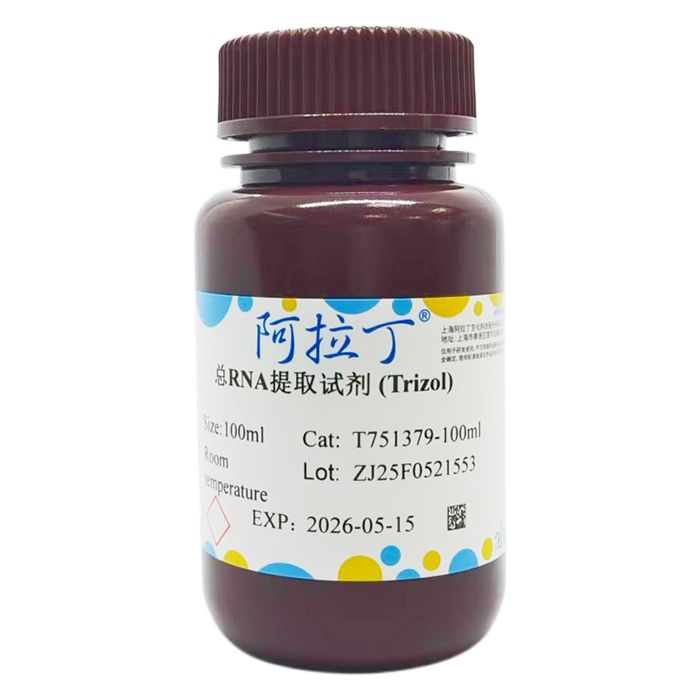
Trizol是细胞或组织总RNA抽提试剂。本产品采用和Invitrogen公司的TRlzol完全相似的原理和方法,抽提的方法和步骤完全相同。Trizol的颜色和TRIzol相同,加入氯仿后上层呈无色,下层呈红色,便于吸取上层水相。Trizol抽提所得RNA无DNA和蛋白污染。一般所得RNA溶于DEPC水后的A260/280值为1.8-2.0。裂解细胞或和组织共匀浆时,Trizol 可以保持样品中RNA的完整性,即可以有效抑制RNA的降解。每1x10⁶细胞用Trizol抽提可得5~15μg RNA;每mg组织用Trizol抽提可得1~10μgRNA。产量因细胞和组织不同而异。Trizol抽提所得RNA可直接用于Northern,点杂交,纯化mRNA,体外翻译,RNaseprotection assay,cDNA克隆,以及RTPCR;也可以用于基因表达芯片分析、高通量测序等对RNA质量要求较高的情况。
注意事项:
1. 如果需要测量RNA的A260/A280的比值,建议使用RNA定量缓冲液对样品稀释后,进行测量。
2. 所有离心管,枪头及相关溶液都必须无RNA酶污染。耐高温器物可180°C烘烤4小时以去除RNA酶,其它器物去除RNA酶可考虑用0.01%的DEPC水浸泡过夜,然后灭菌,烘干。溶液需用DEPC水配制。加0.01% DEPC至重蒸水或MiliQ级水中,处理过夜,灭菌即成DEPC水。
3. 使用冻存的细胞或组织抽提总RNA的效果通常比新鲜的细胞或组织差一些。因为在细胞或组织冻融过程中一些细胞或组织内的RNase会被释放出来并剪切样品。如果不能及时抽RNA,推荐先加入适量Trizol,并裂解样品后冻存。
4. 必须戴一次性手套操作,且尽量不要对着RNA样品呼气或说话,以防RNA酶污染。建议戴一次性口罩操作。
5. Trizol含有毒物质苯酚,避免接触皮肤或吸入。为防止溅入眼睛,请戴防护眼镜或使用透明保护屏。如皮肤接触Trizol,请立即用大量去垢剂和水冲洗,如仍有不适,请听取医生意见。
使用说明:
1 样品均浆
1.1 确定样品的种类,在室温下,根据下表进行均浆。样品的体积不能超过Trizol的10%。必须确保使用足够量的Trizol,因为不足量的Trizol,会导致DNA污染RNA。
| 样品类型 | 流程 |
| 组织 | 1. 50-100mg组织+1mL Trizol;
2. 使用均浆器均浆样品。
注意:收集样品后,立即进行实验,或立即冻存。 |
| 贴壁细胞 | 1. 去除培养基;
2. 在每10cm2的培养皿中加入1mL Trizol;
注意:在35mm培养皿中加入1mL Trziol,在60mm培养皿中加入3mL Trziol,在100mm培养皿中加入8mL Trziol,与细胞数无关;
3. 在培养皿中用吸头反复吹打裂解细胞。 |
| 悬浮细胞 | 1. 离心收集细胞后,去除培养基;
2. 在0.25mL样品(5~10x106cells,动物、植物或酵母,或者10x107细菌细胞)中加入0.75mL Trizol;
注意:加入Trizol之前不要洗涤细胞,避免增加mRNA降解的可能性;
3. 反复吹打裂解细胞,酵母与细菌细胞需要均浆。 |
注意: 10cm2, 5~10x106, 10x107,数字2,6,7均为上标
1.2 (可选择)当含大量脂肪、蛋白、多糖或细胞外基质(例如,肌肉、脂肪或植物的块胶组织)的样品制备RNA时,需增加离心步骤,从样品中去除不溶解的物质。注意: 如果进行DNA分离,不要离心。
| 样品类型 | 流程 |
| 高脂肪、蛋白、多糖或细胞外基质的组织或细胞 | 1. 均浆后,4°C下,12000g离心10min;
注意:沉淀中含细胞外基质、多糖及高分子DNA,而上清液中含RNA。在高脂肪样品中,上清液的上层为脂肪层;
2. 去除脂肪层;
3. 将上清液转移至新的试管中。 |
2 相分离:
2.1 在室温下,将均浆液孵育5min,允许核蛋白复合体分离;
2.2 在每1mL Trizol制备的均浆液中加入0.1mL分相试剂BCP或者氯仿,盖紧盖子;
2.3 剧烈震荡试管15s;
2.4 在室温下孵育2-3min;
2.5 在4°C下,12000g 离心15min;
注意: 裂解液分为红色的苯酚-BCP层(氯仿层),中间层,无色的水相。RNA完全保留于水相中。上层的水相大约为总体积的50% ;
2.6 将试管倾斜45。,小心吸出上层溶液,不要扰动中间层及苯酚层;
2.7 将上层溶液转移至新的试管中;
3 RNA沉淀
使用恰当预防措施避免RNase污染。
3.1 (可选择) 当从小量样品( < 10°细胞或< 10mg组织)中沉淀RNA时,应在水相中加入5~10μg无RNase酶的糖原(glycogen); 注意:糖原(glycogen) 与RNA共沉淀,当其浓度≤4mg/mL时,不抑制第一链的合成,不抑制PCR反应。
3.2 在每1mL Trizol均浆后,所得到的水相中加入0.5mL异丙醇;
3.3 在室温下孵育10min;
3.4 在4°C下,12000g 离心10min;
注意:在离心前,RNA 是不可见的,离心后,在试管底部及侧壁形成胶样沉淀。
4 RNA洗涤
4.1 从试管中取出上清液,只剩下RNA沉淀;
4.2 用1mL75%乙醇洗涤沉淀(起始为1mL Trizol所得到的沉淀) ;
4.3 短暂涡旋,然后在4°C下,7500g 离心5min,其上清;
Trizol is a reagent for extracting total RNA from cells or tissues. This product adopts the same principles and methods as TRlzol from Invitrogen, with identical extraction methods and steps. The color of Trizol is the same as that of TRIzol. After adding chloroform, the upper layer appears colorless and the lower layer appears red, making it easy to absorb the upper aqueous phase. The RNA extracted by Trizol is free from DNA and protein contamination. The A260/280 value of RNA obtained by dissolving it in DEPC water is generally 1.8-2.0. When cells are lysed or homogenized with tissues, Trizol can maintain the integrity of RNA in the sample, effectively inhibiting RNA degradation. 5-15 μ g RNA can be obtained by extracting 1x10⁶ cells with Trizol; Extraction with Trizol can yield 1-10 μ g RNA per mg of tissue. The yield varies depending on the cells and tissues. The RNA extracted by Trizol can be directly used for Northern blotting, point hybridization, mRNA purification, in vitro translation, RNase protection assay, cDNA cloning, and RT-PCR; It can also be used for gene expression chip analysis, high-throughput sequencing, and other situations that require high RNA quality.
Precautions:
1. If it is necessary to measure the A260/A280 ratio of RNA, it is recommended to dilute the sample with RNA quantification buffer for measurement.
2. All centrifuge tubes, gun heads, and related solutions must be free of RNAse contamination. High temperature resistant objects can be baked at 180°C for 4 hours to remove RNA enzymes. For other objects, RNA enzymes can be removed by 1. soaking them overnight in 0.01% DEPC water, followed by sterilization and drying. The solution needs to be prepared with DEPC water. Add 0.01% DEPC to re distilled water or MiliQ grade water, treat overnight, and sterilize to obtain DEPC water.
3. The effectiveness of extracting total RNA from frozen cells or tissues is usually inferior to that of fresh cells or tissues. Because during the freezing and thawing process of cells or tissues, some RNases within the cells or tissues are released and the samples are sheared. If RNA cannot be extracted in a timely manner, it is recommended to add an appropriate amount of Trizol first, lyse the sample, and then freeze it.
4. Disposable gloves must be worn during operation, and try not to exhale or speak towards RNA samples to prevent RNA enzyme contamination. It is recommended to wear a disposable mask during operation.
5. Trizol contains toxic substance phenol, avoid contact with skin or inhalation. To prevent splashing into the eyes, please wear protective glasses or use a transparent protective screen. If skin comes into contact with Trizol, immediately rinse with a large amount of detergent and water. If discomfort persists, seek medical advice.
Instructions for Use:
1 Sample slurry
1.1 Determine the type of sample and homogenize it at room temperature according to the table below. The volume of the sample cannot exceed 10% of Trizol. It is necessary to ensure the use of sufficient amounts of Trizol, as insufficient amounts of Trizol can lead to DNA contamination of RNA.
Type
| process
|
organization
| 1. 50-100mg tissue+1mL Trizol;
2. Use a homogenizer to homogenize the sample.
Attention: After collecting the samples, conduct the experiment immediately or freeze them immediately.
|
Adherent cell
| 1. Remove the culture medium;
2. Add 1mL Trizol to every 10cm2 culture dish;
Note: Add 1mL Trziol to a 35mm culture dish, 3mL Trziol to a 60mm culture dish, and 8mL Trziol to a 100mm culture dish, regardless of the number of cells;
3. Use a pipette tip to repeatedly blow and lyse cells in a culture dish.
|
Suspension cell
| 1. After collecting cells by centrifugation, remove the culture medium;
2. Add 0.75mL Trizol to 0.25mL sample (5-10x106cells, animal, plant or yeast, or 10x107 bacterial cells);
Note: Do not wash cells before adding Trizol to avoid increasing the possibility of mRNA degradation;
3. Repeatedly blow and beat to lyse cells, yeast and bacterial cells need to be homogenized. |
1.2 (Optional) When preparing RNA from samples containing a large amount of fat, protein, polysaccharides, or extracellular matrix (such as muscle, fat, or plant tissue), an additional centrifugation step is required to remove insoluble substances from the sample. Attention: If DNA separation is performed, do not centrifuge.
Type
| process
|
Tissues or cells high in fat, protein, polysaccharides, or extracellular matrix
| 1. After homogenization, centrifuge at 12000g for 10 minutes at 4 ° C;
Note: The precipitate contains extracellular matrix, polysaccharides, and high molecular weight DNA, while the supernatant contains RNA. In high-fat samples, the upper layer of the supernatant is the fat layer;
2. Remove the fat layer;
3. Transfer the supernatant to a new test tube. |
2 Phase separation:
2.1 Incubate the homogenate at room temperature for 5 minutes to allow separation of the nuclear protein complex;
2.2 Add 0.1mL of phase separation reagent BCP or chloroform to every 1mL of Trizol prepared slurry, and cover tightly;
2.3 Vigorously shake the test tube for 15 seconds;
2.4 Incubate at room temperature for 2-3 minutes;
2.5 Centrifuge 12000g at 4 ° C for 15 minutes;
Attention: The lysate is divided into a red phenol BCP layer (chloroform layer), an intermediate layer, and a colorless aqueous phase. RNA is completely retained in the aqueous phase. The upper water phase accounts for approximately 50% of the total volume;
2.6 Tilt the test tube 45 degrees., Be careful to extract the upper layer solution and do not disturb the middle layer and phenol layer;
2.7 Transfer the upper solution to a new test tube;
3 RNA precipitation
Take appropriate preventive measures to avoid RNase contamination.
3.1 (Optional) When precipitating RNA from small samples (<10 ° cells or<10mg tissue), 5-10 μ g of RNase free glycogen should be added to the aqueous phase; Attention: Glycogen co precipitates with RNA, and when its concentration is ≤ 4mg/mL, it does not inhibit the synthesis of the first strand or the PCR reaction.
3.2 Add 0.5mL of isopropanol to the aqueous phase obtained after homogenizing 1mL of Trizol;
3.3 Incubate at room temperature for 10 minutes;
3.4 Centrifuge at 12000g for 10 minutes at 4 ° C;
Note: Before centrifugation, RNA is not visible. After centrifugation, gel like precipitates form at the bottom and side walls of the test tube.
4 RNA washing
4.1 Remove the supernatant from the test tube, leaving only RNA precipitate;
4.2 Wash the precipitate with 1mL 75% ethanol (starting from the precipitate obtained from 1mL Trizol);
4.3 Briefly vortex, then centrifuge at 7500g for 5 minutes at 4 ° C to obtain the supernatant;

 ZJ26F0938897

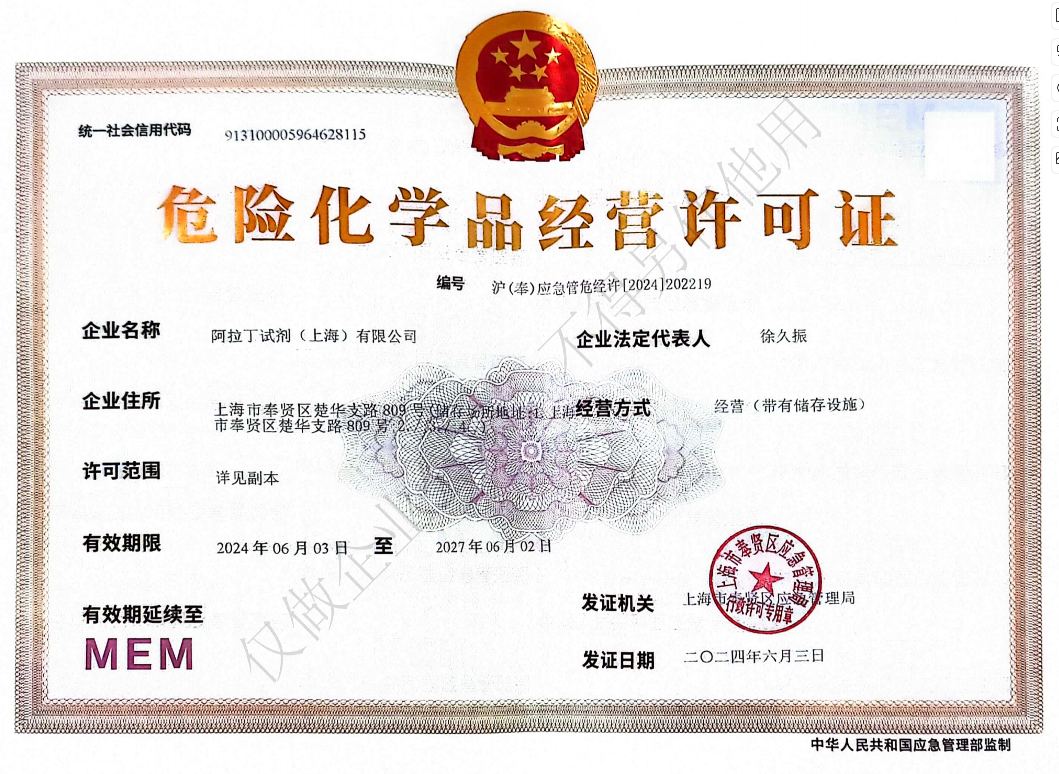 危险品化学品经营许可证(带存储)