Rabbit anti Human HLA-DR Antibody, Recombinant (MyR1-HLA-Dra), could be used for IHC and so on.
Application
IHC: 1/100-1/200
Protein Function
Binds peptides derived from antigens that access the endocytic route of antigen presenting cells (APC) and presents them on the cell surface for recognition by the CD4 T-cells. The peptide binding cleft accommodates peptides of 10-30 residues. The peptides presented by MHC class II molecules are generated mostly by degradation of proteins that access the endocytic route, where they are processed by lysosomal proteases and other hydrolases. Exogenous antigens that have been endocytosed by the APC are thus readily available for presentation via MHC II molecules, and for this reason this antigen presentation pathway is usually referred to as exogenous. As membrane proteins on their way to degradation in lysosomes as part of their normal turn-over are also contained in the endosomal/lysosomal compartments, exogenous antigens must compete with those derived from endogenous components. Autophagy is also a source of endogenous peptides, autophagosomes constitutively fuse with MHC class II loading compartments. In addition to APCs, other cells of the gastrointestinal tract, such as epithelial cells, express MHC class II molecules and CD74 and act as APCs, which is an unusual trait of the GI tract. To produce a MHC class II molecule that presents an antigen, three MHC class II molecules (heterodimers of an alpha and a beta chain) associate with a CD74 trimer in the ER to form an heterononamer. Soon after the entry of this complex into the endosomal/lysosomal system where antigen processing occurs, CD74 undergoes a sequential degradation by various proteases, including CTSS and CTSL, leaving a small fragment termed CLIP (class-II-associated invariant chain peptide). The removal of CLIP is facilitated by HLA-DM via direct binding to the alpha-beta-CLIP complex so that CLIP is released. HLA-DM stabilizes MHC class II molecules until primary high affinity antigenic peptides are bound. The MHC II molecule bound to a peptide is then transported to the cell membrane surface. In B-cells, the interaction between HLA-DM and MHC class II molecules is regulated by HLA-DO. Primary dendritic cells (DCs) also to express HLA-DO. Lysosomal miroenvironment has been implicated in the regulation of antigen loading into MHC II molecules, increased acidification produces increased proteolysis and efficient peptide loading.
规格
产品名称
Recombinant HLA-DR Antibody
别名
HLA-DRa单克隆抗体 | 重组HLA-DR抗体
英文别名
DASS-397D15.1 antibody | DR alpha chain antibody | DR alpha chain precursor antibody | DRA_HUMAN antibody | DRB1 antibody | DRB4 antibody | FLJ51114 antibody | Histocompatibility antigen HLA DR alpha antibody | Histocompatibility antigen HLA-DR alpha anti
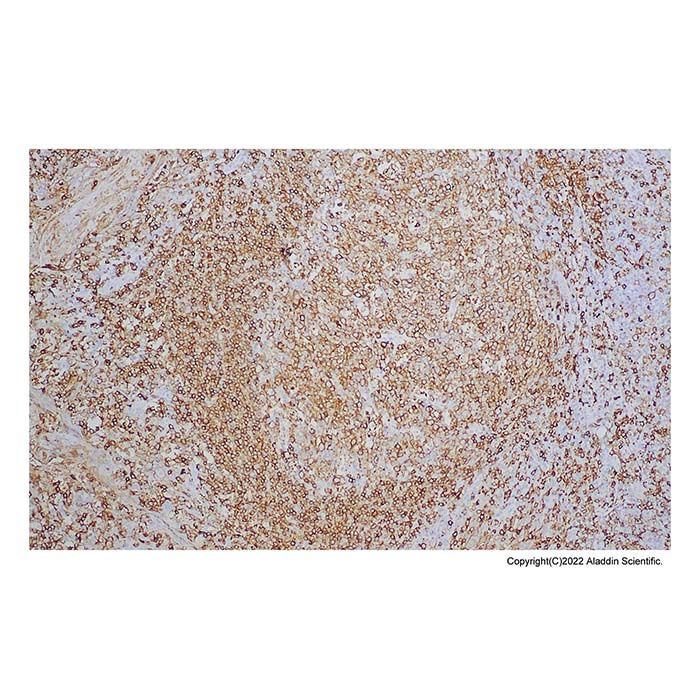
Recombinant HLA-DR Antibody (Ab108246) - IHC Immunohistochemistry analysis of paraffin-embedded human tonsil tissue labelling HLA-DR with Recombinant HLA-DR Antibody (Ab108246) at 1/200 dilution. The section was incubated with Ab108246 for 30 mins at room temperature. Perform heat mediated antigen retrieval with Tris/EDTA buffer pH 9.0 was used for antigen retrieval.

 ZJ24F0505248


 危险品化学品经营许可证(带存储)