纤维素酶(β-1,4-葡聚糖-4-葡聚糖水解酶,Cellulase简称CES)是降解纤维素生成葡萄糖的一组酶的总称,它不是单体酶,而是起协同作用的多组分酶系,是一种复合酶,主要由外切β-葡聚糖酶、内切β-葡聚糖酶和β-葡萄糖苷酶等组成,还有很高活力的木聚糖酶。在分解纤维素时起生物催化作用,是可以将纤维素分解成寡糖或单糖的蛋白质。
纤维素酶Cellulase广泛存在于自然界生物体中。细菌、真菌、动物体内等都能产生纤维素酶。一般用于生产的纤维素酶来自于真菌,比较典型的有木霉属(Trichoderma)、曲霉属(Aspergillus)和青霉属(Penicillium)。微生物纤维素酶在转化不溶性纤维素成葡萄糖以及在果蔬汁中破坏细胞壁从而提高果汁得率等方面具有非常重要的意义。纤维素酶在食品行业和环境行业均有广泛应用。在进行酒精发酵时,纤维素酶的添加可以增加原料的利用率,并对酒质有所提升。
检测原理:用羧甲基纤维素钠盐(CMC)作底物,经纤维素酶水解后生成还原糖(葡萄糖),还原糖在碱性加热条件下被氧化成糖酸,3,5-二硝基水杨酸(DNS)被还原为棕红色的氨基化合物,在一定范围内还原糖的量与棕红色产物的颜色深浅程度呈正比,在540nm处用酶标仪测定棕红色物质的吸光度,即可求得还原糖的含量,进而求得纤维素酶活的大小。本产品仅用于科研领域,不用于临床诊断或其他用途。
C1507302
| Component
| 100T | Storage
|
C1507302A
| Glu标准 (1mg/mL) | 1.8 mL | 2-8℃ |
C1507302B
| CES Assay Buffer | 20 mL | RT
|
C1507302C
| CMC Solution | 30 mL | RT
|
C1507302D
| DNS试剂 | 30 mL | RT. Store in the dark. |
自备仪器和试剂
1、去离子水或蒸馏水
2、电子天平、振荡器、纱布、离心机、离心管或试管
3、三角瓶、容量瓶、水浴锅、培养箱、酶标仪、96孔板
实验流程
1、标准曲线绘制
取6支试管按下表设置,准确吸取Glu标准 (1mg/mL) 与CES Assay buffer混匀,即得不同浓度的葡萄糖液。
加入物 (μl)
| Std.0
| Std.1
| Std.2
| Std.3
| Std.4
| Std.5 |
Glu标准 (1mg/mL)
| 0 | 50 | 75 | 100 | 125 | 150 |
CES Assay buffer
| 500 | 450 | 425 | 400 | 375 | 350 |
葡萄糖标准 (μg/ml)
| 0 | 100 | 150 | 200 | 250 | 300 |
每管中各加0.3ml DNS显色液,摇匀后置于沸水浴中准确加热5min,流水冷却。各管依次抽取280μl至96孔板中,以”Std.0”号管调零,酶标仪测定540nm处各管的吸光度。
2、准备样品
称取样品10g(或10ml)加入装有玻璃珠的三角瓶中,再加入一定体积的蒸馏水稀释,静置20min,200r/min振荡30min,然后四层纱布过滤,滤液3000r/min离心10min,上清液加入50ml容量瓶中,补水定容,即为纤维素酶提取液,用于样品CES活力的检测。如样品酶活力较高,应稀释至合适浓度再次检测。
3、加样
提前把CMC Solution在60℃水浴中预热。取2支离心管按下表设置依次加入:
加入物 (ml)
| 对照管
| 测定管
|
酶提取液
| -- | 0.1
|
CES Assay buffer
| 0.1
| 0.1
|
CMC Solution
| 0.3 | 0.3
|
60℃水浴20min。
立即摇匀,放入沸水浴中,显色5min,立即取出,流水冷却。
4、测定
各管依次抽取280μl至96孔板中,以”Std.0”号管调零,酶标仪测定540nm处各管的吸光度。
5、计算
以系列葡萄糖标准 (μg/ml)(1~5号)为横坐标,以相应的吸光度为纵坐标,作图得标准曲线,根据标准曲线计算出酶提取液(对照管、测定管)的吸光度相对应的葡萄糖浓度,根据下式再计算纤维素酶活性。
纤维素酶活力单位定义:在60℃条件下,1ml酶提取液,1min催化羧甲基纤维素钠水解产生1μg葡萄糖定义为1个酶活力单位(U)。根据酶活性定义,计算出样品中的纤维素酶活性。
U=k×(C₁-C₀) /t 或 U=k×(C₁-C₀) ×V₀/(m×t)
参数说明:
U:样品的酶活,单位为ug/(ml·min)或ug/(g·min)
k:样品稀释倍数
C₁:样品测定管葡萄糖浓度,单位为μg/ml
C₀:样品对照管葡萄糖浓度,单位为μg/ml
t:酶与底物的反应时间,单位为min(=20)
V₀:固体样品的酶提取液总体积,单位为ml
m:称取样品的质量,单位为g(=10)
注意事项
1、Glu标准应避免反复冻融,以免失效或效率下降。
2、待测酶提取液样品如不能及时测定,应置于-20℃保存,3天内稳定。
3、如果样品酶活性过高,应用蒸馏水稀释酶提取液后重测,结果乘以稀释倍数。
4、待测样品中不能含有纤维素酶抑制剂,同时需避免反复冻融。
5、纤维素酶的最适pH一般在4.5~6.5。葡萄糖酸内酯能有效的抑制纤维素酶,重金属离子如铜和汞离子,也能抑制纤维素酶,但是半胱氨酸能消除它们的抑制作用,甚至进一步激活纤维素酶。植物组织中含有天然的纤维素酶抑制剂;它能保护植物免遭霉菌的腐烂作用,这些抑制剂是酚类化合物。如果植物组织中存在着高的氧化酶活力,那么它能将酚类化合物氧化成醌类化合物,后者能抑制纤维素酶。
6、本试剂盒亦适用于其他样品的纤维素酶活性测定,但需有相关资料做为参考依据。
7、CES Assay buffer如果出现浑浊或絮状物,应弃用。
8、为了您的安全和健康,请穿实验服并戴一次性手套操作。
9、试剂开封后请尽快使用,以防影响后续实验效果。
附录
在室温条件下根据说明书步骤操作,测定葡萄糖标准溶液的浓度依次为100、150、200、250、300μg/ml,采用酶标仪540nm测出其相应的吸光度,据此做出如下标准曲线。

采用酶标仪540nm测定,“Std.0”号管吸光度为0.12左右,呈黄色,100μg/ml以上呈棕红色并逐渐加深。测定结果显示,当葡萄糖浓度大于350μg/ml时,OD值开始偏离,当葡萄糖浓度在100~300μg/ml以内比较合适,因此当测定结果明显偏高应稀释后再测。因测定仪器及操作手法等不同,测定结果可有一定偏差。
Cellulase (β-1,4-glucan-4-glucanohydrolase, abbreviated as CES) is a general term for a group of enzymes that degrade cellulose into glucose. It is not a single enzyme but a synergistic multi-component enzyme system, specifically a complex enzyme. It primarily consists of exo-β-glucanase, endo-β-glucanase, and β-glucosidase, and often exhibits high xylanase activity. It acts as a biocatalyst in cellulose decomposition, being a protein capable of breaking down cellulose into oligosaccharides or monosaccharides.
Cellulase is widely distributed in organisms throughout nature. Bacteria, fungi, and animals can all produce cellulase. Cellulase used for industrial production typically comes from fungi, notably from the genera Trichoderma, Aspergillus, and Penicillium. Microbial cellulase is highly significant for converting insoluble cellulose into glucose and for disrupting cell walls in fruit and vegetable juices to increase juice yield. Cellulase has extensive applications in both the food and environmental industries. During alcohol fermentation, adding cellulase can increase raw material utilization and improve liquor quality.
Detection Principle
Using carboxymethyl cellulose sodium salt (CMC) as the substrate, cellulase hydrolyzes it to produce reducing sugars (glucose). Under alkaline and heating conditions, the reducing sugars are oxidized to sugar acids, while 3,5-dinitrosalicylic acid (DNS) is reduced to a brown-red amino compound. Within a certain range, the amount of reducing sugar is proportional to the intensity of the brown-red color. The absorbance of this brown-red product is measured at 540 nm using a microplate reader, allowing the determination of the reducing sugar content and subsequently the cellulase activity. This product is for research use only and not intended for clinical diagnosis or other purposes.
C1507302
| Component
| 100T | Storage
|
C1507302A
| Glu Standard (1 mg/mL)
| 1.8 mL | 2-8℃ |
C1507302B
| CES Assay Buffer | 20 mL | RT
|
C1507302C
| CMC Solution | 30 mL | RT
|
C1507302D
| DNS Reagent
| 30 mL | RT. Store in the dark. |
Materials Required but Not Provided
Deionized water or distilled water
Electronic balance, shaker, gauze, centrifuge, centrifuge tubes or test tubes
Conical flasks, volumetric flasks, water bath, incubator, microplate reader, 96-well plate
Experimental Procedure
1. Standard Curve Preparation
Take 6 test tubes and set them up according to the table below. Precisely pipette the Glu Standard (1 mg/mL) and mix with CES Assay Buffer to obtain glucose solutions of different concentrations.
Reagent (μL)
| Std.0
| Std.1
| Std.2
| Std.3
| Std.4
| Std.5 |
Glu Standard (1 mg/mL)
| 0 | 50 | 75 | 100 | 125 | 150 |
CES Assay buffer
| 500 | 450 | 425 | 400 | 375 | 350 |
Glucose Std (μg/mL)
| 0 | 100 | 150 | 200 | 250 | 300 |
Add 0.3 mL of DNS Reagent to each tube, mix well, and place in a boiling water bath for exactly 5 minutes. Cool under running water. Transfer 280 μL from each tube sequentially to a 96-well plate. Using "Std.0" to zero the instrument, measure the absorbance of each tube at 540 nm with the microplate reader.
2. Sample Preparation
Weigh 10 g (or 10 mL) of the sample into a conical flask containing glass beads. Add a certain volume of distilled water for dilution, let stand for 20 minutes, shake at 200 rpm for 30 minutes, then filter through four layers of gauze. Centrifuge the filtrate at 3000 rpm for 10 minutes. Transfer the supernatant to a 50 mL volumetric flask, bring to volume with water – this is the cellulase extraction solution, used for CES activity detection. If the sample enzyme activity is high, dilute to an appropriate concentration before re-testing.
3. Assay Setup
Pre-warm the CMC Solution in a 60°C water bath. Take 2 centrifuge tubes and add reagents as follows:
Reagent (mL)
| Control Tube
| Test Tube
|
Enzyme Extract
| -- | 0.1
|
CES Assay buffer
| 0.1
| 0.1
|
CMC Solution
| 0.3 | 0.3
|
Incubate at 60°C water bath for 20 min.
DNS Reagent
| 0.3
| 0.3
|
Enzyme Extract
| 0.1
| --
|
Mix immediately, place in a boiling water bath for color development for 5 min, remove immediately, and cool under running water.
4. Measurement
Transfer 280 μL from each tube sequentially to a 96-well plate. Using "Std.0" to zero the instrument, measure the absorbance of each tube at 540 nm with the microplate reader.
5. Calculation
Plot the standard curve using the series of glucose standard concentrations (μg/mL) (tubes 1–5) as the x-axis and the corresponding absorbance values as the y-axis. Calculate the glucose concentrations corresponding to the absorbances of the enzyme extraction solution (Control and Test tubes) based on the standard curve. Then calculate the cellulase activity using the formula below.
Cellulase Activity Unit Definition: One unit of cellulase activity (U) is defined as the amount of enzyme that catalyzes the hydrolysis of carboxymethyl cellulose sodium to produce 1 μg of glucose per minute per mL of enzyme extraction solution under the conditions of 60°C. Calculate the cellulase activity in the sample based on this definition.
U = k × (C₁-C₀) / t OR U = k × (C₁-C₀) × V₀/ (m × t)
Parameter Description:
U: Enzyme activity of the sample, in μg/(mL·min) or μg/(g·min)
k: Sample dilution factor
C<sub>₁</sub>: Glucose concentration in the sample test tube, in μg/mL
C<sub>₀</sub>: Glucose concentration in the sample control tube, in μg/mL
t: Reaction time between enzyme and substrate, in min (=20)
V<sub>₀</sub>: Total volume of enzyme extraction solution for solid samples, in mL
m: Mass of the weighed sample, in g (=10)
Precautions
Avoid repeated freeze-thaw cycles of the Glu Standard to prevent inactivation or decreased efficiency.
If the enzyme extraction solution cannot be assayed immediately, store at -20°C; it remains stable for 3 days.
If the sample enzyme activity is too high, dilute the enzyme extraction solution with distilled water and re-assay, multiplying the result by the dilution factor.
The test sample must not contain cellulase inhibitors, and repeated freeze-thaw cycles should be avoided.
The optimum pH for cellulase is generally 4.5–6.5. Gluconolactone effectively inhibits cellulase. Heavy metal ions like copper and mercury also inhibit cellulase, but cysteine can eliminate their inhibition and even further activate cellulase. Plant tissues contain natural cellulase inhibitors, which are phenolic compounds protecting plants from fungal decay. If plant tissues have high oxidase activity, it can oxidize phenolic compounds into quinones, which inhibit cellulase.
This kit is also suitable for assaying cellulase activity in other samples, but relevant reference data should be available.
If the CES Assay Buffer becomes turbid or develops flocculent matter, discard it.
For your safety and health, wear a lab coat and disposable gloves during operation.
Use reagents promptly after opening to prevent potential effects on subsequent experimental results.
Appendix
Following the kit instructions at room temperature, measure the absorbances corresponding to glucose standard concentrations of 100, 150, 200, 250, 300 μg/mL at 540 nm using a microplate reader, and plot the standard curve as shown below.
Using a microplate reader at 540 nm, the absorbance of the "Std.0" tube is about 0.12 and appears yellow. Concentrations of 100 μg/mL and above appear brown-red and gradually intensify. Results show that when the glucose concentration exceeds 350 μg/mL, the OD value begins to deviate. Glucose concentrations within 100–300 μg/mL are more suitable. Therefore, if the measured result is significantly high, dilute and re-measure. Deviations may occur due to differences in instruments and operational techniques.


 J2617013

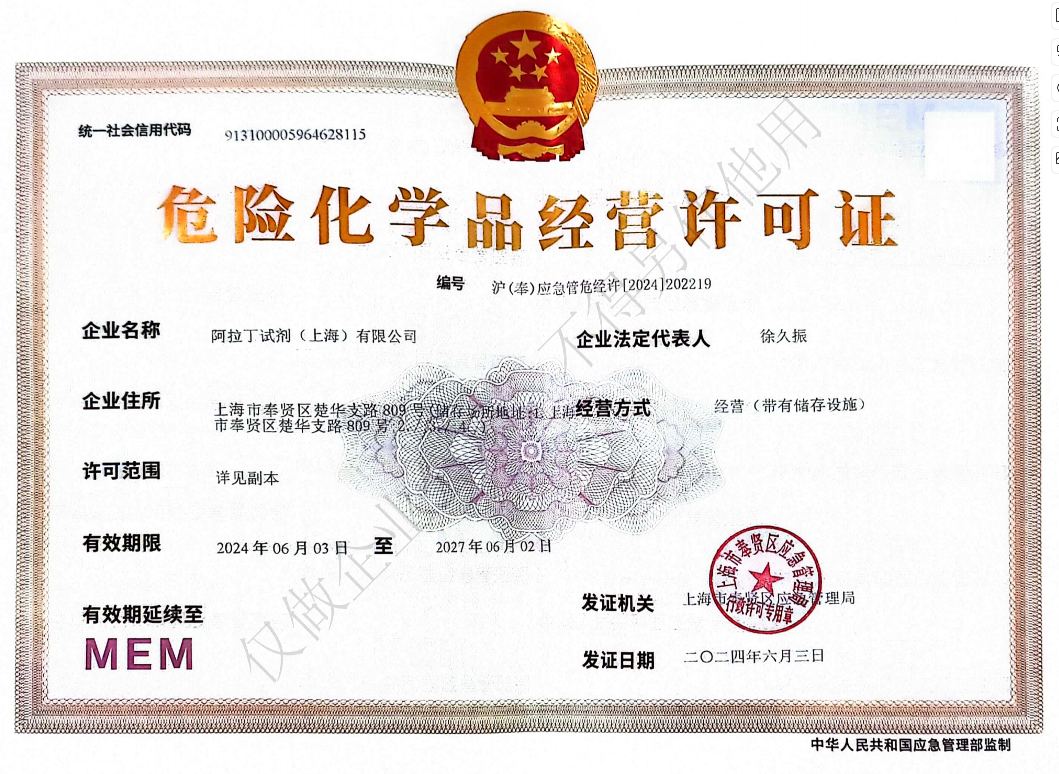 危险品化学品经营许可证(带存储)