
计算溶液所需的质量、体积或浓度。
| 活性类型 | 活性值-log(M) | 作用机制 | 期刊 | 参考文献(PubMed IDs) |
|---|
,适用于对基线干扰要求严格的色谱和分析工作流程。
-80℃储存。特低温运输 。请查阅批次 COA 获取详细规格。
SDS、COA、产品数据表及规格说明书均可下载。可通过批号查询获取批次 COA。
在色谱分析、有机合成和交叉偶联反应领域已被 6 篇同行评审文献引用。
PF-2341066 shows inhibition of Met phosphorylation in mIMCD3 mouse of MDCK canine epithelial cells with an IC50 of 5 nM and 20 nM, respectively, as well as NCI-H69 and HOP92 cells, with an IC50 of 13 nM and 16 nM, respectively. PF-2341066 shows a near-equivalent IC50 of 24 nM against the nucleophosmin (NPM)-anaplastic lymphoma kinase (ALK) oncogenic fusion varient of the ALK RTK expressed by the KARPAS299 human anaplastic large-cell lymphoma (ALCL) cell line. PF-2341066 supresses human GTL-16 gastric carcinoma cell growth with an IC50 of 9.7 nM. PF-2341066 induces apoptosis in GTL-16 cells with an IC5050 of 30 nM.
A Met inhibitor effective against various cell lines
Crizotinib has been used:
· to investigate its effects on hepatocyte growth factor receptor (c-Met) expression, proliferation and apoptosis
· to block neurotrophic tyrosine kinase receptor type 1 (NTRK1) activity in epithelial cells
· to restore sensitivity to erlotinib
Information
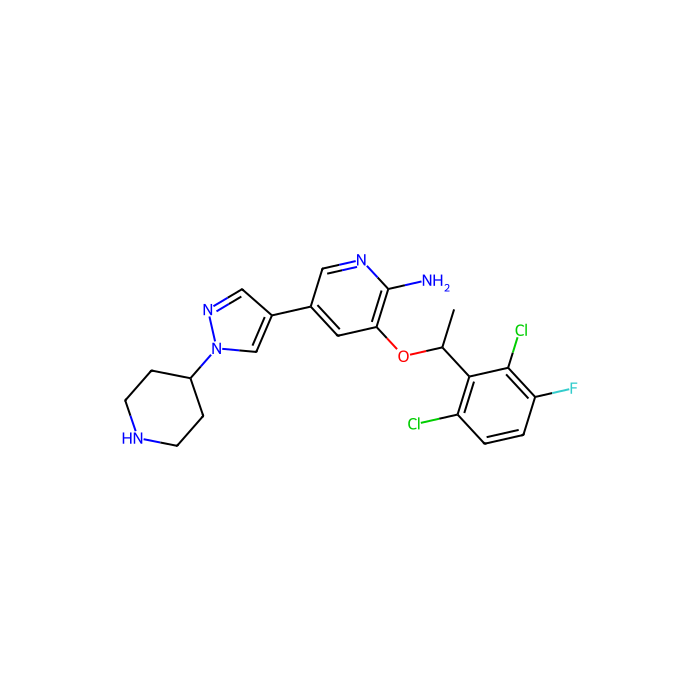
Crizotinib (PF-02341066) Crizotinib (PF-02341066) is a potent inhibitor of c-Met and ALK with IC50 of 11 nM and 24 nM in cell-based assays, respectively. It is also a potent ROS1 inhibitor with Ki value less than 0.025 nM. Crizotinib induces autophagy t
In vitro
PF-2341066 displays similar potency against c-Met phosphorylation in mIMCD3 mouse or MDCK canine epithelial cells with IC50 of 5 nM and 20 nM, respectivly. PF-2341066 shows improved or similar activity against NIH3T3 cells engineered to express c-Met ATP-binding site mutants V1092I or H1094R or the P-loop mutant M1250T with IC50 of 19 nM, 2 nM and 15 nM, respectively, compared with NIH3T3 cells expressing wild-type receptor with IC50 of 13 nM. In contrast, a marked shift in potency of PF-2341066 is observed against cells engineered to express c-Met activation loop mutants Y1230C and Y1235D with IC50 of 127 nM and 92 nM, respectively, compared with wild-type receptor. PF-2341066 also potently prevents the phosphorylation of c-Met in NCI-H69 and HOP92 cells, with IC50 of 13 nM and 16 nM, respectively, which express the endogenous c-Met variants R988C and T1010I, respectively. PF-2341066 is >1,000-fold selective for the VEGFR2 and PDGFRβ RTKs, >250-fold selective for IRK and Lck, and ∼40- to 60-fold selective for Tie2, TrkA, and TrkB, all compared with c-Met. PF-2341066 is 20- to 30-fold selective for RON and Axl RTKs. In contrast, PF-2341066 shows a near-equivalent IC50 of 24 nM against the nucleophosmin (NPM)-anaplastic lymphoma kinase (ALK) oncogenic fusion variant of the ALK RTK expressed by the KARPAS299 human anaplastic large cell lymphoma (ALCL) cell line. PF-2341066 inhibits c-Met–dependent neoplastic phenotypes of cancer cells and angiogenic phenotypes of endothelial cells. PF-2341066 suppresses human GTL-16 gastric carcinoma cell growth with IC50 of 9.7 nM. PF-2341066 induces apoptosis in GTL-16 cells with IC50 of 8.4 nM. PF-2341066 inhibits HGF-stimulated human NCI-H441 lung carcinoma cell migration and invasion with IC50 of 11 nM and 6.1 nM, respectively. PF-2341066 inhibits MDCK cell scattering with IC50 of 16 nM. PF-2341066 prevents HGF-stimulated c-Met phosphorylation, cell survival, and Matrigel invasion with IC50 of 11 nM, 14 nM and 35 nM, respectively. In addition, PF-2341066 prevents serum-stimulated HMVEC branching tubulogenesis (formation of vascular tubes) in fibrin gels. PF-2341066 also potently inhibits NPM-ALK phosphorylation in Karpas299 or SU-DHL-1 ALCL cells with an IC50 of 24 nM. PF-2341066 potently prevents cell proliferation, which is associated with G(1)-S-phase cell cycle arrest and induction of apoptosis in ALK-positive ALCL cells with IC50 of 30 nM, but not ALK-negative lymphoma cells. Besides, PF-2341066 prevents osteosarcoma behavior associated with primary tumor growth (i.e., proliferation and survival) as well as metastasis (eg, invasion and clonogenicity).
In vivo
In the GTL-16 model, PF-2341066 reveals the ability to cause marked regression of large established tumors (>600 mm3) in both the 50 mg/kg/day and 75 mg/kg/day treatment cohorts, with a 60% decrease in mean tumor volume over the 43-day administration schedule. In an another study, PF-2341066 displays the ability to completely inhibits GTL-16 tumor growth for >3 months, with only 1 of 12 mice exhibiting a significant increase in tumor growth over the 3-month treatment schedule at 50 mg/kg/day. In the NCI-H441 NSCLC model, a 43% decrease in mean tumor volume is observed at 50 mg/kg/day during the 38-day PF-2341066 administration cycle. In the Caki-1 RCC model, a 53% decrease in mean tumor volume is observed to be associated with decreased volume of each tumor by at least 30% at 50 mg/kg/day during the 33-day PF-2341066 administration cycle. PF-2341066 also reveals near-complete prevention of the growth of established tumors at 50 mg/kg/day in the U87MG glioblastoma or PC-3 prostate carcinoma xenograft models, with 97% or 84% inhibition on the final study day, respectively. In contrast, PF-2341066 p.o. given at 50 mg/kg/day does not significantly inhibit tumor growth in the MDA-MB-231 breast carcinoma model, or the DLD-1 colon carcinoma model. A significant dose-dependent reduction of CD31–positive endothelial cells is observed at 12.5 mg/kg/day, 25 mg/kg/day, and 50 mg/kg/day in GTL-16 tumors, indicating that inhibition of MVD shows a dose-dependent correlation to antitumor efficacy. PF-2341066 displays a significant dose-dependent reduction of human VEGFA and IL-8 plasma levels in both the GTL-16 and U87MG models. Marked inhibition of phosphorylated c-Met, Akt, Erk, PLCλ1, and STAT5 levels is observed in GTL-16 tumors following p.o. administration of PF-2341066. P.o. administration of PF-2341066 to severe combined immunodeficient-Beige mice bearing Karpas299 ALCL tumor xenografts leads to dose-dependent antitumor efficacy with complete regression of all tumors at the 100 mg/kg/d dose within 15 days of initial compound administration. In addition, inhibition of key NPM-ALK signaling mediators, including phospholipase C-gamma, signal transducers and activators of transcription 3, extracellular signal-regulated kinases, and Akt by PF-2341066 are observed at concentrations or dose levels, which correlated with inhibition of NPM-ALK phosphorylation and function. PF-2341066 prevents osteosarcoma behavior associated with primary tumor growth (eg, proliferation and survival) as well as metastasis (eg, invasion and clonogenicity). In nude mice treated with PF-2341066 via oral gavage, the growth and associated osteolysis and extracortical bone matrix formation of osteosarcoma xenografts are prevented by PF-2341066. Treatment of c-MET-amplified GTL-16 xenografts with 50 mg/kg PF-2341066 elicits tumor regression that is associated with a slow reduction in 18F-FDG uptake and decreases expression of the glucose transporter 1, GLUT-1.
Cell Data
cell lines:
Concentrations:0-256 nM
Incubation Time:1 hour
Powder Purity:≥99%
分类树(Taxonomy Tree)
| 界(kingdom) | 有机化合物 |
|---|---|
| 超类(Superclass) | 有机杂环化合物 |
| 类(Class) | 吡啶及其衍生物 |
| 亚类(Subclass) | 吡唑基吡啶 |
| 中间层级节点(Intermediate Tree Nodes) | 暂无 |
| 直接上位类(Direct Parent) | 吡唑基吡啶 |
| 其他上位类(Alternative Parents) | 二氯苯 烷基芳基醚 氨基吡啶及其衍生物 氟苯类 哌啶类 芳基氯化物 芳基氟化物 咪唑内酰胺类 吡唑类 杂芳族化合物 氮杂环化合物 二烷基胺 伯胺 有机氯化物 有机氟化物 有机光子化合物 碳氢化合物衍生物 |
| 分子骨架(Molecular Framework) | 芳香族杂单环化合物 |
| 取代基(Substituents) | 1,3-二氯苯 - 3-吡唑基吡啶 - 芳基醚 - 氨基酸 - 氨基吡啶 - 芳香族杂单环化合物 - 芳基氯化物 - 芳基氟化物 - 芳基卤化物 - 氮杂环 - 吡唑 - 苯基化合物 - 氯苯 - 乙醚 - 氟萘 - 卤苯 - 杂芳香族化合物 - 烃衍生物 - 咪唑内酰胺 - 单环苯基基团 - 有机硝基化合物 - 有机氧化合物 - 有机氯化物 - 有机氟化物 - 有机卤化物 - 有机氮化合物 - 有机氧化合物 - 有机氮化合物 - 哌嗪 - 初级胺 - 吡唑 - 二级脂肪胺 - 醛基 |
| 描述(Description) | 该化合物属于吡唑啉吡啶类有机化合物。这类化合物具有吡唑啉吡啶骨架,即通过键连接(而非缩合)的吡唑与吡啶结构单元。 |
| 外部描述符(External Descriptors) | 3-[1-(2,6-dichloro-3-fluorophenyl)ethoxy]-5-[1-(piperidin-4-yl)pyrazol-4-yl]pyridin-2-amine |
| ALogP | 3.7 |
|---|
| 作用机制 | Action Type | target ID | Target Name | Target Type | Target Organism | Binding Site Name | 参考文献 |
|---|
H317: 可能引起皮肤过敏反应
H318: 造成严重的眼睛损伤
H319: 引起严重眼睛刺激
H341: 怀疑引起遗传缺陷
H400: 对水生生物有剧毒
P261: 避免吸入灰尘/烟雾/气体/雾/蒸汽/喷雾
P272: 被污染的工作服不允许离开工作场所
P273: 避免释放到环境中。
P280: 戴防护手套/穿防护服/戴防护眼罩/戴防护面具。
P281: 根据需要使用个人防护设备。
P321: 特殊处理(请参阅此标签上的...)。
P391: 收集溢出物
P302+P352: 如皮肤沾染:用水充分清洗。
P305+P351+P338: 如进入眼睛:用水小心冲洗几分钟。如戴隐形眼镜并可方便地取出,取出隐形眼镜。继续冲洗。
P333+P313: 如发生皮肤刺激或皮疹:求医/就诊。
P362+P364: 脱掉沾污的衣服,清洗后方可重新使用。
P405: 密闭存放
P501: 将内容物/容器处理到。。。
P203: 使用前,获取、阅读并遵守所有安全说明。
P264+P265: 处理后彻底洗手[和…]。不要触摸眼睛。
P305+P354+P338: 如果进入眼睛:立即用水冲洗几分钟。取下隐形眼镜(如果有的话),并且操作简单。继续冲洗。
P318: 如果暴露或担心,请就医。
P317: 寻求紧急医疗救助。
P337+P317: 如果眼睛刺激持续:寻求医疗帮助。
通过匹配包装上的批号来查找并下载产品的 COA,每批产品都进行了严格的验证,您可放心使用!
| 批号(Lot Number) | 证书类型 | 货号 |
|---|---|---|
 L2214589 |
分析证书 | C408520 |


 危险品化学品经营许可证(带存储)