
1-Azidonaphthalene: Properties, Handling & Lab Applications
Learn the properties, safe handling, storage, and lab applications of 1-Azidonaphthalene (A1322146). Essential guide for researchers using aromatic azides.
用于检测、定量和定位抗原与抗体的技术——ELISA、免疫印迹、免疫组化与流式细胞术。以下是我们知识库中标注该主题的实验方案、常见问题与技术文章。
Learn the properties, safe handling, storage, and lab applications of 1-Azidonaphthalene (A1322146). Essential guide for researchers using aromatic azides.
Step-by-step protocol for using Ac4GalNAz (T304292) in metabolic glycan labeling and bioorthogonal click chemistry for O-GalNAc glycoprotein detection.
Find answers about 1,3,4,6-Tetra-O-acetyl-2-[(azidoacetyl)amino]-2-deoxy-β-D-galactopyranose: uses, storage, handling, and ordering from Aladdin Scientific.
Step-by-step protocol for 4-Ethynylpyridin-2-amine: storage, solubility, stock preparation, and lab applications. SKU E729946 from Aladdin Scientific.
Step-by-step protocol for handling, storing, and using 4-Ethynylpyridin-2-amine (E729946) in click chemistry and medicinal chemistry workflows.
Step-by-step protocol for handling, dissolving, and applying 5-(2-Methoxyphenyl)-1H-tetrazole in synthetic chemistry. Safety tips and storage guidance included.
Answers to common questions about 5-Ethynylthiophene-2-carbaldehyde (SKU E728394): structure, reactivity, storage, and synthetic applications.
Step-by-step protocol for handling, dissolving, and using 5-Ethynylthiophene-2-carbaldehyde (E728394) safely in synthetic chemistry workflows.
Answers to common questions about 2-Ethynyl-1,4-dimethylbenzene: structure, purity, handling, storage, and applications in synthesis and click chemistry.
Learn properties, safety handling, storage, and key research applications of 2-Ethynyl-1,4-dimethylbenzene (SKU E469623) from Aladdin Scientific.
Learn how to select, prepare, and use DBCO PEG Maleimide (DBCO-PEG-Mal) for bioorthogonal conjugation and thiol-reactive PEGylation in research applications.
Comprehensive guideline on 1-Chloro-4-ethynylbenzene: chemical properties, safe handling, storage, and key research applications for laboratory scientists.
Step-by-step guidelines for handling, storing, and using Azido-PEG20-alcohol (A596194) in bioconjugation and click chemistry workflows.
Learn how Aminooxy-PEG4-propargyl enables oxime ligation and CuAAC click chemistry for bioconjugation, ADC synthesis, and PEGylation research applications.
Explore Azido-PEG4-(CH2)3-methyl ester (A596057): a bifunctional PEG linker combining an azide handle and methyl ester for click chemistry conjugation.
Answers to common questions about azidobutyric acid NHS ester: chemistry, bioconjugation uses, reactivity, handling, and storage from Aladdin Scientific.
Answers to common questions about 5-ethynyl isophthalic acid: structure, purity, storage, MOF synthesis, and click-chemistry applications. Shop Aladdin B300243.
Learn how BCN-carbamate-PEG2-Bromide enables fast, selective IEDDA bioconjugation with enhanced solubility for antibody-drug and protein labeling research.
Answers to key questions about TCO-PEG4-TFP Ester: bioorthogonal chemistry, amine labeling, solubility, storage, and bioconjugation applications.
Step-by-step protocol for handling, dissolving, and using BCN-carbamate-PEG2-Bromide in IEDDA bioconjugation and alkylation reactions.
Step-by-step guidelines for using endo-BCN-PEG4-Biotin in bioorthogonal labeling, IEDDA click chemistry, and streptavidin-based detection workflows.
Guidelines for safe handling, storage, and click-chemistry applications of 1-Azido-2-(2-(2-methoxyethoxy)ethoxy)ethane (A487268) from Aladdin Scientific.
The 2022 Nobel Prize in Chemistry was awarded to American scientists Carolyn R. Bertozzi, K. Barry Sharpless, and Danish scientist Morten Meldal in recognition of their contributions to the development of click chemistry and bioorthogonal chemistry. These three scientists pioneered a brand-new ...
Tris(3-hydroxypropyltriazolylmethyl)amine (THPTA) is a water-soluble ligand, is widely used to promote Cu-catalyzed alkyneazide cyclization (CuAAC), the typical bioorthogonal reaction with non-interference in living systems.
Classic Click Chemistry uses copper, Cu(I), to catalyze the 1,3-dipolar cycloaddition of an alkyne with an azide to form a 1,2,3-triazole.1,2 Sources of Cu(I) include copper(I) iodide, copper(I) bromide, copper turnings, or copper (II) sulfate (CuSO4) and a reducing agent.1 However, the ...
Connecting multiple peptide fragments to form an extended peptide chain is referred to as ligation. Click chemistry offers a convenient method for creating peptide-peptide linkages. By introducing an alkyne group to one peptide fragment and an N-terminal azide moiety to another, a triazole ...
Among the click chemical reaction family, the most interesting one may be the Cu(I)-catalyzed 1,3-dipolar cycloaddition reaction between terminal alkynes and organic azides (Huisgen reaction) to produce 1,4-disubstituted 1,2,3-triazoles (Scheme 1).As a "good" click reaction, this reaction is ...
Click Chemistry serves as a potent technique for investigating the intracellular distribution of small molecules. Unveiling the precise cellular destinations of these compounds provides profound insights into their mechanisms of action. This methodology has been extensively employed in various ...
As a prevalent click reaction, strain-promoted alkyne-azide cycloaddition (SPAAC) operates without the need for metal catalysts, reducing agents, or enduring ligands. Instead, it harnesses the enthalpy liberated from the inherent ring strain of cyclooctyne to facilitate the formation of stable ...
SPAAC can be carried out efficiently. On the one hand, the chemical potential energy of azide and alkyne substrates as reactants is very high. Diaryl-strained-cyclooctynes, such as dibenzylcyclooctyne (DIBO), have found application in reacting with 1,3-nitrones in strain-promoted alkyne-nitrone ...
Strained alkenes leverage strain relief as a motivating factor, enabling their engagement in click reactions. Trans-cycloalkenes, typically cyclooctenes, and other strained alkenes like oxanorbornadiene, participate in click reactions with various counterparts, including azides, tetrazines, and ...
The azide-alkyne Huisgen cycloaddition is a 1,3-dipolar cycloaddition that involves the reaction between an azide and a terminal or internal alkyne, leading to the formation of a 1,2,3-triazole. Rolf Huisgen was a trailblazer in understanding the wide applicability of this organic reaction.
Click chemistry is a new approach to synthesizing drug-like molecules that can accelerate the drug discovery process by utilizing a number of practical and reliable reactions. Chemist K B Sharpless and colleagues define a click reaction as one that is wide-ranging, easy to perform, uses only ...
常与免疫学实验一起研究的技术。


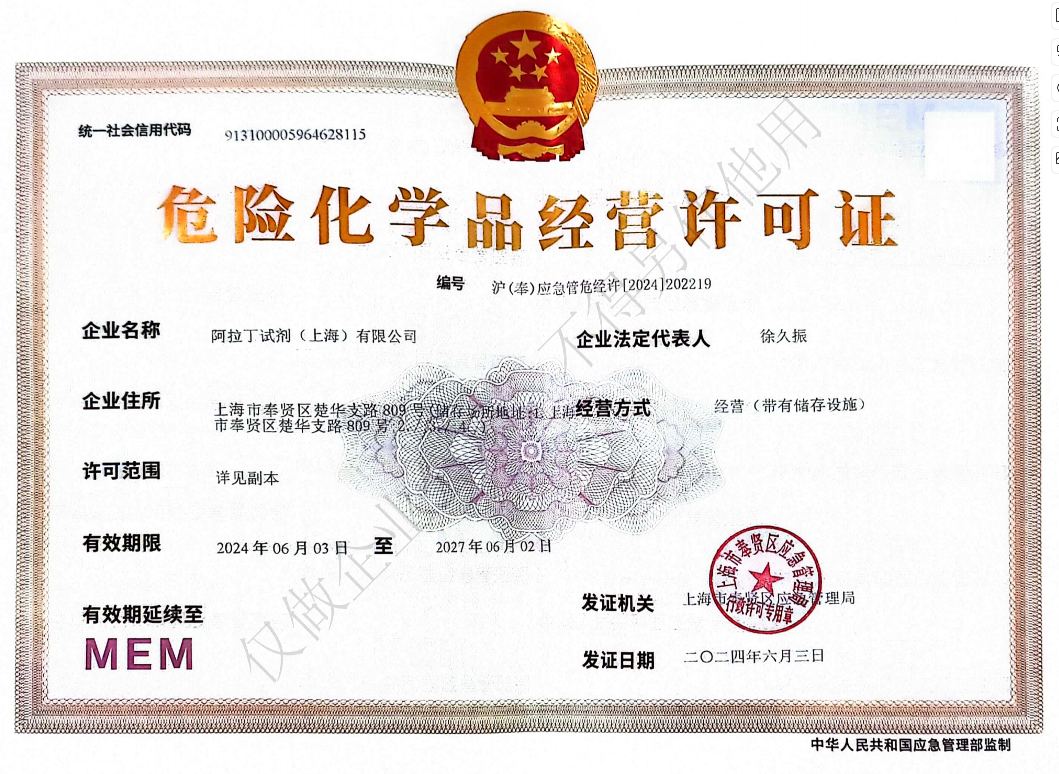 危险品化学品经营许可证(带存储)