
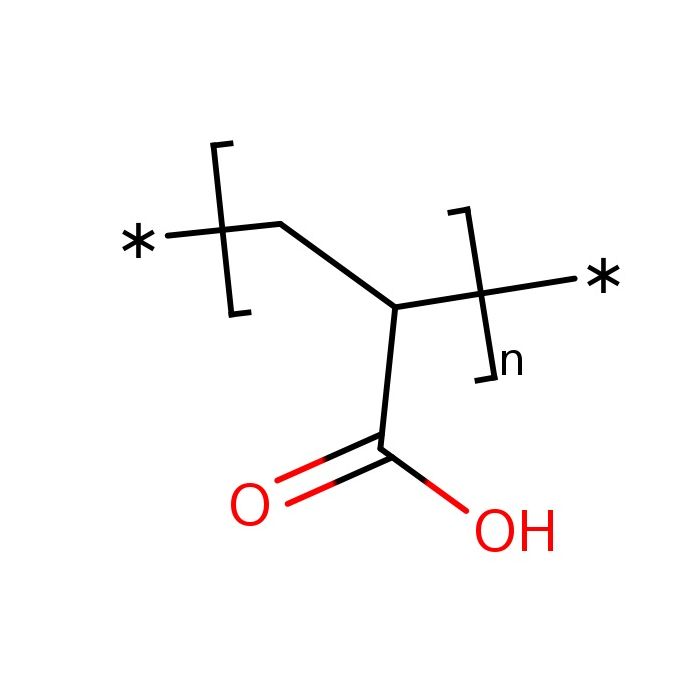
聚丙烯酸(PAA)

CAS: 9003-01-4 货号: P104272 分子式: (C3H4O2)n Beilstein号: MFCD00084394 EC号: 920-377-3
有货
级别和纯度: average Mv ~450,000
储存条件
室温,干燥
运输条件
常规运输
★
规格
库存
价格
数量
1g
P104272-1g
现货 Stock Image
¥78.90
5g
P104272-5g
期货 Stock Image
¥306.90
25g
P104272-25g
现货 Stock Image
¥1,162.90
请输入您要添加的产品数量
🧪
为什么选择此级别

,适用于对基线干扰要求严格的色谱和分析工作流程。

🌡

储存与运输

室温,干燥。常规运输 。请查阅批次 COA 获取详细规格。

📋

质量文档

SDS、COA、产品数据表及规格说明书均可下载。可通过批号查询获取批次 COA。

📚

文献证明

在色谱分析、有机合成和交叉偶联反应领域已被 719 篇同行评审文献引用。

概述

聚丙烯酸(PAA)易吸湿、易变脆且无色,Tg 接近106oC。当温度高于200至250oC时,它将失水并变成不能溶解的交联聚合物酸酐。干燥PAA在水中的溶解度随温度升高而增加。PAA的浓缩水溶液具有触变性。 

应用

聚丙烯酸(PAA)/聚甲基丙烯酸甲酯共聚物可用于药物传输。
其他应用可能包括:
· 研究聚乙烯醇/PAA共聚物水凝胶中的溶质扩散;
· 合成对温度和pH刺激响应的聚(N-异丙基丙烯酰胺)-嵌段-PAA共聚物;
· 制备用于疏水性药物胶束递送的寡聚甲基丙烯酸甲酯/PAA的嵌段共聚物;
作为粘合剂的增稠剂。

Poly (acrylic acid) (PAA) is hygroscopic, brittle and colorless in nature with Tg at nearly 106oC. At temperatures above 200 to 250oC, it loses water and becomes an insoluble crosslinked polymer anhydride. Solubility of dried PAA in water increases with rise in temperatures. Concentrated solutions of PAA in water is thixotropic in nature.

规格

英文别名
Glacial acrylic acid | XPA | 2-Propenoic acid | ACRYLIC ACID [IARC] | RCRA waste number U008 | Carbopol 934 (TN) | Carbopol 940 (TN) | EINECS 201-177-9 | Jurimer AC 10P | Versicol E 7 | Viscon 103 | ACRYLIC ACID (IARC) | Aron A 10H | Acroleic acid | Arald
规格或纯度
average Mv ~450,000
英文名称
Poly(acrylic acid)(PAA)
应用
Poly (acrylic acid) (PAA)/Poly methyl methacrylate copolymers are used for drug delivery. Other applications may include: · to study solute diffusion in Polyvinyl alcohol/PAA copolymer hydrogel; · synthesizing poly(N-isopropylacrylamide)-block-PAA copolymer which responds to both temperature and pH stimuli; · in preparing block copolymer of oligo (methyl methacrylate)/PAA for micellar delivery of hydrophobic drugs; as thickening agent for adhesives.
储存条件
室温,干燥
运输条件
常规运输
名称和识别符
PubChem SID
EC号
920-377-3
分子类型
小分子
IUPAC Name
prop-2-enoic acid
INCHI
1S/C3H4O2/c1-2-3(4)5/h2H,1H2,(H,4,5)
InChi Key
NIXOWILDQLNWCW-UHFFFAOYSA-N
Smiles
C=CC(=O)O
Isomeric SMILES
C=CC(=O)O
Beilstein号
MFCD00084394
Reaxy-Rn
635743
Reaxys-RN link address
https://www.reaxys.com/reaxys/secured/hopinto.do?context=S&query=IDE.XRN=635743&ln=

技术文档

📋 安全数据表 (SDS)

全面的危险、操作、储存及法规合规文件。

下载 SDS →

✅ 分析证书 (COA)

批次质量数据。输入批号以获取对应 COA。

查询 COA →

📊 产品数据表

产品规格和应用的快速参考摘要。

查看数据表 →

🔬 规格说明书

该级别的完整质量属性和验收标准。

查看规格说明 →

高级数据

系统学分类

分类树(Taxonomy Tree)

界(kingdom) 有机化合物
超类(Superclass) 有机酸及其衍生物
类(Class) 羧酸及其衍生物
亚类(Subclass) 丙烯酸及其衍生物
中间层级节点(Intermediate Tree Nodes) 暂无
直接上位类(Direct Parent) 丙烯酸
其他上位类(Alternative Parents) 一元羧酸及其衍生物  羧酸  有机氧化物  碳氢化合物衍生物  羰基化合物  
分子骨架(Molecular Framework) 脂肪族无环化合物
取代基(Substituents) 丙烯酸 - 脂肪族非环化合物 - 羰基 - 羧酰胺基 - 烃衍生物 - 单羧酸或其衍生物 - 有机氧化物 - 有机氧化合物 - 有机氧化合物
描述(Description) 该化合物属于丙烯酸类有机化合物。这类化合物含有丙烯酸基团CH₂=CHCO₂H。
外部描述符(External Descriptors) Unsaturated fatty acids
三维结构
交互式化学结构模型


关联靶点(人)
CHAT Tchem Choline acetylase (63 活性数据)
活性类型 Relation Activity value Units Action Type 期刊 PubMed Id doi Assay Aladdin ID
EHMT2 Tchem Histone-lysine N-methyltransferase, H3 lysine-9 specific 3 (93046 活性数据)
活性类型 Relation Activity value Units Action Type 期刊 PubMed Id doi Assay Aladdin ID
LMNA Tbio Prelamin-A/C (36751 活性数据)
活性类型 Relation Activity value Units Action Type 期刊 PubMed Id doi Assay Aladdin ID
关联靶点(其它种属)
Hdac6 Histone deacetylase 6 (222 活性数据)
活性类型 Relation Activity value Units Action Type 期刊 PubMed Id doi Assay Aladdin ID
Mus musculus (284745 活性数据)
活性类型 Relation Activity value Units Action Type 期刊 PubMed Id doi Assay Aladdin ID
作用机制
作用机制 Action Type target ID Target Name Target Type Target Organism Binding Site Name 参考文献
化学和物理性质
溶解性
不溶于水,溶于乙醇和碱
密度
1.15
沸点
116℃
分子量
72.060 g/mol
XLogP3
0.300
氢键供体数Hydrogen Bond Donor Count
1
氢键受体数Hydrogen Bond Acceptor Count
2
可旋转键计数Rotatable Bond Count
1
精确质量Exact Mass
72.0211 Da
单同位素质量Monoisotopic Mass
72.0211 Da
拓扑极表面积Topological Polar Surface Area
37.300 Ų
重原子数Heavy Atom Count
5
形式电荷Formal Charge
0
复杂度Complexity
55.900
同位素原子数Isotope Atom Count
0
定义的原子立体中心计数Defined Atom Stereocenter Count
0
未定义的原子立体中心计数Undefined Atom Stereocenter Count
0
定义的键立体中心计数Defined Bond Stereocenter Count
0
未定义的键立体中心计数Undefined Bond Stereocenter Count
0
所有立体化学键的总数The total count of all stereochemical bonds
0
共价键合单元计数Covalently-Bonded Unit Count
1
安全和危险性(GHS)
象形图
GHS05,   GHS07,   GHS09
信号词
危险
危险声明

H226: 易燃液体和蒸气

H302: 吞食有害

H312: 皮肤接触有害

H314: 造成严重的皮肤灼伤和眼睛损伤

H332: 吸入有害

H400: 对水生生物有剧毒

预防措施声明

P210: 远离热源,热表面,火花,明火和其他点火源。 - 禁止抽烟。

P233: 保持容器密闭。

P240: 地面/粘结容器和接收设备

P241: 使用防爆的[电气/通风/照明/.../]设备。

P242: 仅使用无火花的工具。

P243: 采取防静电措施

P260: 不要吸入灰尘/烟雾/气体/雾/蒸汽/喷雾。

P261: 避免吸入灰尘/烟雾/气体/雾/蒸汽/喷雾

P264: 处理后要彻底洗手。

P270: 使用本产品时,请勿进食、饮水或吸烟。

P271: 仅在室外或通风良好的地方使用。

P273: 避免释放到环境中。

P280: 戴防护手套/穿防护服/戴防护眼罩/戴防护面具。

P321: 特殊处理(请参阅此标签上的...)。

P330: 漱口

P363: 再次使用之前,请清洗受污染的衣物。

P391: 收集溢出物

P301+P330+P331: 如误吞咽:漱口。不要诱导呕吐。

P302+P352: 如皮肤沾染:用水充分清洗。

P303+P361+P353: 如皮肤(或头发)沾染:立即脱掉所有沾染的衣服。用水清洗皮肤/淋浴。

P304+P340: 如误吸入:将人转移到空气新鲜处,保持呼吸舒适体位。

P362+P364: 脱掉沾污的衣服,清洗后方可重新使用。

P370+P378: 火灾时:使用干砂、干粉或抗醇泡沫灭火。

P405: 密闭存放

P403+P235: 存放在通风良好的地方。保持低温。

P501: 将内容物/容器处理到。。。

P301+P317: 如果被吞咽:请寻求医疗帮助。

P305+P354+P338: 如果进入眼睛:立即用水冲洗几分钟。取下隐形眼镜(如果有的话),并且操作简单。继续冲洗。

P317: 寻求紧急医疗救助。

P302+P361+P354: 如果接触皮肤:立即脱掉所有被污染的衣服。立即用水冲洗几分钟。

P316: 立即寻求紧急医疗救助。

WGK Germany
1
RTECS
AT4680000
个人防护装备
Eyeshields,Gloves,type N95 (US),type P1 (EN143) respirator filter
质检证书(CoA,COO,BSE/TSE 和分析图谱)
C of A & Other Certificates(BSE/TSE, COO):
输入批号以搜索分析图谱:

通过匹配包装上的批号来查找并下载产品的 COA,每批产品都进行了严格的验证,您可放心使用!

找到38个结果

批号(Lot Number) 证书类型 货号
L2215255 分析证书 P104272
L2215253 分析证书 P104272
L2215251 分析证书 P104272
L2505599 分析证书 P104272
L2505593 分析证书 P104272
L2505592 分析证书 P104272
L2505393 分析证书 P104272
E2618118 分析证书 P104272
D2515456 分析证书 P104272
D2515454 分析证书 P104272
D2515455 分析证书 P104272
C2526553 分析证书 P104272
C2526554 分析证书 P104272
C2526549 分析证书 P104272
L2416419 分析证书 P104272
L2416420 分析证书 P104272
L2416421 分析证书 P104272
L2416422 分析证书 P104272
L2410543 分析证书 P104272
L2410544 分析证书 P104272
K2421003 分析证书 P104272
F2421458 分析证书 P104272
F2421457 分析证书 P104272
F2421455 分析证书 P104272
C2418068 分析证书 P104272
L2215457 分析证书 P104272
G2223132 分析证书 P104272
G2223133 分析证书 P104272
B2309087 分析证书 P104272
G2223131 分析证书 P104272
G2223128 分析证书 P104272
G2223126 分析证书 P104272
B2309084 分析证书 P104272
C2204356 分析证书 P104272
C2204323 分析证书 P104272
C2204357 分析证书 P104272
B2309085 分析证书 P104272
E2126110 分析证书 P104272
技术文档和文章
聚合物-粘土纳米复合材料:多功能材料的设计与应用
锂离子电池正极材料研究进展
锂离子电池电极材料指南:工作机理、材料地图与选型导航(含表1–表4)
Panorama Guide to Lithium-Ion Battery Electrode Materials: Working Principles, Materials Map, and Selection Navigation (incl. Tables 1–4)
材料也会“开关”:智能聚合物如何响应温度、pH 与光(附实验选型与产品导航)
Materials Can “Switch”: How Smart Polymers Respond to Temperature, pH, and Light (with Experimental Selection Tips & Product Navigation)
亲水性聚合物的水相行为解析:水化机制、结构旋钮与任务导向选型导航(含表1–表3)
Understanding Hydrophilic Polymers in Aqueous Systems: Hydration Mechanisms, Structural Knobs, and Task-Oriented Selection Guide (Including Tables 1–3)
有机酸如何“稳住体系”:pH 窗口、盐型与金属离子管理的选型逻辑(附表A–E导航)
How Organic Acids “Stabilize a System”: Selection Logic via the pH Window, Salt Forms, and Metal-Ion Management (with a navigation guide to Tables A–E)
聚电解质多层膜的研究价值:界面组成、传质与功能的逐层设计
Research Value of Polyelectrolyte Multilayers: Layer-by-Layer Design of Interfacial Composition, Mass Transport, and Function
医用水凝胶研发中的关键判断:从聚合物来源、交联方式到灭菌安排、放大可行性与质量控制
Key Judgments in Medical Hydrogel R&D: From Polymer Source and Crosslinking Strategy to Sterilization Planning, Scale-Up Feasibility, and Quality Control
什么时候选择硅树脂?与环氧、丙烯酸、聚氨酯、氟树脂等涂料树脂的选型对比
When Should You Choose Silicone Resin? Selection Comparison with Epoxy, Acrylic, Polyurethane, Fluororesin, and Other Coating Resins
丙烯酸树脂在涂料中的应用与选型:建筑、工业及配套材料解析
Applications and Selection of Acrylic Resins in Coatings: Analysis of Architectural, Industrial, and Supporting Materials
水性树脂技术解析:水性化形态、性能平衡与技术地图
Waterborne Resin Technology Explained: Waterborne Forms, Performance Balance, and a Technology Map
涂料配方中的树脂极性:从分子结构到溶解、相容、界面作用与配方设计
Resin Polarity in Coating Formulations: From Molecular Structure to Dissolution, Compatibility, Interfacial Interactions, and Formulation Design
日化配方中螯合剂的作用、选型与验证方法
The Role, Selection, and Validation of Chelating Agents in Daily Chemical Formulations
从结构到流变:卡波姆如何形成凝胶结构并实现增稠、悬浮与乳液辅助稳定?
From Structure to Rheology: How Carbomer Forms Gel Structures and Enables Thickening, Suspension, and Auxiliary Emulsion Stabilization
三乙醇胺与二乙醇胺有何不同:从分子结构看日化配方作用、应用差异与选用逻辑
What Is the Difference Between Triethanolamine and Diethanolamine: Understanding Their Formulation Functions, Application Differences, and Selection Logic from a Molecular-Structure Perspective
日化清洁配方中的分散剂、抗再沉积剂与抗垢材料:作用机制、选型逻辑与代表产品
Dispersants, Anti-Redeposition Agents, and Scale-Control Materials in Household Cleaning Formulations: Mechanisms of Action, Selection Logic, and Representative Products
日化清洁配方中的 AES(脂肪醇聚氧乙烯醚硫酸盐):结构、性能与低温流动性解析
AES (Fatty Alcohol Polyoxyethylene Ether Sulfate) in Personal and Home-Care Cleansing Formulations: An Analysis of Structure, Performance, and Low-Temperature Flowability
从结构到流变:日化用纤维素醚的增稠、稳定与选型逻辑
From Structure to Rheology: Thickening, Stabilization, and Selection Logic of Cellulose Ethers for Personal Care Applications
强酸清洁体系如何选择增稠剂:增稠机制比较与脂肪胺乙氧基化物应用思路
How to Select Thickeners for Strongly Acidic Cleaning Systems: Comparison of Thickening Mechanisms and Application Considerations for Fatty Amine Ethoxylates
三聚磷酸钠 STPP 如何替代?从助洗机理到低磷/无磷助洗体系的配方选择
How Can Sodium Tripolyphosphate (STPP) Be Replaced? From Detergency Mechanisms to Formulation Choices for Low-Phosphorus/Phosphorus-Free Builder Systems
夏季日化产品为什么容易返稀?核心机理、排查方法与解决思路
Why Are Daily Chemical Products Prone to Viscosity Thinning in Summer? Core Mechanisms, Troubleshooting Methods, and Solutions
水性色浆长期稳定的关键变量:分散剂分子量分布(MWD)如何影响颜料分散、表面吸附层构筑与储存稳定性
Key Variable in the Long-Term Stability of Waterborne Pigment Concentrates: How Dispersant Molecular Weight Distribution (MWD) Affects Pigment Dispersion, Surface Adsorption-Layer Formation, and Storage Stability
中性腻子胶结/凝胶材料怎么选?4组应用小试看预糊化淀粉、PVA与乳胶粉的性能差异
How to Select Binding/Gel Materials for Neutral Wall Putty? A Comparison of Pregelatinized Starch, PVA, and Redispersible Polymer Powder Based on Four Application Trials
Polymer-Clay Nanocomposites: Design and Application of Multi-Functional Materials
日化清洁配方中的分散剂、抗再沉积剂与抗垢材料:作用机制、选型逻辑与代表产品
Dispersants, Anti-Redeposition Agents, and Scale-Control Materials in Household Cleaning Formulations: Mechanisms of Action, Selection Logic, and Representative Products
传明酸在色斑护理中的作用机制:从纤溶酶系统到炎症促黑信号调节
Mechanism of Action of Tranexamic Acid in Pigmentation Care: From the Plasmin System to Regulation of Inflammation-Driven Pro-Melanogenic Signaling
此产品的引用文献
溶液计算器
