
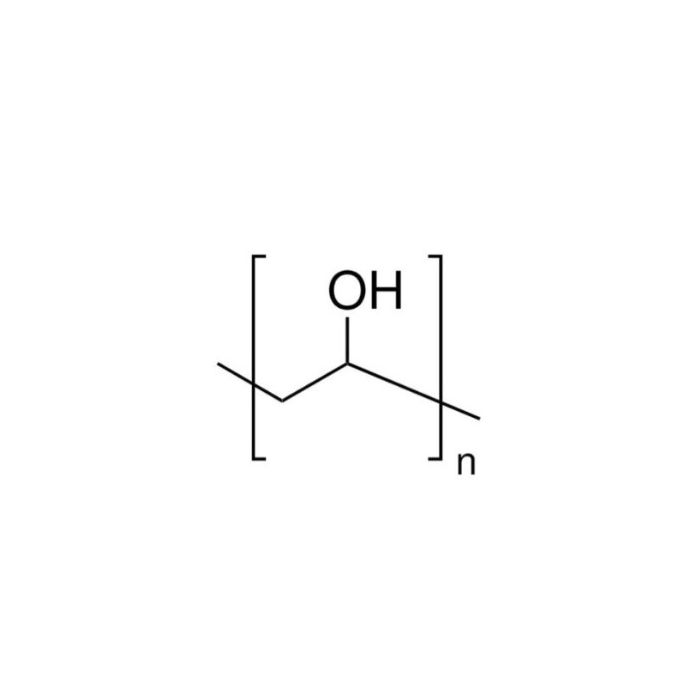
聚乙烯醇(PVA)1799型

CAS: 9002-89-5 货号: P105126 分子式: [-CH2CHOH-]n EC号: 618-340-9 PubChem CID: 11199
有货
级别和纯度: 醇解度:98~99%(mol/mol)
储存条件
室温
运输条件
常规运输
★
规格
库存
价格
数量
500g
P105126-500g
现货 Stock Image
¥79.90
12×500g
P105126-12×500g
现货 Stock Image
¥899.90
请输入您要添加的产品数量
🧪
为什么选择此级别

,适用于对基线干扰要求严格的色谱和分析工作流程。

🌡

储存与运输

室温。常规运输 。请查阅批次 COA 获取详细规格。

📋

质量文档

SDS、COA、产品数据表及规格说明书均可下载。可通过批号查询获取批次 COA。

📚

文献证明

在色谱分析、有机合成和交叉偶联反应领域已被 4848 篇同行评审文献引用。

概述

溶解方法:
将PVA投入水中,直接吹进蒸气,边搅拌边溶解。一般来讲,将温度低于室温的水倒在溶解槽中,边搅拌边慢慢的投入PVA,等充分分散于水中后,搅拌升温到95℃,保温60分钟左右,PVA完全溶解,搅拌冷却至室温。
但是,部分醇解PVA在溶解时易于产生团状快物,故请注意如下:
1. 加料时的水温要保持低于25℃。
2. PVA的加料速度稍慢。
3. 加料后,按照原来的温度充分搅拌10~15分钟后开始升温,在升温中也继续搅拌。
溶解液的储存:
PVA水溶液即使长期储存也不会发生化学性能的变化,但随着水质的变化而有可能发霉。另外粘度随时间有可能上升。
1. 对于发霉的对策:将有机氮系、有机碘系、阳离子界面活性剂系等防霉剂对PVA 添加0.01-0.05%。
2. 对于增粘的对策:就完全醇解PVA的高浓度水溶液等易于增粘的,推荐在 50~70℃保管。
性质:
PVA的主要性质是由分子的醇解度和聚合度而决定的,并具有如下性质:
1. 水溶性:易溶于水,不溶于几乎所有的有机溶剂。
2. 水溶液的粘度:PVA水溶液的粘度是随聚合度和温度以及溶液浓度变化而变化的。
3. 成膜性:PVA的水溶液易成膜,其皮膜有优异的抗拉强度和耐磨强度等物理性能。
4. 吸湿性:PVA的皮膜有较低的吸湿性,而且吸湿性随湿度的变化也比其他水溶性高分子小。
5. 耐药品耐油性:PVA具有很强的耐弱酸和弱碱性,另外还有非常优异的耐油脂性。


规格

英文别名
Polyvinyl alcohol
规格或纯度
醇解度:98~99%(mol/mol)
英文名称
Poly(vinyl alcohol)(PVA) 1799
储存条件
室温
运输条件
常规运输
名称和识别符
PubChem SID
EC号
618-340-9
分子类型
聚合物
IUPAC Name
ethenol
INCHI
1S/C2H4O/c1-2-3/h2-3H,1H2
InChi Key
IMROMDMJAWUWLK-UHFFFAOYSA-N
Smiles
C=CO
Isomeric SMILES
C=CO
PubChem CID

技术文档

📋 安全数据表 (SDS)

全面的危险、操作、储存及法规合规文件。

下载 SDS →

✅ 分析证书 (COA)

批次质量数据。输入批号以获取对应 COA。

查询 COA →

📊 产品数据表

产品规格和应用的快速参考摘要。

查看数据表 →

🔬 规格说明书

该级别的完整质量属性和验收标准。

查看规格说明 →

高级数据

系统学分类

分类树(Taxonomy Tree)

界(kingdom) 有机化合物
超类(Superclass) 有机氧化合物
类(Class) 有机氧化合物
亚类(Subclass) 烯醇
中间层级节点(Intermediate Tree Nodes) 暂无
直接上位类(Direct Parent) 烯醇
其他上位类(Alternative Parents) 碳氢化合物衍生物  
分子骨架(Molecular Framework) 脂肪族无环化合物
取代基(Substituents) 脂肪族非环化合物 - 乙烯醇 - 烃衍生物
描述(Description) 该化合物属于烯醇类有机化合物。这类化合物含有烯醇官能团,结构为HO(R)C=CR'。含一个或多个α-氢原子的酮会发生酮-烯醇互变异构,其互变异构体即为烯醇。
外部描述符(External Descriptors) 暂无
三维结构
交互式化学结构模型


关联靶点(其它种属)
pol Human immunodeficiency virus type 1 protease (9113 活性数据)
活性类型 Relation Activity value Units Action Type 期刊 PubMed Id doi Assay Aladdin ID
作用机制
作用机制 Action Type target ID Target Name Target Type Target Organism Binding Site Name 参考文献
化学和物理性质
密度
1.3
敏感性
对湿度敏感
折光率
1.49-1.53
熔点
250℃
分子量
44.050 g/mol
XLogP3
0.500
氢键供体数Hydrogen Bond Donor Count
1
氢键受体数Hydrogen Bond Acceptor Count
1
可旋转键计数Rotatable Bond Count
0
精确质量Exact Mass
44.0262 Da
单同位素质量Monoisotopic Mass
44.0262 Da
拓扑极表面积Topological Polar Surface Area
20.200 Ų
重原子数Heavy Atom Count
3
形式电荷Formal Charge
0
复杂度Complexity
10.300
同位素原子数Isotope Atom Count
0
定义的原子立体中心计数Defined Atom Stereocenter Count
0
未定义的原子立体中心计数Undefined Atom Stereocenter Count
0
定义的键立体中心计数Defined Bond Stereocenter Count
0
未定义的键立体中心计数Undefined Bond Stereocenter Count
0
所有立体化学键的总数The total count of all stereochemical bonds
0
共价键合单元计数Covalently-Bonded Unit Count
1
安全和危险性(GHS)
WGK Germany
1
RTECS
TR8100000
个人防护装备
Eyeshields, Gloves, type N95 (US), type P1 (EN143) respirator filter
质检证书(CoA,COO,BSE/TSE 和分析图谱)
C of A & Other Certificates(BSE/TSE, COO):
输入批号以搜索分析图谱:

通过匹配包装上的批号来查找并下载产品的 COA,每批产品都进行了严格的验证,您可放心使用!

找到31个结果

批号(Lot Number) 证书类型 货号
J2608660 分析证书 P105126
J2608659 分析证书 P105126
I2601263 分析证书 P105126
I2601262 分析证书 P105126
G2627341 分析证书 P105126
G2627340 分析证书 P105126
G2628382 分析证书 P105126
F2611495 分析证书 P105126
F2611494 分析证书 P105126
F2611493 分析证书 P105126
B2603358 分析证书 P105126
L2512526 分析证书 P105126
H2507474 分析证书 P105126
E2508368 分析证书 P105126
E2508313 分析证书 P105126
D2510528 分析证书 P105126
D2510507 分析证书 P105126
D2510527 分析证书 P105126
E2311279 分析证书 P105126
L2426475 分析证书 P105126
K2419403 分析证书 P105126
I2423493 分析证书 P105126
I2423492 分析证书 P105126
F2413172 分析证书 P105126
F2413173 分析证书 P105126
F2301064 分析证书 P105126
B2327791 分析证书 P105126
B2327831 分析证书 P105126
H2217505 分析证书 P105126
H2217504 分析证书 P105126
C2214374 分析证书 P105126
技术文档和文章
聚乙烯醇(PVA)从入门到选型:关键参数、冻融/化学交联水凝胶路线与阿拉丁产品清单
Poly(vinyl alcohol) (PVA): From Basics to Selection Key Parameters, Freeze–Thaw vs. Chemical Crosslinking Hydrogel Routes, and an Aladdin Product List
香精科普:从配方黑箱到可工程化体系——相容性、稳定性、控释、可追溯与选型指南
A Practical Guide to Fragrance Compositions: Turning a Black-Box Formula into an Engineerable System—Compatibility, Stability, Controlled Release, Traceability, and Selection
合成树脂全景指南:定义与合成机理、分类框架、常见树脂应用、包装标识与选型导航(表1–表3)
A Panorama Guide to Synthetic Resins: Definitions & Polymerization Mechanisms, Classification Frameworks, Common Resins and Applications, Packaging Codes, and a Selection Roadmap (Tables 1–3)
亲水性聚合物的水相行为解析:水化机制、结构旋钮与任务导向选型导航(含表1–表3)
Understanding Hydrophilic Polymers in Aqueous Systems: Hydration Mechanisms, Structural Knobs, and Task-Oriented Selection Guide (Including Tables 1–3)
生物医用聚合物解析:任务角色地图、六大材料旋钮与风险导向证据链(含产品导航与产品表1–表3)
Biomedical Polymer Insights: Role-Based Task Map, Six Key Material Levers, and a Risk-Driven Evidence Chain (including the Product Navigation Guide and Product Tables 1–3)
脂肪酶(Lipase,甘油三酯水解酶):界面催化机理、选择性类型与检测及应用体系
Lipase (Triacylglycerol Hydrolase): Interfacial Catalysis, Selectivity Classes, and Assay/Application Systems
植酸酶:酶学特性、作用机理与饲料及食品领域应用
Phytase: Enzymological Properties, Mechanism of Action, and Applications in Feed and Food
医用水凝胶研发中的关键判断:从聚合物来源、交联方式到灭菌安排、放大可行性与质量控制
Key Judgments in Medical Hydrogel R&D: From Polymer Source and Crosslinking Strategy to Sterilization Planning, Scale-Up Feasibility, and Quality Control
免疫学实验中封片体系的类型比较与选择策略
Comparative Analysis and Selection Strategies for Mounting Media in Immunological Experiments
硅烷偶联剂底涂液的配制方法与注意事项
Preparation Methods and Precautions for Silane Coupling Agent Primer Solutions
从天然纤维素到纳米晶体:CNC 的结构特性、应用方向与产业化挑战
From Natural Cellulose to Nanocrystals: Structural Characteristics, Application Directions, and Industrialization Challenges of CNC
醋丙乳液(乙烯基丙烯酸乳液):建筑涂料中成本与性能的平衡方案
Vinyl Acetate-Acrylic Emulsion (Vinyl Acrylic Emulsion): A Cost-Performance Balance Solution for Architectural Coatings
PVAc、VAE 与醋酸乙烯酯类乳液:建筑涂料中的成膜逻辑与性能边界
PVAc, VAE, and Vinyl Acetate-Based Emulsions: Film-Forming Logic and Performance Boundaries in Architectural Coatings
乙烯基相关树脂怎么选:从基材、性能目标和失效风险建立配方判断
How to Select Vinyl-Related Resins: Building Formulation Judgment Based on Substrate, Performance Targets, and Failure Risks
水性树脂技术解析:水性化形态、性能平衡与技术地图
Waterborne Resin Technology Explained: Waterborne Forms, Performance Balance, and a Technology Map
涂料配方中的树脂极性:从分子结构到溶解、相容、界面作用与配方设计
Resin Polarity in Coating Formulations: From Molecular Structure to Dissolution, Compatibility, Interfacial Interactions, and Formulation Design
日化清洁配方中的分散剂、抗再沉积剂与抗垢材料:作用机制、选型逻辑与代表产品
Dispersants, Anti-Redeposition Agents, and Scale-Control Materials in Household Cleaning Formulations: Mechanisms of Action, Selection Logic, and Representative Products
石墨烯生物传感器的信号转换机制:从分子识别到电学/光学信号读出与材料选型
Signal Transduction Mechanism of Graphene Biosensors: From Molecular Recognition to Electrical/Optical Signal Readout and Materials Selection
粉体香精与香精递送材料的结构、性能与作用机理:稳定性、释放机制与选型逻辑
Structure, Properties, and Mechanisms of Powdered Fragrances and Fragrance Delivery Materials: Stability, Release Mechanisms, and Selection Logic
腻子用羟丙基甲基纤维素(HPMC)生产工艺解析:从大配比与小配比看取代结构和凝胶温度差异
Analysis of the Production Process of Hydroxypropyl Methylcellulose (HPMC) for Putty: Understanding Differences in Substitution Structure and Gelation Temperature from High-Ratio and Low-Ratio Formulations
水性色浆长期稳定的关键变量:分散剂分子量分布(MWD)如何影响颜料分散、表面吸附层构筑与储存稳定性
Key Variable in the Long-Term Stability of Waterborne Pigment Concentrates: How Dispersant Molecular Weight Distribution (MWD) Affects Pigment Dispersion, Surface Adsorption-Layer Formation, and Storage Stability
腻子中常用纤维素醚的类型、作用机理、质量指标与选择应用
Types, Mechanisms of Action, Key Quality Indicators, and Selection and Application of Common Cellulose Ethers in Wall Putty
中性腻子起泡影响因素及控制思路:基于HPMC用量、粘度与重钙细度的实验分析
Influencing Factors and Control Strategies for Blistering in Neutral Wall Putty: An Experimental Analysis Based on HPMC Dosage, Viscosity, and Ground Calcium Carbonate Fineness
中性腻子胶结/凝胶材料怎么选?4组应用小试看预糊化淀粉、PVA与乳胶粉的性能差异
How to Select Binding/Gel Materials for Neutral Wall Putty? A Comparison of Pregelatinized Starch, PVA, and Redispersible Polymer Powder Based on Four Application Trials
耐水腻子打磨脱层的原因与机理分析
Causes and Mechanism Analysis of Delamination During Sanding of Water-Resistant Putty
聚乙烯醇1788、2488、2699有什么区别?从聚合度和醇解度看施工性、粘结强度与相对耐水性
What Are the Differences Between Polyvinyl Alcohol 1788, 2488, and 2699? Understanding Workability, Bonding Strength, and Relative Water Resistance from the Perspective of Degree of Polymerization and Degree of Hydrolysis
中性腻子为什么会出现锈点?铁源、水分迁移、氧化显色与防控要点
Why Do Rust Spots Appear on Neutral Wall Putty? Iron Sources, Moisture Migration, Oxidative Color Development, and Prevention Measures
夏季高温条件下中性腻子常见问题及配方调整思路
Common Problems and Formulation Adjustment Strategies for Neutral Putty Under High Summer Temperatures
中性腻子配方中木薯与玉米来源预糊化淀粉的区别及应用选择
Differences and Application Selection of Cassava- and Corn-Based Pregelatinized Starch in Neutral Putty Formulations
中性腻子中膨润土的作用、选型、开裂风险分析与添加量控制
The Role, Selection, Cracking Risk Analysis, and Dosage Control of Bentonite in Neutral Putty
日化清洁配方中的分散剂、抗再沉积剂与抗垢材料:作用机制、选型逻辑与代表产品
Dispersants, Anti-Redeposition Agents, and Scale-Control Materials in Household Cleaning Formulations: Mechanisms of Action, Selection Logic, and Representative Products
对伞花烃在问题肌肤中的潜在作用机制:膜扰动、炎症信号调节与局部递送
Potential Mechanisms of p-Cymene in Problem-Prone Skin: Membrane Perturbation, Inflammatory Signaling Modulation, and Localized Delivery
此产品的引用文献
溶液计算器

常见问题

本产品应如何储存?
请于室温条件下保存。
本产品如何运输?
本产品按常温标准条件运输,无需温控包装。
本产品的 CAS 号、分子式和分子量是多少?
本产品的 CAS 号为 9002-89-5,分子式为 [-C2nH4nOn-]。InChIKey IMROMDMJAWUWLK-UHFFFAOYSA-N。
如何获取批次专用COA?
每个订单都会随附分析证书(COA),您也可以从账户订单历史中下载。如需订购前的COA,请联系您的客户代表,或使用PDP上的"申请COA"按钮——我们将提供代表性批次的COA。
